 Add to Chrome
 Add to Firefox
 Add to Edge
SBCO: Self-Supervised, Verifier-Grounded Harness Optimization For Planning Agents
Aug 10, 2026
Self-improving agents seek to reduce the human engineering effort behind AI systems by enabling them to evolve and self-improve their performance over time. Recently, methods like the Darwin Gödel Machine and the Huxley Gödel Machine have been proposed which enable open-ended, recursive self-improvement through self-reference where a coding agent edits its own code. Such self-referential self-improvement methods require that the competence required to perform the task coincides or aligns well with the competence required for self-modification which is the case for coding tasks. For domains or tasks, which do not satisfy the alignment needed, self-referential self-improvement is not available. In such cases, it is possible to adapt the above algorithms to other tasks by removing the self-referential aspect or introducing explicit self-modification of a meta-agent -- both computationally expensive, relying on population or self-modification search over many candidate agents. For planning tasks with explicit constraints, we propose a far cheaper alternative. We introduce SBCO (Self-supervised Block Coordinate Optimizer), a verifier-grounded harness optimizer in the same closed-loop, improve-from-experience family as the Gödel-machine methods, but self-supervised rather than self-referential. Given an agentic harness, SBCO learns a decomposed bank of verifiers and a harness policy via approximate block coordinate ascent, improving the agent's outputs from its own graded feedback---with a fixed meta-agent and no human labels. Across two domains SBCO matches or exceeds a customized self-modifying baseline while using 4-5.5 times less compute budget.

STEER: Semantic Turn Extension-Expansion Recognition for Voice Assistants
Oct 25, 2023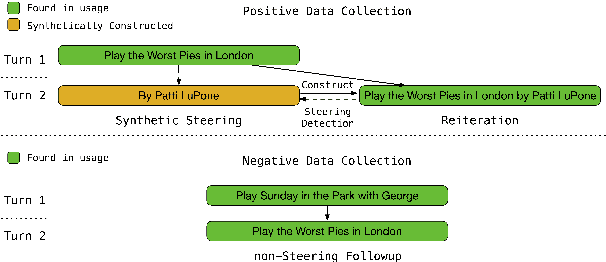
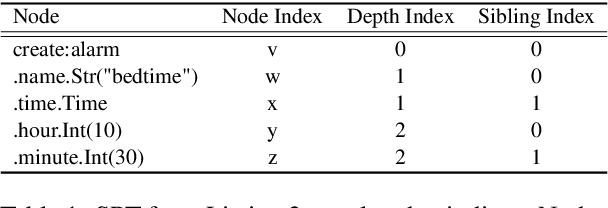
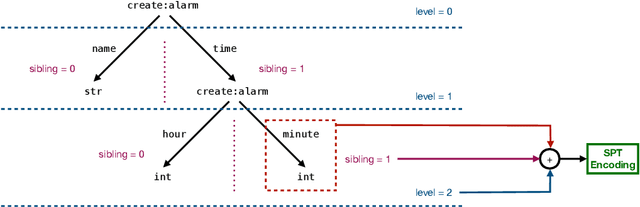
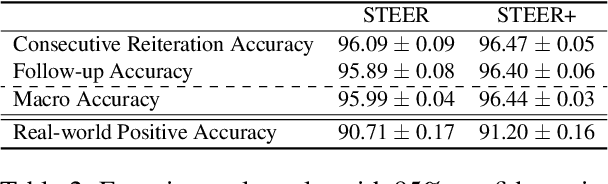
In the context of a voice assistant system, steering refers to the phenomenon in which a user issues a follow-up command attempting to direct or clarify a previous turn. We propose STEER, a steering detection model that predicts whether a follow-up turn is a user's attempt to steer the previous command. Constructing a training dataset for steering use cases poses challenges due to the cold-start problem. To overcome this, we developed heuristic rules to sample opt-in usage data, approximating positive and negative samples without any annotation. Our experimental results show promising performance in identifying steering intent, with over 95% accuracy on our sampled data. Moreover, STEER, in conjunction with our sampling strategy, aligns effectively with real-world steering scenarios, as evidenced by its strong zero-shot performance on a human-graded evaluation set. In addition to relying solely on user transcripts as input, we introduce STEER+, an enhanced version of the model. STEER+ utilizes a semantic parse tree to provide more context on out-of-vocabulary words, such as named entities that often occur at the sentence boundary. This further improves model performance, reducing error rate in domains where entities frequently appear, such as messaging. Lastly, we present a data analysis that highlights the improvement in user experience when voice assistants support steering use cases.