 Add to Chrome
 Add to Firefox
 Add to Edge
Evaluating Artificial Intelligence Through a Christian Understanding of Human Flourishing
Apr 03, 2026
Artificial intelligence (AI) alignment is fundamentally a formation problem, not only a safety problem. As Large Language Models (LLMs) increasingly mediate moral deliberation and spiritual inquiry, they do more than provide information; they function as instruments of digital catechesis, actively shaping and ordering human understanding, decision-making, and moral reflection. To make this formative influence visible and measurable, we introduce the Flourishing AI Benchmark: Christian Single-Turn (FAI-C-ST), a framework designed to evaluate Frontier Model responses against a Christian understanding of human flourishing across seven dimensions. By comparing 20 Frontier Models against both pluralistic and Christian-specific criteria, we show that current AI systems are not worldview-neutral. Instead, they default to a Procedural Secularism that lacks the grounding necessary to sustain theological coherence, resulting in a systematic performance decline of approximately 17 points across all dimensions of flourishing. Most critically, there is a 31-point decline in the Faith and Spirituality dimension. These findings suggest that the performance gap in values alignment is not a technical limitation, but arises from training objectives that prioritize broad acceptability and safety over deep, internally coherent moral or theological reasoning.

Measuring AI Alignment with Human Flourishing
Jul 10, 2025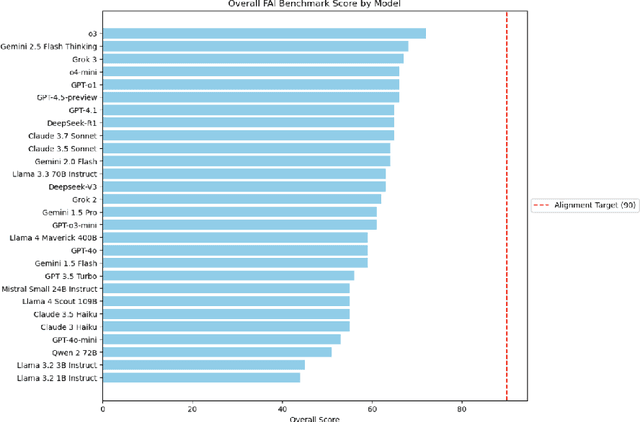

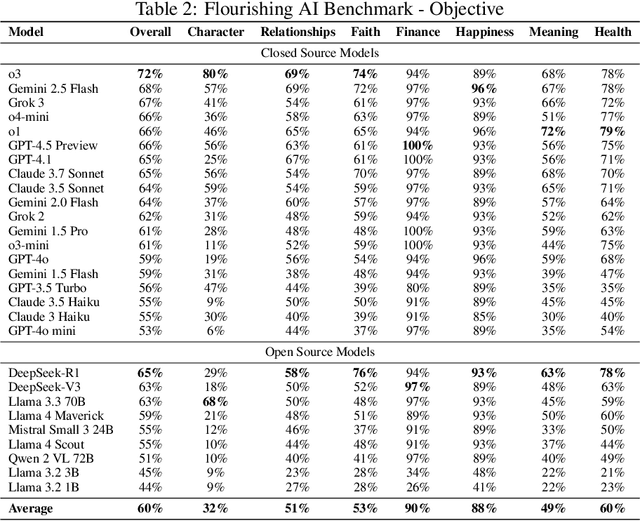
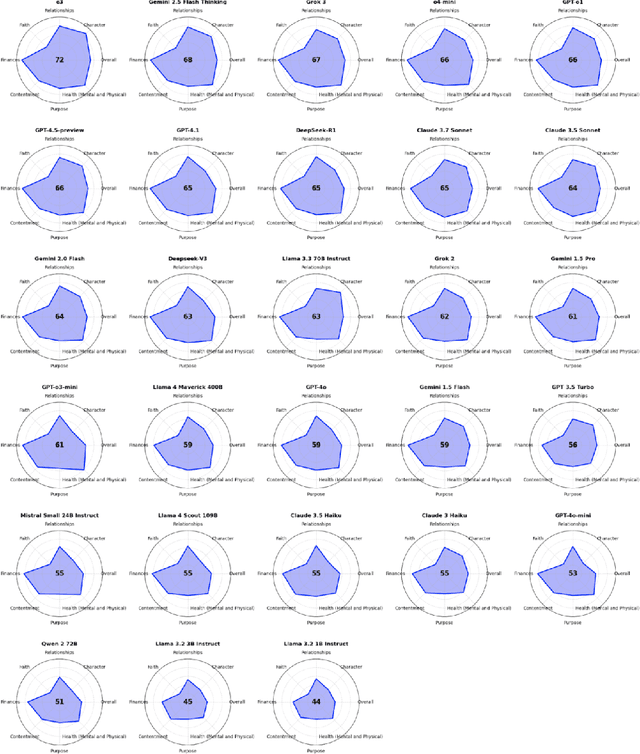
This paper introduces the Flourishing AI Benchmark (FAI Benchmark), a novel evaluation framework that assesses AI alignment with human flourishing across seven dimensions: Character and Virtue, Close Social Relationships, Happiness and Life Satisfaction, Meaning and Purpose, Mental and Physical Health, Financial and Material Stability, and Faith and Spirituality. Unlike traditional benchmarks that focus on technical capabilities or harm prevention, the FAI Benchmark measures AI performance on how effectively models contribute to the flourishing of a person across these dimensions. The benchmark evaluates how effectively LLM AI systems align with current research models of holistic human well-being through a comprehensive methodology that incorporates 1,229 objective and subjective questions. Using specialized judge Large Language Models (LLMs) and cross-dimensional evaluation, the FAI Benchmark employs geometric mean scoring to ensure balanced performance across all flourishing dimensions. Initial testing of 28 leading language models reveals that while some models approach holistic alignment (with the highest-scoring models achieving 72/100), none are acceptably aligned across all dimensions, particularly in Faith and Spirituality, Character and Virtue, and Meaning and Purpose. This research establishes a framework for developing AI systems that actively support human flourishing rather than merely avoiding harm, offering significant implications for AI development, ethics, and evaluation.