 Add to Chrome
 Add to Firefox
 Add to Edge
SiPaKosa: A Comprehensive Corpus of Canonical and Classical Buddhist Texts in Sinhala and Pali
Mar 31, 2026
SiPaKosa is a comprehensive corpus of Sinhala and Pali doctrinal texts comprising approximately 786K sentences and 9.25M words, incorporating 16 copyright-cleared historical Buddhist documents alongside the complete web-scraped Tripitaka canonical texts. The corpus was created through high-quality OCR using Google Document AI on historical manuscripts, combined with systematic web scraping of canonical repositories, followed by rigorous quality control and metadata annotation. The corpus is organised into language-specific subcorpora: Sinhala and Mixed Sinhala-Pali. We evaluate the performance of language models using ten pretrained models, with perplexity scores ranging from 1.09 to 189.67 on our corpus. This analysis shows that proprietary models significantly outperform open-source alternatives by factors of three to six times. This corpus supports the pretraining of domain-adapted language models, facilitates historical language analysis, and aids in the development of information retrieval systems for Buddhist scholarship while preserving Sinhala cultural heritage.

SiDiaC-v.2.0: Sinhala Diachronic Corpus Version 2.0
Mar 11, 2026SiDiaC-v.2.0 is the largest comprehensive Sinhala Diachronic Corpus to date, covering a period from 1800 CE to 1955 CE in terms of publication dates, and a historical span from the 5th to the 20th century CE in terms of written dates. The corpus consists of 244k words across 185 literary works that underwent thorough filtering, preprocessing, and copyright compliance checks, followed by extensive post-processing. Additionally, a subset of 59 documents totalling 70k words was annotated based on their written dates. Texts from the National Library of Sri Lanka were selected from the SiDiaC-v.1.0 non-filtered list, which was digitised using Google Document AI OCR. This was followed by post-processing to correct formatting issues, address code-mixing, include special tokens, and fix malformed tokens. The construction of SiDiaC-v.2.0 was informed by practices from other corpora, such as FarPaHC, SiDiaC-v.1.0, and CCOHA. This was particularly relevant for syntactic annotation and text normalisation strategies, given the shared characteristics of low-resource language status between Faroese and the similar cleaning strategies utilised in CCOHA. This corpus is categorised into two layers based on genres: primary and secondary. The primary categorisation is binary, assigning each book to either Non-Fiction or Fiction. The secondary categorisation is more detailed, grouping texts under specific genres such as Religious, History, Poetry, Language, and Medical. Despite facing challenges due to limited resources, SiDiaC-v.2.0 serves as a comprehensive resource for Sinhala NLP, building upon the work previously done in SiDiaC-v.1.0.
SinhaLegal: A Benchmark Corpus for Information Extraction and Analysis in Sinhala Legislative Texts
Mar 05, 2026SinhaLegal introduces a Sinhala legislative text corpus containing approximately 2 million words across 1,206 legal documents. The dataset includes two types of legal documents: 1,065 Acts dated from 1981 to 2014 and 141 Bills from 2010 to 2014, which were systematically collected from official sources. The texts were extracted using OCR with Google Document AI, followed by extensive post-processing and manual cleaning to ensure high-quality, machine-readable content, along with dedicated metadata files for each document. A comprehensive evaluation was conducted, including corpus statistics, lexical diversity, word frequency analysis, named entity recognition, and topic modelling, demonstrating the structured and domain-specific nature of the corpus. Additionally, perplexity analysis using both large and small language models was performed to assess how effectively language models respond to domain-specific texts. The SinhaLegal corpus represents a vital resource designed to support NLP tasks such as summarisation, information extraction, and analysis, thereby bridging a critical gap in Sinhala legal research.
SinFoS: A Parallel Dataset for Translating Sinhala Figures of Speech
Feb 09, 2026Figures of Speech (FoS) consist of multi-word phrases that are deeply intertwined with culture. While Neural Machine Translation (NMT) performs relatively well with the figurative expressions of high-resource languages, it often faces challenges when dealing with low-resource languages like Sinhala due to limited available data. To address this limitation, we introduce a corpus of 2,344 Sinhala figures of speech with cultural and cross-lingual annotations. We examine this dataset to classify the cultural origins of the figures of speech and to identify their cross-lingual equivalents. Additionally, we have developed a binary classifier to differentiate between two types of FOS in the dataset, achieving an accuracy rate of approximately 92%. We also evaluate the performance of existing LLMs on this dataset. Our findings reveal significant shortcomings in the current capabilities of LLMs, as these models often struggle to accurately convey idiomatic meanings. By making this dataset publicly available, we offer a crucial benchmark for future research in low-resource NLP and culturally aware machine translation.
A Hybrid Architecture with Efficient Fine Tuning for Abstractive Patent Document Summarization
Mar 13, 2025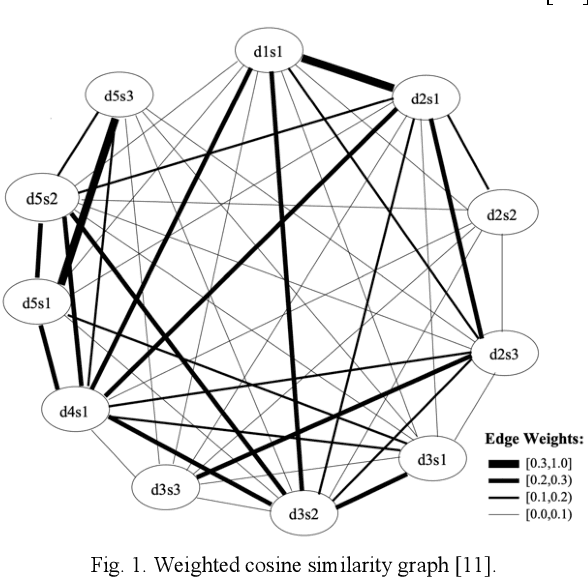
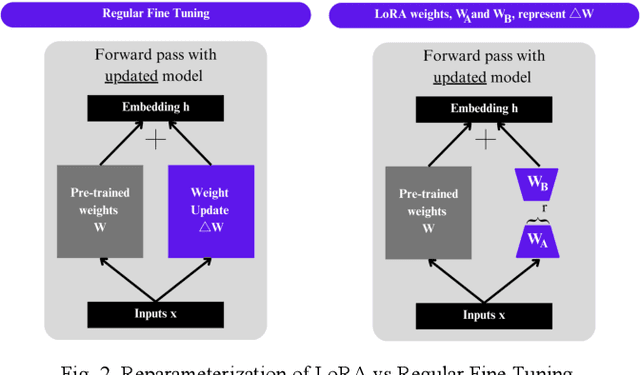
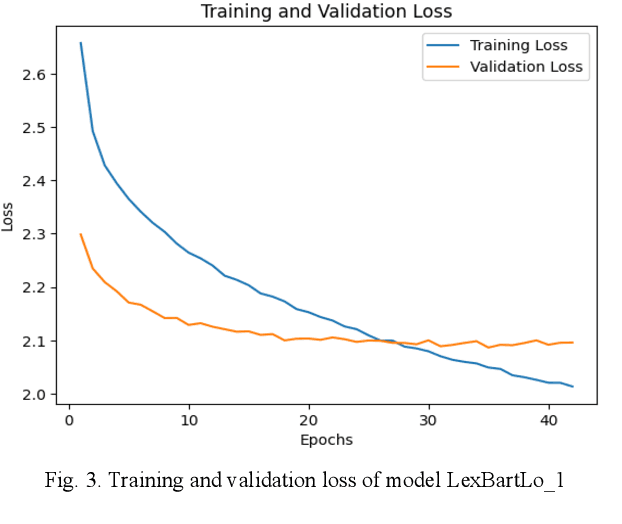
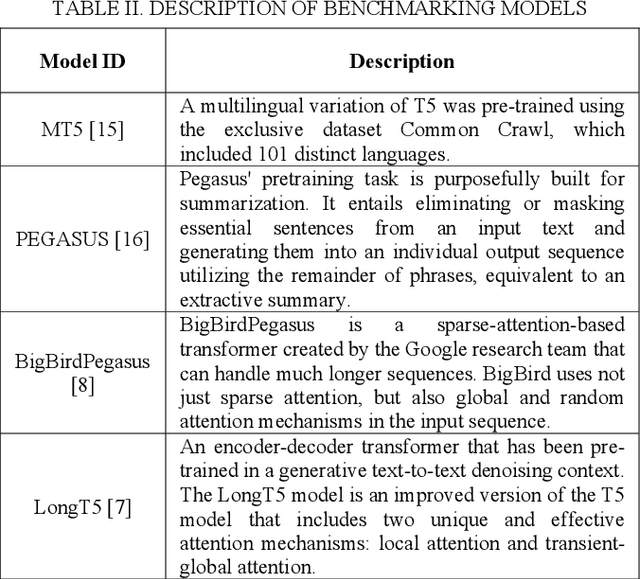
Automatic patent summarization approaches that help in the patent analysis and comprehension procedure are in high demand due to the colossal growth of innovations. The development of natural language processing (NLP), text mining, and deep learning has notably amplified the efficacy of text summarization models for abundant types of documents. Summarizing patent text remains a pertinent challenge due to the labyrinthine writing style of these documents, which includes technical and legal intricacies. Additionally, these patent document contents are considerably lengthier than archetypal documents, which intricates the process of extracting pertinent information for summarization. Embodying extractive and abstractive text summarization methodologies into a hybrid framework, this study proposes a system for efficiently creating abstractive summaries of patent records. The procedure involves leveraging the LexRank graph-based algorithm to retrieve the important sentences from input parent texts, then utilizing a Bidirectional Auto-Regressive Transformer (BART) model that has been fine-tuned using Low-Ranking Adaptation (LoRA) for producing text summaries. This is accompanied by methodical testing and evaluation strategies. Furthermore, the author employed certain meta-learning techniques to achieve Domain Generalization (DG) of the abstractive component across multiple patent fields.
Advancements in Natural Language Processing for Automatic Text Summarization
Feb 27, 2025


The substantial growth of textual content in diverse domains and platforms has led to a considerable need for Automatic Text Summarization (ATS) techniques that aid in the process of text analysis. The effectiveness of text summarization models has been significantly enhanced in a variety of technical domains because of advancements in Natural Language Processing (NLP) and Deep Learning (DL). Despite this, the process of summarizing textual information continues to be significantly constrained by the intricate writing styles of a variety of texts, which involve a range of technical complexities. Text summarization techniques can be broadly categorized into two main types: abstractive summarization and extractive summarization. Extractive summarization involves directly extracting sentences, phrases, or segments of text from the content without making any changes. On the other hand, abstractive summarization is achieved by reconstructing the sentences, phrases, or segments from the original text using linguistic analysis. Through this study, a linguistically diverse categorizations of text summarization approaches have been addressed in a constructive manner. In this paper, the authors explored existing hybrid techniques that have employed both extractive and abstractive methodologies. In addition, the pros and cons of various approaches discussed in the literature are also investigated. Furthermore, the authors conducted a comparative analysis on different techniques and matrices to evaluate the generated summaries using language generation models. This survey endeavors to provide a comprehensive overview of ATS by presenting the progression of language processing regarding this task through a breakdown of diverse systems and architectures accompanied by technical and mathematical explanations of their operations.
* 11 pages, 9 figures, ICCS 2024