 Add to Chrome
 Add to Firefox
 Add to Edge
Gaussian Pixel Codec Avatars: A Hybrid Representation for Efficient Rendering
Dec 17, 2025
We present Gaussian Pixel Codec Avatars (GPiCA), photorealistic head avatars that can be generated from multi-view images and efficiently rendered on mobile devices. GPiCA utilizes a unique hybrid representation that combines a triangle mesh and anisotropic 3D Gaussians. This combination maximizes memory and rendering efficiency while maintaining a photorealistic appearance. The triangle mesh is highly efficient in representing surface areas like facial skin, while the 3D Gaussians effectively handle non-surface areas such as hair and beard. To this end, we develop a unified differentiable rendering pipeline that treats the mesh as a semi-transparent layer within the volumetric rendering paradigm of 3D Gaussian Splatting. We train neural networks to decode a facial expression code into three components: a 3D face mesh, an RGBA texture, and a set of 3D Gaussians. These components are rendered simultaneously in a unified rendering engine. The networks are trained using multi-view image supervision. Our results demonstrate that GPiCA achieves the realism of purely Gaussian-based avatars while matching the rendering performance of mesh-based avatars.

Hardware-Rasterized Ray-Based Gaussian Splatting
Mar 24, 2025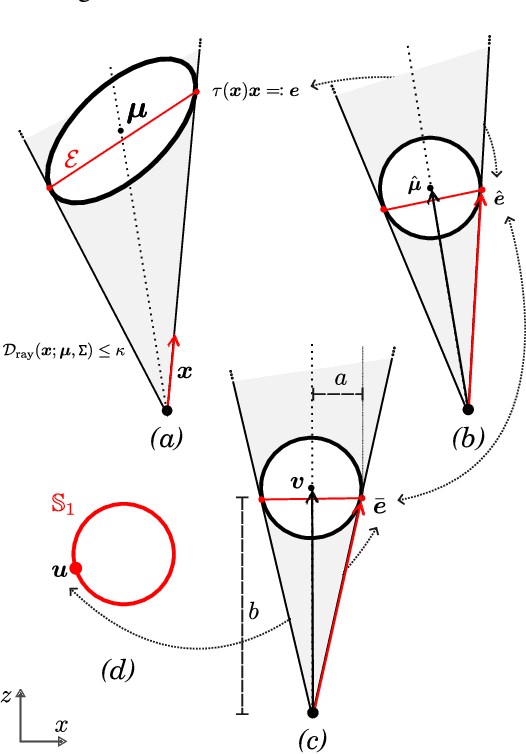
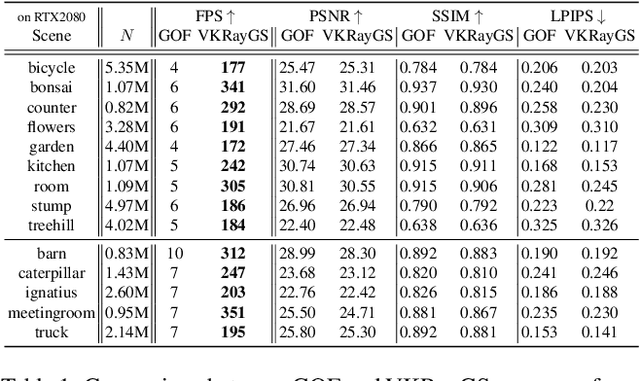
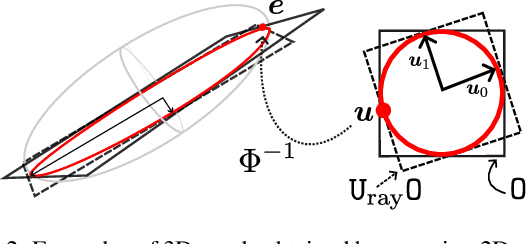
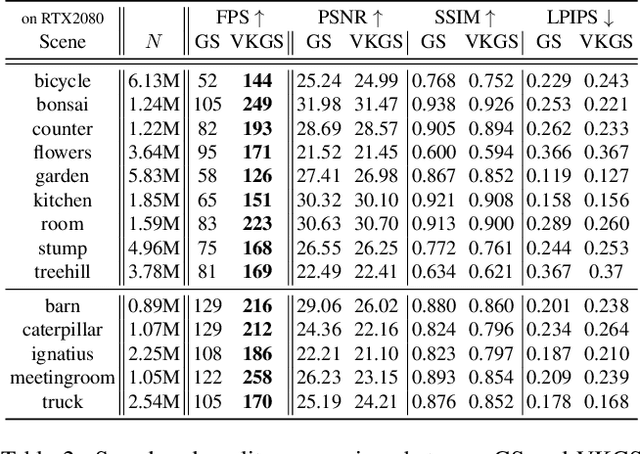
We present a novel, hardware rasterized rendering approach for ray-based 3D Gaussian Splatting (RayGS), obtaining both fast and high-quality results for novel view synthesis. Our work contains a mathematically rigorous and geometrically intuitive derivation about how to efficiently estimate all relevant quantities for rendering RayGS models, structured with respect to standard hardware rasterization shaders. Our solution is the first enabling rendering RayGS models at sufficiently high frame rates to support quality-sensitive applications like Virtual and Mixed Reality. Our second contribution enables alias-free rendering for RayGS, by addressing MIP-related issues arising when rendering diverging scales during training and testing. We demonstrate significant performance gains, across different benchmark scenes, while retaining state-of-the-art appearance quality of RayGS.
SqueezeMe: Efficient Gaussian Avatars for VR
Dec 19, 2024


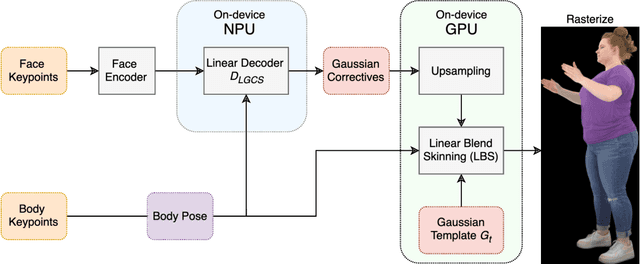
Gaussian Splatting has enabled real-time 3D human avatars with unprecedented levels of visual quality. While previous methods require a desktop GPU for real-time inference of a single avatar, we aim to squeeze multiple Gaussian avatars onto a portable virtual reality headset with real-time drivable inference. We begin by training a previous work, Animatable Gaussians, on a high quality dataset captured with 512 cameras. The Gaussians are animated by controlling base set of Gaussians with linear blend skinning (LBS) motion and then further adjusting the Gaussians with a neural network decoder to correct their appearance. When deploying the model on a Meta Quest 3 VR headset, we find two major computational bottlenecks: the decoder and the rendering. To accelerate the decoder, we train the Gaussians in UV-space instead of pixel-space, and we distill the decoder to a single neural network layer. Further, we discover that neighborhoods of Gaussians can share a single corrective from the decoder, which provides an additional speedup. To accelerate the rendering, we develop a custom pipeline in Vulkan that runs on the mobile GPU. Putting it all together, we run 3 Gaussian avatars concurrently at 72 FPS on a VR headset. Demo videos are at https://forresti.github.io/squeezeme.