 Add to Chrome
 Add to Firefox
 Add to Edge
Kernel weighted importance sampling for off-policy evaluation in contextual bandits
Jul 16, 2026
This article presents a novel estimator for performing off-policy evaluation using only offline data for contextual bandits. The proposed estimator, Kernel-WIS is demonstrated to be asymptotically consistent and to empirically outperform strong baselines (including vanilla weighted importance sampling), particularly under complex conditions including behaviour policy miss-specification. The benefit of Kernel-WIS is derived from combining the bounded property of vanilla weighted importance sampling with the linearity of vanilla importance sampling.

Evaluating covariate balance for long time horizon Markov decision processes
Jul 16, 2026This article explores the application of covariate balance diagnostics for detecting the presence of hidden confounding/model miss-specification in studies applying offline reinforcement learning (RL) to deriving optimal treatment recommendations. The results demonstrate that, either there is a high risk of bias within existing offline RL studies for treatment recommendations or, existing covariate balance metrics are not sufficient to assess such studies. Regardless, existing offline RL studies cannot be concluded as being statistically robust. The conclusions propose future research directions for obtaining more methodologically robust applications of offline RL to treatment recommendation problems.
LLM4EHR: Aligning Clinical Time Series with Medical Event Sequences via Large Language Models
Jul 16, 2026Recent research in clinical machine learning, focusing on outcome predictions in intensive care unit (ICU), has shifted from bespoke supervised models to foundation models, utilising modern representation learning methods. Here, foundation models are pre-trained on mixtures of complex clinical data modalities, useful for various downstream tasks. Existing works often utilise Electronic Health Records (EHR) to provide rich and diverse patient observations to train clinical foundation models. However, existing methods do not sufficiently explore the shared temporal structures between clinical events and time series (TS) observations recorded in EHRs. This limitation potentially leads to less robust and adaptive clinical foundation models, resulting in reduced performance on downstream tasks. To fully exploit this temporal structure, we propose LLM4EHR, a new clinical foundation model trained on ICU EHR data. Combining domain adapted large language models with a transformer TS encoder, we pre-trained LLM4EHR by temporally aligning the EHR events and TS. For this, we propose a regularised contrastive objective to learn robust EHR TS representations conditioned on EHR event embeddings produced by the domain adapted LLM. Supported by an ablation study, we find that learnt EHR TS embeddings from LLM4EHR improve performance on various downstream clinical tasks with competitive performance. Further, we empirically demonstrate that LLM4EHR learns transferable clinical TS embeddings that can be deployed to new cohorts via k-shot adaptation. These findings provide a step towards building more generalisable and performant clinical foundation models.
MotionInput v2.0 supporting DirectX: A modular library of open-source gesture-based machine learning and computer vision methods for interacting and controlling existing software with a webcam
Aug 10, 2021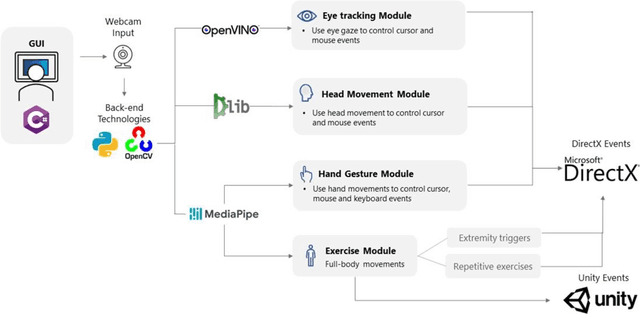
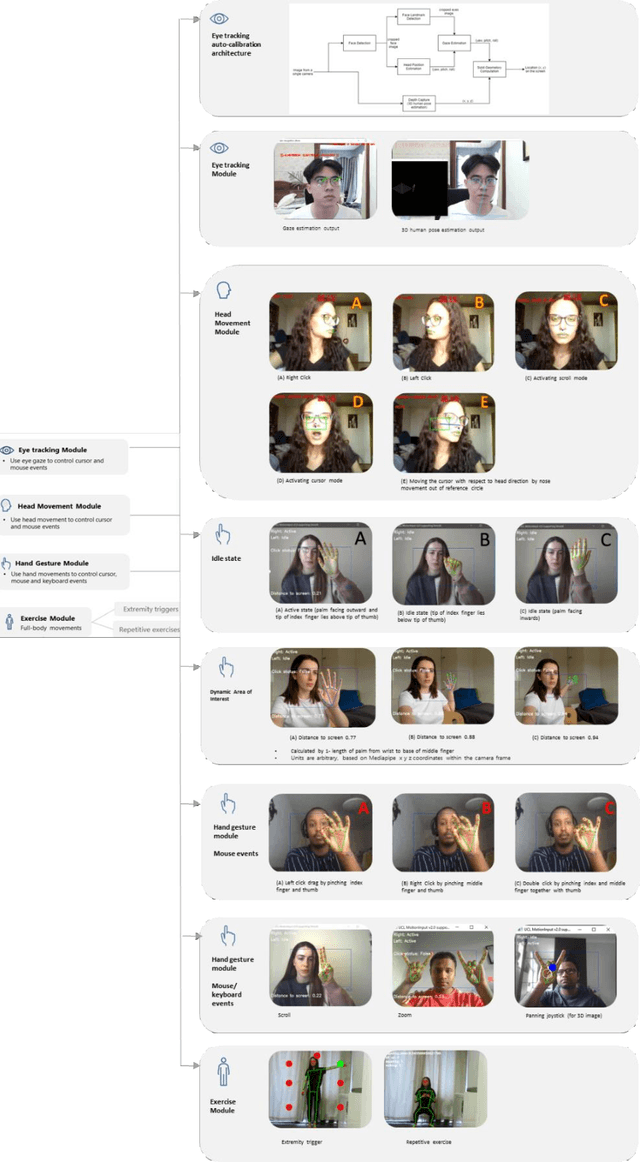
Touchless computer interaction has become an important consideration during the COVID-19 pandemic period. Despite progress in machine learning and computer vision that allows for advanced gesture recognition, an integrated collection of such open-source methods and a user-customisable approach to utilising them in a low-cost solution for touchless interaction in existing software is still missing. In this paper, we introduce the MotionInput v2.0 application. This application utilises published open-source libraries and additional gesture definitions developed to take the video stream from a standard RGB webcam as input. It then maps human motion gestures to input operations for existing applications and games. The user can choose their own preferred way of interacting from a series of motion types, including single and bi-modal hand gesturing, full-body repetitive or extremities-based exercises, head and facial movements, eye tracking, and combinations of the above. We also introduce a series of bespoke gesture recognition classifications as DirectInput triggers, including gestures for idle states, auto calibration, depth capture from a 2D RGB webcam stream and tracking of facial motions such as mouth motions, winking, and head direction with rotation. Three use case areas assisted the development of the modules: creativity software, office and clinical software, and gaming software. A collection of open-source libraries has been integrated and provide a layer of modular gesture mapping on top of existing mouse and keyboard controls in Windows via DirectX. With ease of access to webcams integrated into most laptops and desktop computers, touchless computing becomes more available with MotionInput v2.0, in a federated and locally processed method.