 Add to Chrome
 Add to Firefox
 Add to Edge
Do Multimodal Large Language Models Need Reasoning to Classify Dementia from Speech?
Jun 30, 2026
Multimodal large language models (MLLMs) have emerged as a promising approach for improving the accuracy, transferability, and explainability of automatic dementia classification (ADC) systems from voice recordings. Yet it remains unclear whether their reasoning capabilities are beneficial for ADC, and how such capabilities should be leveraged. In this paper, we conduct a careful evaluation of reasoning MLLMs for ADC and show that naive strategies, such as relying on text-based rationales, can lead to hallucinated and inconsistent rationales for diagnosis and yield inferior ADC performance compared with LLM-free baselines. To overcome this limitation, we propose \textbf{De}mentia \textbf{T}hinker with Nonlinear \textbf{A}daptor and Re\textbf{i}nforcement \textbf{L}earning (DeTAiL), an adaptor-based framework that exploits the internal representations of reasoning MLLMs for improved dementia classification. Across two dementia datasets with distinct test formats and label granularities, DeTAiL consistently outperforms strong baselines and methods that rely on text-based rationales. Code and demo will be released upon acceptance.

The syntax-lexicon tradeoff in writing
Jun 24, 2022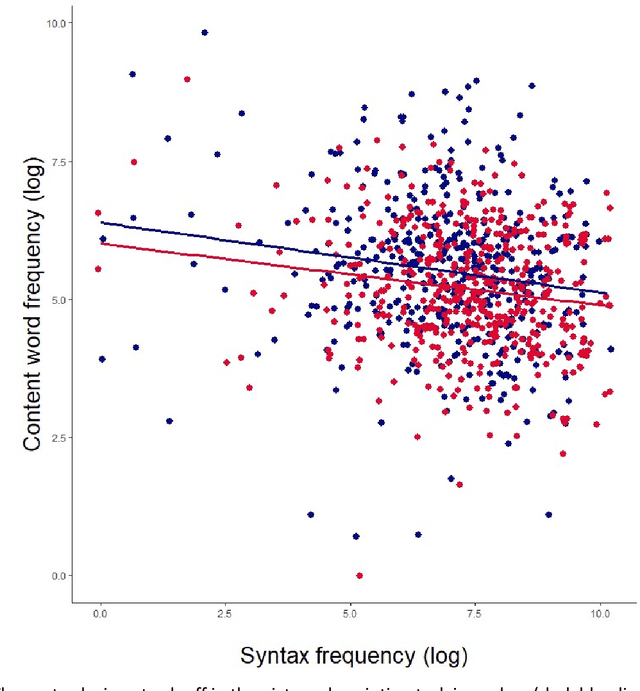
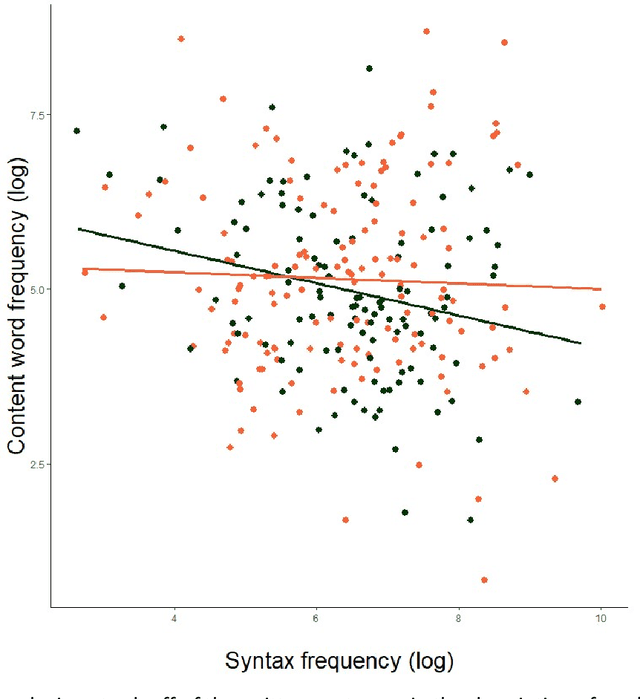
As speakers turn their thoughts into sentences, they maintain a balance between the complexity of words and syntax. However, it is unclear whether this syntax-lexicon tradeoff is unique to the spoken language production that is under the pressure of rapid online processing. Alternatively, it is possible that the tradeoff is a basic property of language irrespective of the modality of production. This work evaluates the relationship between the complexity of words and syntactic rules in the written language of neurotypical individuals on three different topics. We found that similar to speaking, constructing sentences in writing involves a tradeoff between the complexity of the lexical and syntactic items. We also show that the reduced online processing demands during writing allows for retrieving more complex words at the cost of incorporating simpler syntax. This work further highlights the role of accessibility of the elements of a sentence as the driving force in the emergence of the syntax-lexicon tradeoff.