 Add to Chrome
 Add to Firefox
 Add to Edge
The Need for Neural ISP in the Small-Pixel Era: How Shrinking Pixels Push Optics to the Limit and Neural Restoration Pushes Back
Jun 04, 2026
Smartphone telephoto cameras are approaching a "telephoto physics wall": as pixel pitches shrink toward sub-0.5 micron, the optics remain limited by geometric aberrations, leading to diminishing returns on resolution. Traditional Image Signal Processors (ISPs) cannot eliminate these aberrations, because they operate through local, stage-wise processing with no explicit model of the underlying point spread function (PSF). We demonstrate how a learning-based Neural ISP for image restoration, trained on the underlying degradations, inverts what stage-wise pipelines cannot, turning small-pixel designs into a net advantage. We investigate this through a controlled simulation of a representative telephoto module, evaluating five configurations (0.35--0.75 micron pixel pitch). The aperture is scaled proportionally to keep per-pixel SNR and diffraction spot size fixed, thereby isolating geometric aberration and spatial sampling. While the traditional ISP improves only modestly with smaller pixels, the Neural ISP scales substantially: at 0.35 micron} it reaches 745 cycles/mm MTF50 (vertical), a 2.5--3x resolution improvement over the traditional ISP, and LPIPS improves significantly from 0.244 to 0.151 while traditional results stay comparatively flat. In a low-SNR extension (15 dB per-frame bursts at 0.35 micron), a multi-frame Neural ISP recovers performance close to the bright-light single-frame baseline, whereas a multi-frame traditional ISP shows no meaningful improvement -- indicating that traditional pipelines at small pixels are bottlenecked by uncorrected PSF blur rather than by noise. These results point to a design philosophy in which Neural ISPs enable high-resolution telephoto modules by correcting residual optical aberrations rather than requiring increasingly complex optics.

Spectral DiffuserCam: lensless snapshot hyperspectral imaging with a spectral filter array
Jun 15, 2020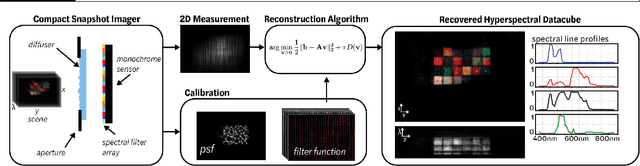
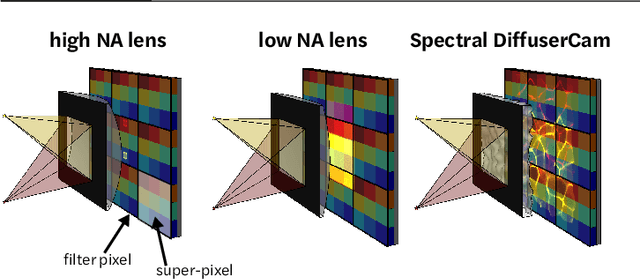
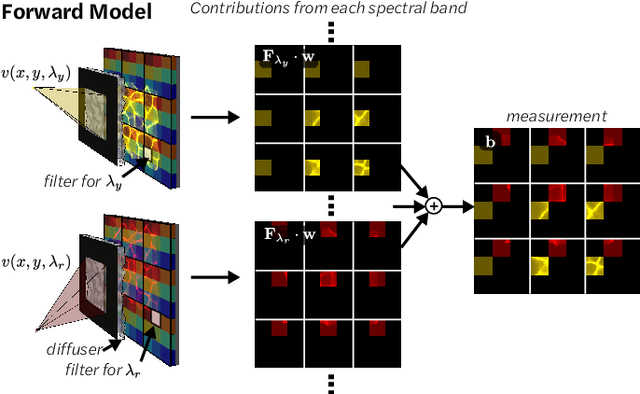
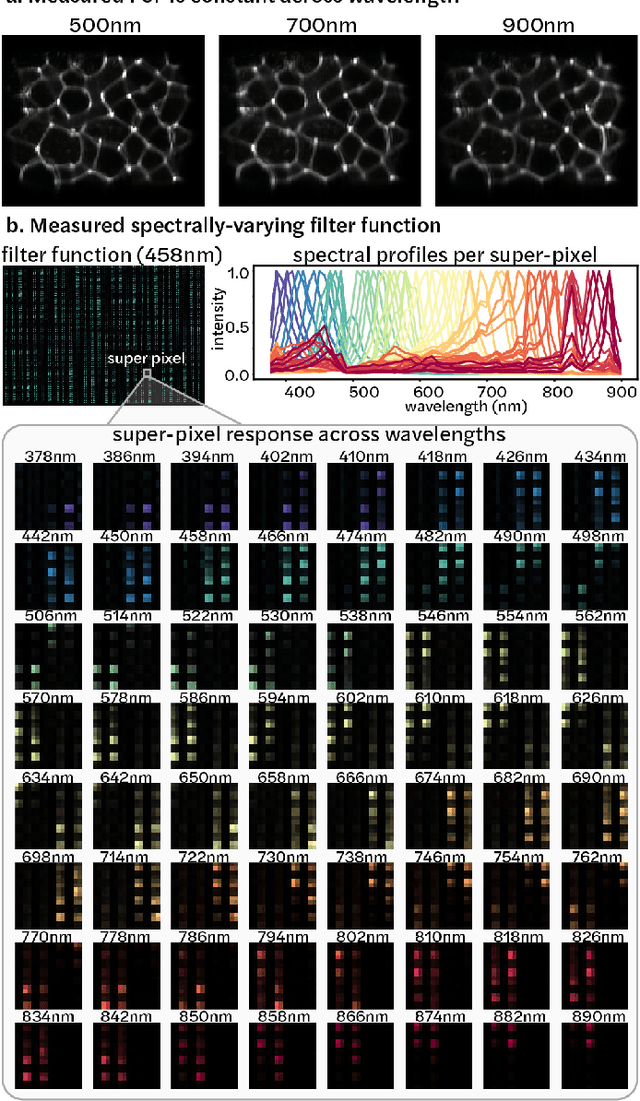
Hyperspectral imaging is useful for applications ranging from medical diagnostics to crop monitoring; however, traditional scanning hyperspectral imagers are prohibitively slow and expensive for widespread adoption. Snapshot techniques exist but are often confined to bulky benchtop setups or have low spatio-spectral resolution. In this paper, we propose a novel, compact, and inexpensive computational camera for snapshot hyperspectral imaging. Our system consists of a repeated spectral filter array placed directly on the image sensor and a diffuser placed close to the sensor. Each point in the world maps to a unique pseudorandom pattern on the spectral filter array, which encodes multiplexed spatio-spectral information. A sparsity-constrained inverse problem solver then recovers the hyperspectral volume with good spatio-spectral resolution. By using a spectral filter array, our hyperspectral imaging framework is flexible and can be designed with contiguous or non-contiguous spectral filters that can be chosen for a given application. We provide theory for system design, demonstrate a prototype device, and present experimental results with high spatio-spectral resolution.