 Add to Chrome
 Add to Firefox
 Add to Edge
Neurosymbolic Learning for Advanced Persistent Threat Detection under Extreme Class Imbalance
Feb 28, 2026
The growing deployment of Internet of Things (IoT) devices in smart cities and industrial environments increases vulnerability to stealthy, multi-stage advanced persistent threats (APTs) that exploit wireless communication. Detection is challenging due to severe class imbalance in network traffic, which limits the effectiveness of traditional deep learning approaches and their lack of explainability in classification decisions. To address these challenges, this paper proposes a neurosymbolic architecture that integrates an optimized BERT model with logic tensor networks (LTN) for explainable APT detection in wireless IoT networks. The proposed method addresses the challenges of mobile IoT environments through efficient feature encoding that transforms network flow data into BERT-compatible sequences while preserving temporal dependencies critical for APT stage identification. Severe class imbalance is mitigated using focal loss, hierarchical classification that separates normal traffic detection from attack categorization, and adaptive sampling strategies. Evaluation on the SCVIC-APT2021 dataset demonstrates an operationally viable binary classification F1 score of 95.27% with a false positive rate of 0.14%, and a 76.75% macro F1 score for multi-class attack categorization. Furthermore, a novel explainability analysis statistically validates the importance of distinct network features. These results demonstrate that neurosymbolic learning enables high-performance, interpretable, and operationally viable APT detection for IoT network monitoring architectures.

Flexible Semantic-Aware Resource Allocation: Serving More Users Through Similarity Range Constraints
Apr 29, 2025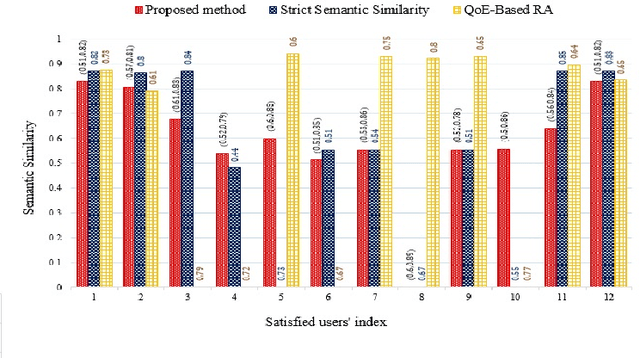
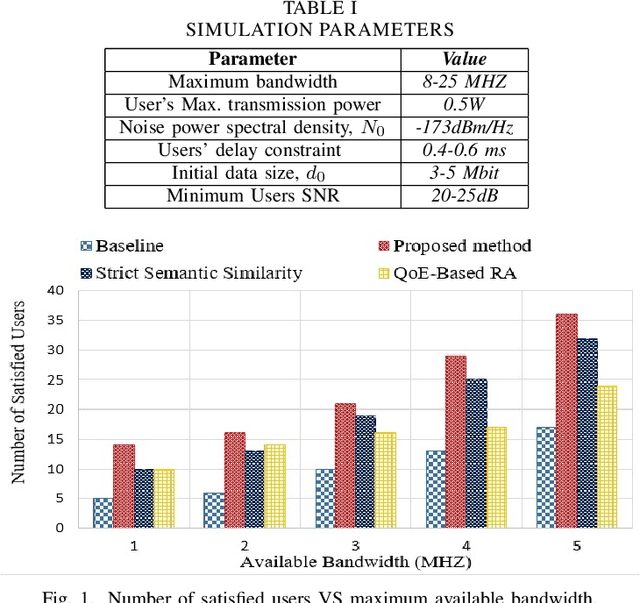
Semantic communication (SemCom) aims to enhance the resource efficiency of next-generation networks by transmitting the underlying meaning of messages, focusing on information relevant to the end user. Existing literature on SemCom primarily emphasizes learning the encoder and decoder through end-to-end deep learning frameworks, with the objective of minimizing a task-specific semantic loss function. Beyond its influence on the physical and application layer design, semantic variability across users in multi-user systems enables the design of resource allocation schemes that incorporate user-specific semantic requirements. To this end, \emph{a semantic-aware resource allocation} scheme is proposed with the objective of maximizing transmission and semantic reliability, ultimately increasing the number of users whose semantic requirements are met. The resulting resource allocation problem is a non-convex mixed-integer nonlinear program (MINLP), which is known to be NP-hard. To make the problem tractable, it is decomposed into a set of sub-problems, each of which is efficiently solved via geometric programming techniques. Finally, simulations demonstrate that the proposed method improves user satisfaction by up to $17.1\%$ compared to state of the art methods based on quality of experience-aware SemCom methods.