 Add to Chrome
 Add to Firefox
 Add to Edge
IceWatch: Forecasting Glacial Lake Outburst Floods (GLOFs) using Multimodal Deep Learning
Jan 18, 2026
Glacial Lake Outburst Floods (GLOFs) pose a serious threat in high mountain regions. They are hazardous to communities, infrastructure, and ecosystems further downstream. The classical methods of GLOF detection and prediction have so far mainly relied on hydrological modeling, threshold-based lake monitoring, and manual satellite image analysis. These approaches suffer from several drawbacks: slow updates, reliance on manual labor, and losses in accuracy when clouds interfere and/or lack on-site data. To tackle these challenges, we present IceWatch: a novel deep learning framework for GLOF prediction that incorporates both spatial and temporal perspectives. The vision component, RiskFlow, of IceWatch deals with Sentinel-2 multispectral satellite imagery using a CNN-based classifier and predicts GLOF events based on the spatial patterns of snow, ice, and meltwater. Its tabular counterpart confirms this prediction by considering physical dynamics. TerraFlow models glacier velocity from NASA ITS_LIVE time series while TempFlow forecasts near-surface temperature from MODIS LST records; both are trained on long-term observational archives and integrated via harmonized preprocessing and synchronization to enable multimodal, physics-informed GLOF prediction. Both together provide cross-validation, which will improve the reliability and interpretability of GLOF detection. This system ensures strong predictive performance, rapid data processing for real-time use, and robustness to noise and missing information. IceWatch paves the way for automatic, scalable GLOF warning systems. It also holds potential for integration with diverse sensor inputs and global glacier monitoring activities.

Person Re-identification: A Retrospective on Domain Specific Open Challenges and Future Trends
Feb 26, 2022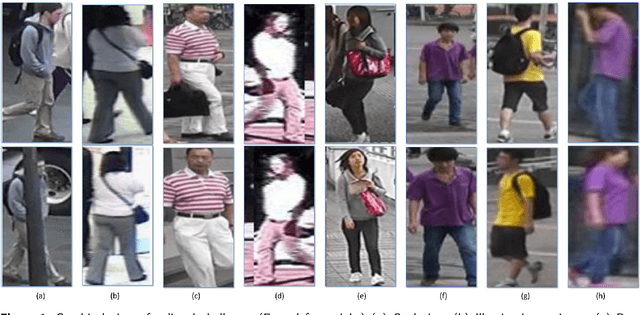
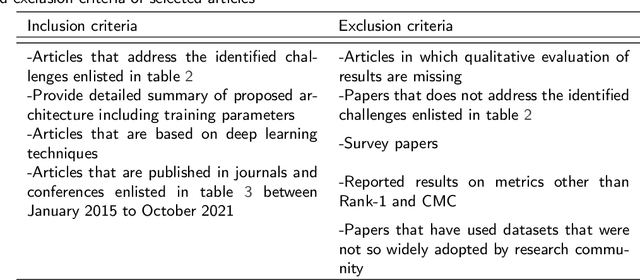
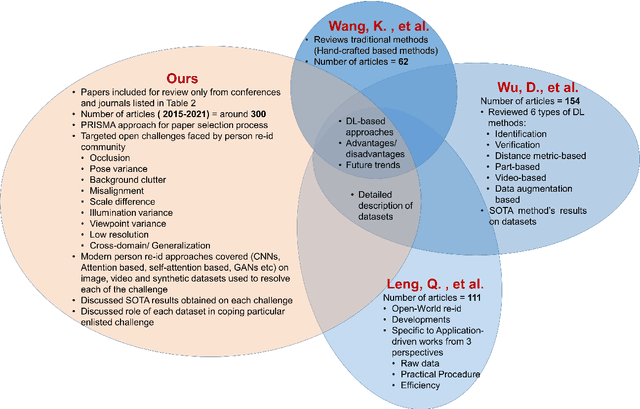
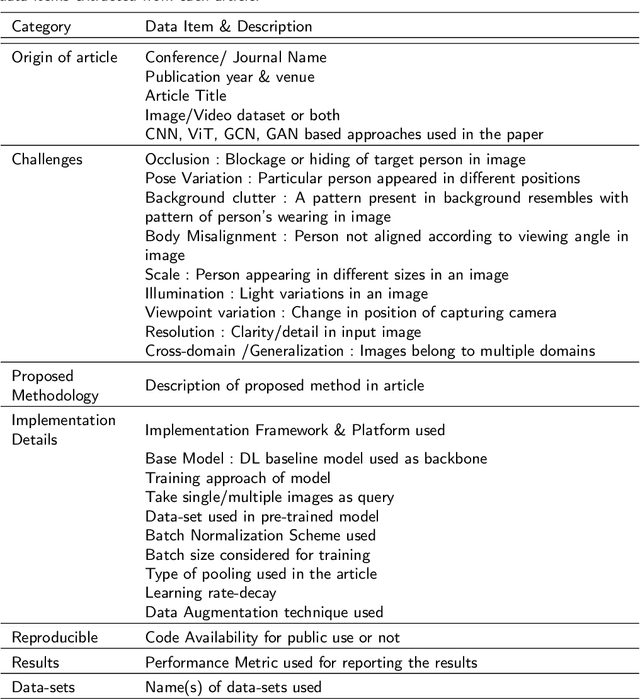
Person re-identification (Re-ID) is one of the primary components of an automated visual surveillance system. It aims to automatically identify/search persons in a multi-camera network having non-overlapping field-of-views. Owing to its potential in various applications and research significance, a plethora of deep learning based re-Id approaches have been proposed in the recent years. However, there exist several vision related challenges, e.g., occlusion, pose scale \& viewpoint variance, background clutter, person misalignment and cross-domain generalization across camera modalities, which makes the problem of re-Id still far from being solved. Majority of the proposed approaches directly or indirectly aim to solve one or multiple of these existing challenges. In this context, a comprehensive review of current re-ID approaches in solving theses challenges is needed to analyze and focus on particular aspects for further advancements. At present, such a focused review does not exist and henceforth in this paper, we have presented a systematic challenge-specific literature survey of 230+ papers between the years of 2015-21. For the first time a survey of this type have been presented where the person re-Id approaches are reviewed in such solution-oriented perspective. Moreover, we have presented several diversified prominent developing trends in the respective research domain which will provide a visionary perspective regarding ongoing person re-Id research and eventually help to develop practical real world solutions.