 Add to Chrome
 Add to Firefox
 Add to Edge
DocDjinn: Controllable Synthetic Document Generation with VLMs and Handwriting Diffusion
Feb 25, 2026
Effective document intelligence models rely on large amounts of annotated training data. However, procuring sufficient and high-quality data poses significant challenges due to the labor-intensive and costly nature of data acquisition. Additionally, leveraging language models to annotate real documents raises concerns about data privacy. Synthetic document generation has emerged as a promising, privacy-preserving alternative. We propose DocDjinn, a novel framework for controllable synthetic document generation using Vision-Language Models (VLMs) that produces annotated documents from unlabeled seed samples. Our approach generates visually plausible and semantically consistent synthetic documents that follow the distribution of an existing source dataset through clustering-based seed selection with parametrized sampling. By enriching documents with realistic diffusion-based handwriting and contextual visual elements via semantic-visual decoupling, we generate diverse, high-quality annotated synthetic documents. We evaluate across eleven benchmarks spanning key information extraction, question answering, document classification, and document layout analysis. To our knowledge, this is the first work demonstrating that VLMs can generate faithful annotated document datasets at scale from unlabeled seeds that can effectively enrich or approximate real, manually annotated data for diverse document understanding tasks. We show that with only 100 real training samples, our framework achieves on average $87\%$ of the performance of the full real-world dataset. We publicly release our code and 140k+ synthetic document samples.

StylusAI: Stylistic Adaptation for Robust German Handwritten Text Generation
Jul 22, 2024
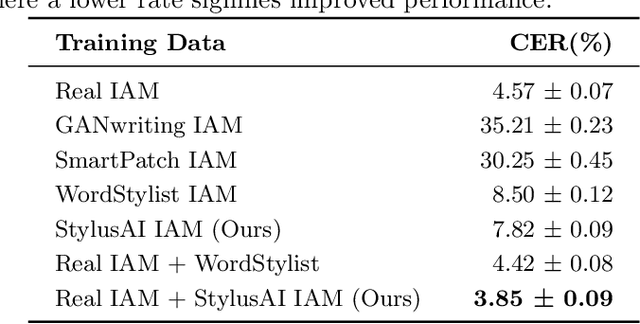
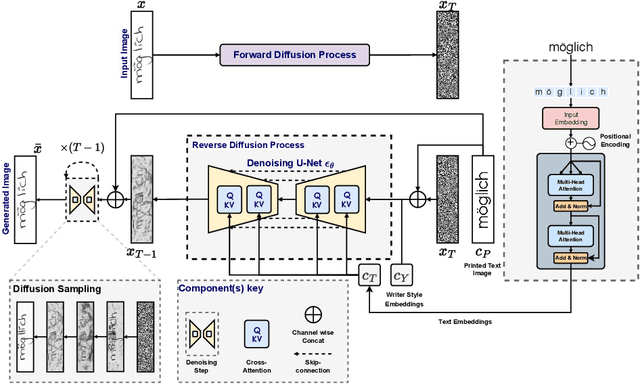
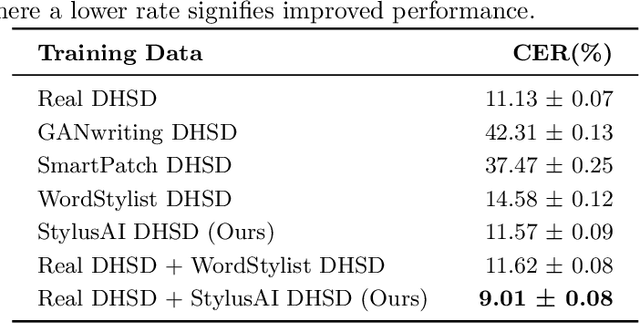
In this study, we introduce StylusAI, a novel architecture leveraging diffusion models in the domain of handwriting style generation. StylusAI is specifically designed to adapt and integrate the stylistic nuances of one language's handwriting into another, particularly focusing on blending English handwriting styles into the context of the German writing system. This approach enables the generation of German text in English handwriting styles and German handwriting styles into English, enriching machine-generated handwriting diversity while ensuring that the generated text remains legible across both languages. To support the development and evaluation of StylusAI, we present the \lq{Deutscher Handschriften-Datensatz}\rq~(DHSD), a comprehensive dataset encompassing 37 distinct handwriting styles within the German language. This dataset provides a fundamental resource for training and benchmarking in the realm of handwritten text generation. Our results demonstrate that StylusAI not only introduces a new method for style adaptation in handwritten text generation but also surpasses existing models in generating handwriting samples that improve both text quality and stylistic fidelity, evidenced by its performance on the IAM database and our newly proposed DHSD. Thus, StylusAI represents a significant advancement in the field of handwriting style generation, offering promising avenues for future research and applications in cross-linguistic style adaptation for languages with similar scripts.