 Add to Chrome
 Add to Firefox
 Add to Edge
FocusSDF: Boundary-Aware Learning for Medical Image Segmentation via Signed Distance Supervision
Nov 14, 2025
Segmentation of medical images constitutes an essential component of medical image analysis, providing the foundation for precise diagnosis and efficient therapeutic interventions in clinical practices. Despite substantial progress, most segmentation models do not explicitly encode boundary information; as a result, making boundary preservation a persistent challenge in medical image segmentation. To address this challenge, we introduce FocusSDF, a novel loss function based on the signed distance functions (SDFs), which redirects the network to concentrate on boundary regions by adaptively assigning higher weights to pixels closer to the lesion or organ boundary, effectively making it boundary aware. To rigorously validate FocusSDF, we perform extensive evaluations against five state-of-the-art medical image segmentation models, including the foundation model MedSAM, using four distance-based loss functions across diverse datasets covering cerebral aneurysm, stroke, liver, and breast tumor segmentation tasks spanning multiple imaging modalities. The experimental results consistently demonstrate the superior performance of FocusSDF over existing distance transform based loss functions.

HazeSpace2M: A Dataset for Haze Aware Single Image Dehazing
Sep 25, 2024
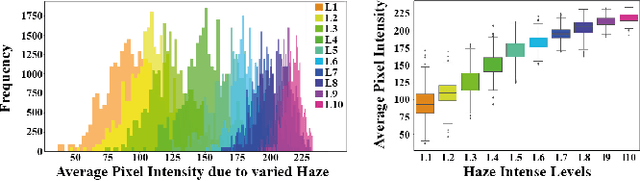
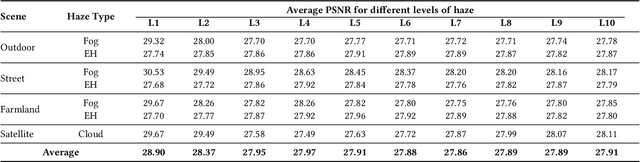
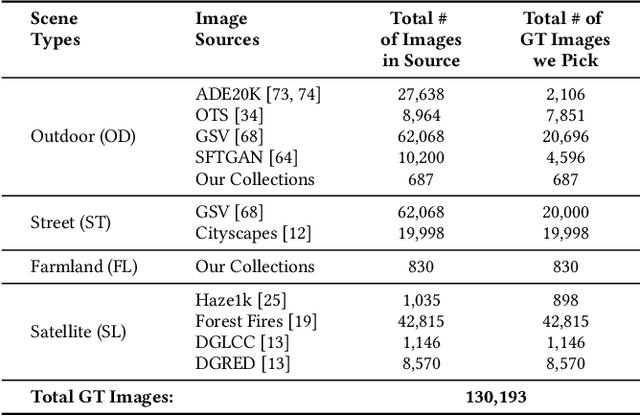
Reducing the atmospheric haze and enhancing image clarity is crucial for computer vision applications. The lack of real-life hazy ground truth images necessitates synthetic datasets, which often lack diverse haze types, impeding effective haze type classification and dehazing algorithm selection. This research introduces the HazeSpace2M dataset, a collection of over 2 million images designed to enhance dehazing through haze type classification. HazeSpace2M includes diverse scenes with 10 haze intensity levels, featuring Fog, Cloud, and Environmental Haze (EH). Using the dataset, we introduce a technique of haze type classification followed by specialized dehazers to clear hazy images. Unlike conventional methods, our approach classifies haze types before applying type-specific dehazing, improving clarity in real-life hazy images. Benchmarking with state-of-the-art (SOTA) models, ResNet50 and AlexNet achieve 92.75\% and 92.50\% accuracy, respectively, against existing synthetic datasets. However, these models achieve only 80% and 70% accuracy, respectively, against our Real Hazy Testset (RHT), highlighting the challenging nature of our HazeSpace2M dataset. Additional experiments show that haze type classification followed by specialized dehazing improves results by 2.41% in PSNR, 17.14% in SSIM, and 10.2\% in MSE over general dehazers. Moreover, when testing with SOTA dehazing models, we found that applying our proposed framework significantly improves their performance. These results underscore the significance of HazeSpace2M and our proposed framework in addressing atmospheric haze in multimedia processing. Complete code and dataset is available on \href{https://github.com/tanvirnwu/HazeSpace2M} {\textcolor{blue}{\textbf{GitHub}}}.
* Accepted by ACM Multimedia 2024