 Add to Chrome
 Add to Firefox
 Add to Edge
Exploring Extrinsic and Intrinsic Properties for Effective Reasoning with Code Interpreter
Jun 15, 2026
Reasoning with a Code Interpreter (CI) has emerged as an effective paradigm for enhancing the reasoning capabilities of large language models (LLMs) through executable computation and iterative verification. Despite its growing adoption, the behavioral properties underlying effective code reasoning remain largely underexplored. In this work, we investigate code reasoning from two distinct perspectives inspired by prior studies of natural language reasoning: extrinsic properties, represented by crucial tokens, and intrinsic properties, represented by code-specific cognitive behaviors. Across multiple LLMs, we find that stronger CI reasoning models consistently exhibit a higher prevalence of crucial tokens and cognitive behaviors, particularly verification, backtracking, and backward chaining. Building on these observations, we examine how these properties can be leveraged during both inference and training. At inference time, appending code-specific crucial tokens improves performance on several reasoning capabilities, including mathematical, ordering, and optimization, while yielding limited benefits elsewhere. At training time, augmenting a state-of-the-art framework with code-specific cognitive behaviors improves supervised fine-tuning and reinforcement learning performance in two of three evaluated models. Further analysis shows that these behaviors reduce overthinking in incorrect responses and improve token efficiency, while also revealing factors that limit gains in a certain model. Our findings provide the first systematic characterization of effective reasoning with CI and demonstrate both the potential and limitations of leveraging key properties to improve CI-based reasoning.

Mitigating Language Bias in Cross-Lingual Job Retrieval: A Recruitment Platform Perspective
Feb 05, 2025Understanding the textual components of resumes and job postings is critical for improving job-matching accuracy and optimizing job search systems in online recruitment platforms. However, existing works primarily focus on analyzing individual components within this information, requiring multiple specialized tools to analyze each aspect. Such disjointed methods could potentially hinder overall generalizability in recruitment-related text processing. Therefore, we propose a unified sentence encoder that utilized multi-task dual-encoder framework for jointly learning multiple component into the unified sentence encoder. The results show that our method outperforms other state-of-the-art models, despite its smaller model size. Moreover, we propose a novel metric, Language Bias Kullback-Leibler Divergence (LBKL), to evaluate language bias in the encoder, demonstrating significant bias reduction and superior cross-lingual performance.
Learning Job Title Representation from Job Description Aggregation Network
Jun 12, 2024
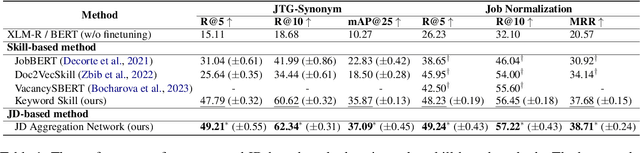
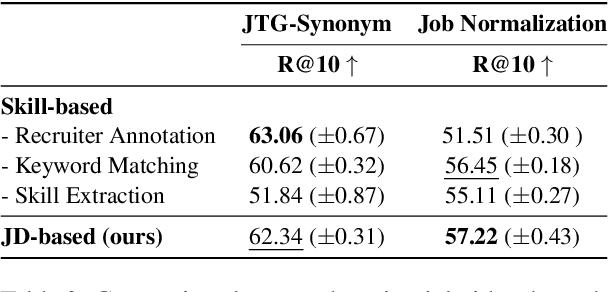
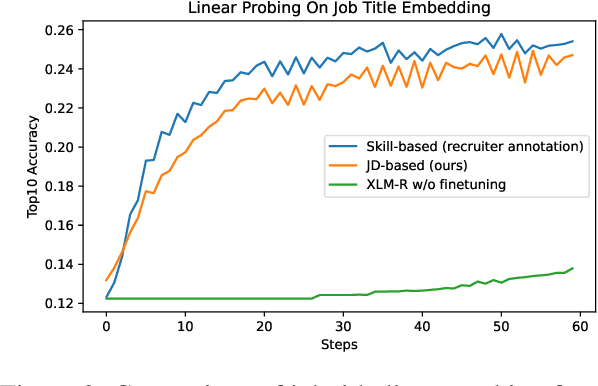
Learning job title representation is a vital process for developing automatic human resource tools. To do so, existing methods primarily rely on learning the title representation through skills extracted from the job description, neglecting the rich and diverse content within. Thus, we propose an alternative framework for learning job titles through their respective job description (JD) and utilize a Job Description Aggregator component to handle the lengthy description and bidirectional contrastive loss to account for the bidirectional relationship between the job title and its description. We evaluated the performance of our method on both in-domain and out-of-domain settings, achieving a superior performance over the skill-based approach.