 Add to Chrome
 Add to Firefox
 Add to Edge
Parameter estimation in softmax decision-making models with linear objective functions
Aug 29, 2015
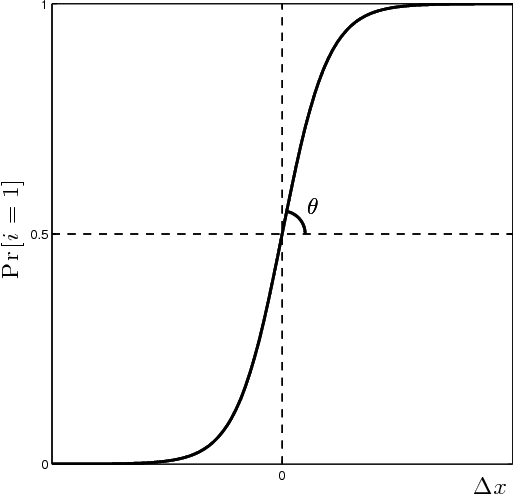
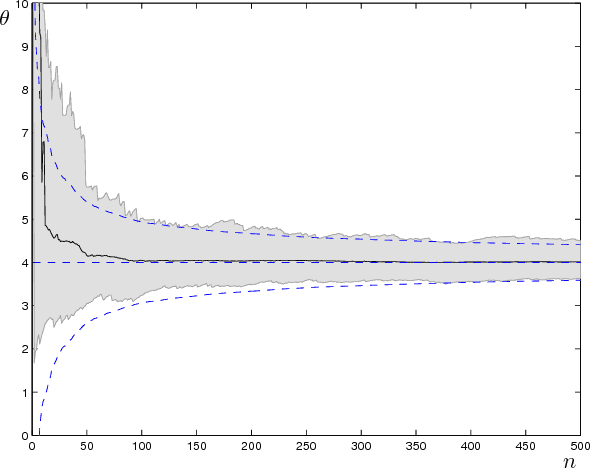
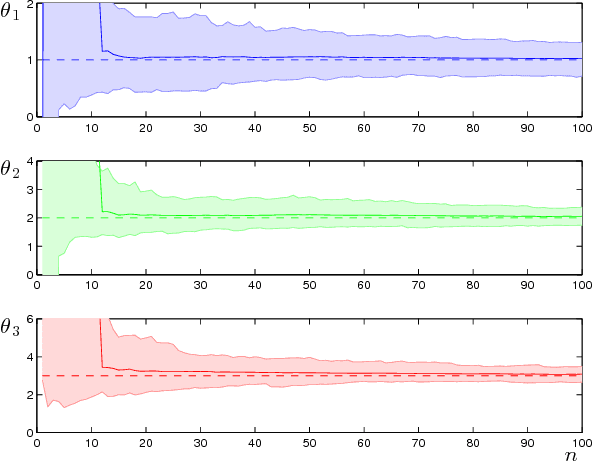
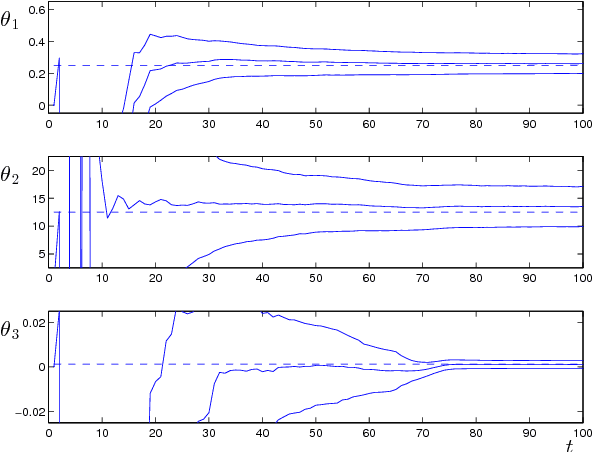
With an eye towards human-centered automation, we contribute to the development of a systematic means to infer features of human decision-making from behavioral data. Motivated by the common use of softmax selection in models of human decision-making, we study the maximum likelihood parameter estimation problem for softmax decision-making models with linear objective functions. We present conditions under which the likelihood function is convex. These allow us to provide sufficient conditions for convergence of the resulting maximum likelihood estimator and to construct its asymptotic distribution. In the case of models with nonlinear objective functions, we show how the estimator can be applied by linearizing about a nominal parameter value. We apply the estimator to fit the stochastic UCL (Upper Credible Limit) model of human decision-making to human subject data. We show statistically significant differences in behavior across related, but distinct, tasks.

Modeling Human Decision-making in Generalized Gaussian Multi-armed Bandits
Feb 14, 2014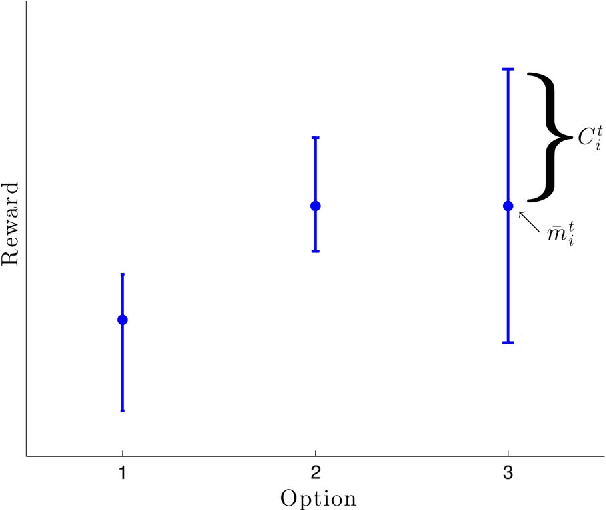
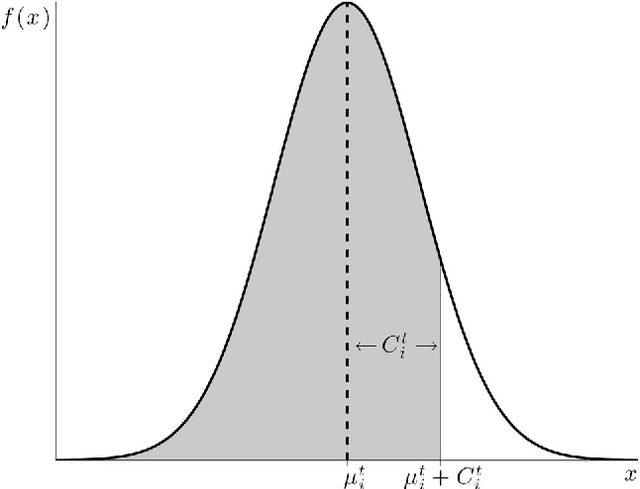
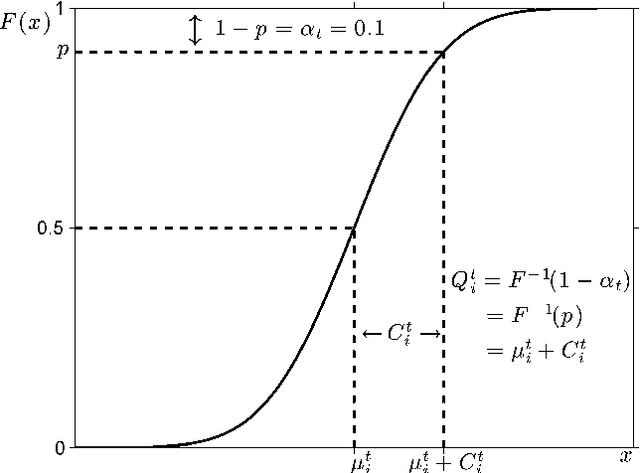
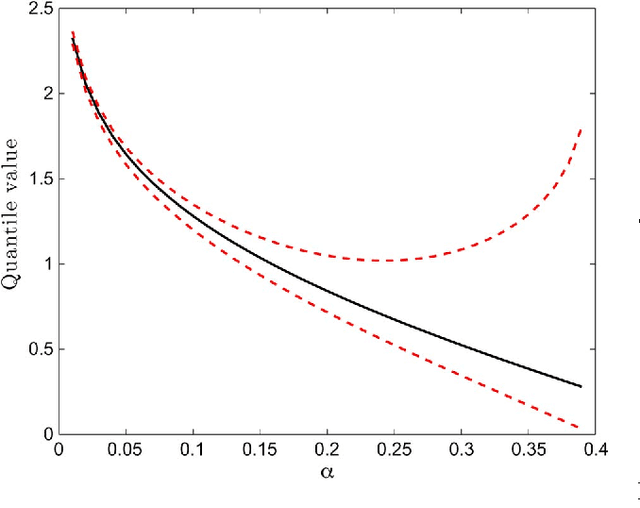
We present a formal model of human decision-making in explore-exploit tasks using the context of multi-armed bandit problems, where the decision-maker must choose among multiple options with uncertain rewards. We address the standard multi-armed bandit problem, the multi-armed bandit problem with transition costs, and the multi-armed bandit problem on graphs. We focus on the case of Gaussian rewards in a setting where the decision-maker uses Bayesian inference to estimate the reward values. We model the decision-maker's prior knowledge with the Bayesian prior on the mean reward. We develop the upper credible limit (UCL) algorithm for the standard multi-armed bandit problem and show that this deterministic algorithm achieves logarithmic cumulative expected regret, which is optimal performance for uninformative priors. We show how good priors and good assumptions on the correlation structure among arms can greatly enhance decision-making performance, even over short time horizons. We extend to the stochastic UCL algorithm and draw several connections to human decision-making behavior. We present empirical data from human experiments and show that human performance is efficiently captured by the stochastic UCL algorithm with appropriate parameters. For the multi-armed bandit problem with transition costs and the multi-armed bandit problem on graphs, we generalize the UCL algorithm to the block UCL algorithm and the graphical block UCL algorithm, respectively. We show that these algorithms also achieve logarithmic cumulative expected regret and require a sub-logarithmic expected number of transitions among arms. We further illustrate the performance of these algorithms with numerical examples.