 Add to Chrome
 Add to Firefox
 Add to Edge
AD-CARE: A Guideline-grounded, Modality-agnostic LLM Agent for Real-world Alzheimer's Disease Diagnosis with Multi-cohort Assessment, Fairness Analysis, and Reader Study
Mar 26, 2026
Alzheimer's disease (AD) is a growing global health challenge as populations age, and timely, accurate diagnosis is essential to reduce individual and societal burden. However, real-world AD assessment is hampered by incomplete, heterogeneous multimodal data and variability across sites and patient demographics. Although large language models (LLMs) have shown promise in biomedicine, their use in AD has largely been confined to answering narrow, disease-specific questions rather than generating comprehensive diagnostic reports that support clinical decision-making. Here we expand LLM capabilities for clinical decision support by introducing AD-CARE, a modality-agnostic agent that performs guideline-grounded diagnostic assessment from incomplete, heterogeneous inputs without imputing missing modalities. By dynamically orchestrating specialized diagnostic tools and embedding clinical guidelines into LLM-driven reasoning, AD-CARE generates transparent, report-style outputs aligned with real-world clinical workflows. Across six cohorts comprising 10,303 cases, AD-CARE achieved 84.9% diagnostic accuracy, delivering 4.2%-13.7% relative improvements over baseline methods. Despite cohort-level differences, dataset-specific accuracies remain robust (80.4%-98.8%), and the agent consistently outperforms all baselines. AD-CARE reduced performance disparities across racial and age subgroups, decreasing the average dispersion of four metrics by 21%-68% and 28%-51%, respectively. In a controlled reader study, the agent improved neurologist and radiologist accuracy by 6%-11% and more than halved decision time. The framework yielded 2.29%-10.66% absolute gains over eight backbone LLMs and converges their performance. These results show that AD-CARE is a scalable, practically deployable framework that can be integrated into routine clinical workflows for multimodal decision support in AD.

Medical Knowledge Intervention Prompt Tuning for Medical Image Classification
Nov 16, 2025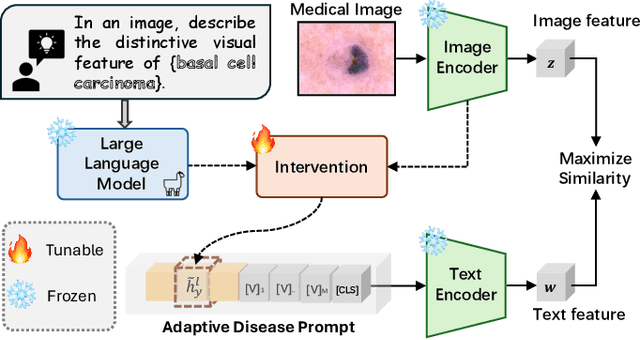
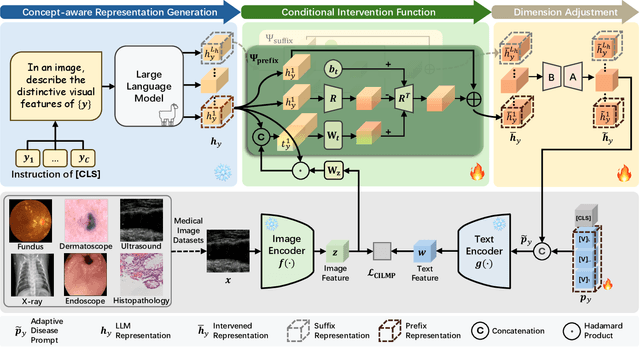
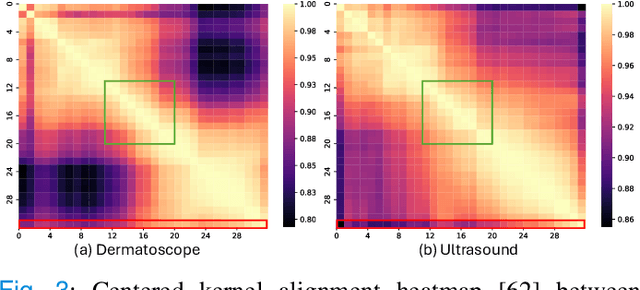
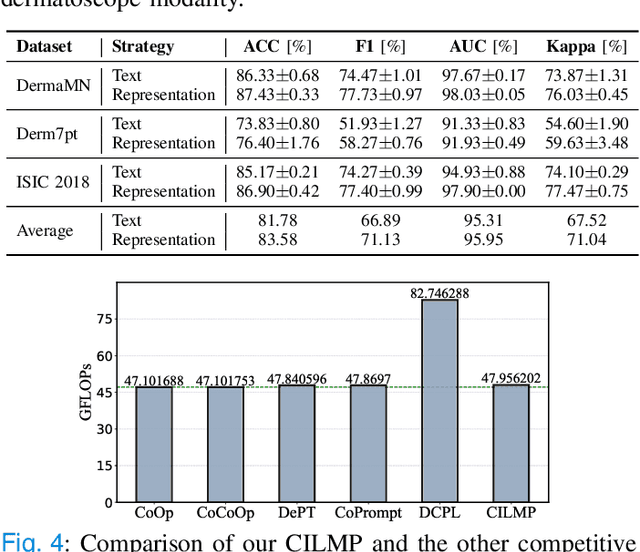
Vision-language foundation models (VLMs) have shown great potential in feature transfer and generalization across a wide spectrum of medical-related downstream tasks. However, fine-tuning these models is resource-intensive due to their large number of parameters. Prompt tuning has emerged as a viable solution to mitigate memory usage and reduce training time while maintaining competitive performance. Nevertheless, the challenge is that existing prompt tuning methods cannot precisely distinguish different kinds of medical concepts, which miss essentially specific disease-related features across various medical imaging modalities in medical image classification tasks. We find that Large Language Models (LLMs), trained on extensive text corpora, are particularly adept at providing this specialized medical knowledge. Motivated by this, we propose incorporating LLMs into the prompt tuning process. Specifically, we introduce the CILMP, Conditional Intervention of Large Language Models for Prompt Tuning, a method that bridges LLMs and VLMs to facilitate the transfer of medical knowledge into VLM prompts. CILMP extracts disease-specific representations from LLMs, intervenes within a low-rank linear subspace, and utilizes them to create disease-specific prompts. Additionally, a conditional mechanism is incorporated to condition the intervention process on each individual medical image, generating instance-adaptive prompts and thus enhancing adaptability. Extensive experiments across diverse medical image datasets demonstrate that CILMP consistently outperforms state-of-the-art prompt tuning methods, demonstrating its effectiveness. Code is available at https://github.com/usr922/cilmp.