 Add to Chrome
 Add to Firefox
 Add to Edge
LOGOS: LiDAR-Only Gaussian Elevation Splatting for Unified Tiny Obstacle Segmentation
Jun 19, 2026
Robust obstacle segmentation is essential for the safety of intelligent robots, where LiDAR-based perception systems play a fundamental role in the robot-environment interaction. While extensive LiDAR-based approaches have demonstrated high performance on common obstacles in urban scenarios, their results on tiny obstacles such as curbs, gravel, and potholes remain unsatisfactory due to the significant similarity between tiny obstacles and inherent road undulations. Moreover, their segmentation accuracy even deteriorates sharply when the LiDAR scans suffer from degradation in challenging off-road scenes. To overcome these bottlenecks, we propose LOGOS, a LiDAR-only unified tiny obstacle segmentation system, which models the road surface as a continuous mixture of 2D Gaussian primitives and distinguishes tiny obstacles via high-presicion elevation estimation. Unlike existing Gaussian splatting methods that rely on iterative RGB training, LOGOS is a backpropagation-free LiDAR-only approach. It directly estimates Gaussian parameters via a freespace-aware initialization by incrementally pruning non-road primitives using smoothness constraints. Subsequently, pointwise signed distances are computed via a novel normal-aware elevation splatting function, ensuring robustness to both flat and sloped terrains. We evaluate LOGOS on a highly heterogeneous benchmark of point cloud frames collected from urban mobility scenarios and mining haulage off-road environments. These data are practically acquired using different LiDAR sensors and exhibit large variations in point density, terrain roughness, and obstacle types. Experiments on the road and off-road scenes demonstrate that LOGOS significantly outperforms other state-of-the-art methods, particularly in degraded point cloud regions and challenging off-road scenarios, while maintaining real-time efficiency.

SDA-SNE: Spatial Discontinuity-Aware Surface Normal Estimation via Multi-Directional Dynamic Programming
Aug 18, 2022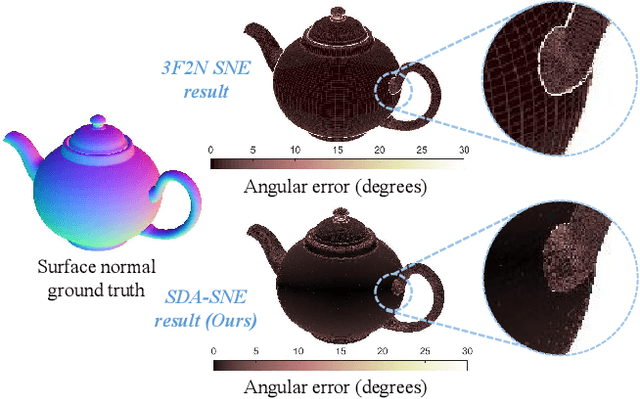
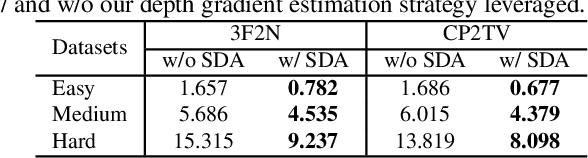
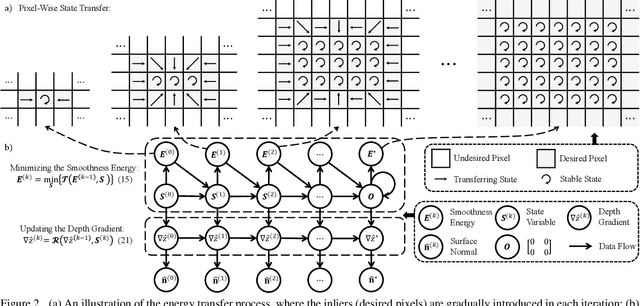
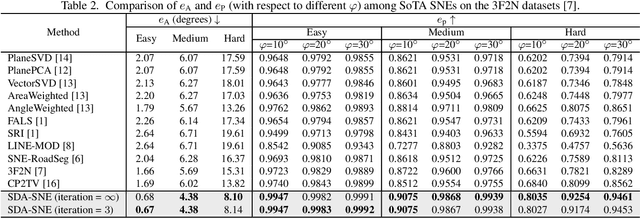
The state-of-the-art (SoTA) surface normal estimators (SNEs) generally translate depth images into surface normal maps in an end-to-end fashion. Although such SNEs have greatly minimized the trade-off between efficiency and accuracy, their performance on spatial discontinuities, e.g., edges and ridges, is still unsatisfactory. To address this issue, this paper first introduces a novel multi-directional dynamic programming strategy to adaptively determine inliers (co-planar 3D points) by minimizing a (path) smoothness energy. The depth gradients can then be refined iteratively using a novel recursive polynomial interpolation algorithm, which helps yield more reasonable surface normals. Our introduced spatial discontinuity-aware (SDA) depth gradient refinement strategy is compatible with any depth-to-normal SNEs. Our proposed SDA-SNE achieves much greater performance than all other SoTA approaches, especially near/on spatial discontinuities. We further evaluate the performance of SDA-SNE with respect to different iterations, and the results suggest that it converges fast after only a few iterations. This ensures its high efficiency in various robotics and computer vision applications requiring real-time performance. Additional experiments on the datasets with different extents of random noise further validate our SDA-SNE's robustness and environmental adaptability. Our source code, demo video, and supplementary material are publicly available at mias.group/SDA-SNE.