 Add to Chrome
 Add to Firefox
 Add to Edge
PLeDO: Pain Level Detection for Osteoarthritis from EMR Data
Aug 16, 2026
Osteoarthritis (OA) is a progressive chronic joint disease resulting in a breakdown of articular cartilage and bone when damaged joint tissues are not able to normally repair themselves. The aim of this pilot research study is to understand the pain severity for OA from patients' primary care Electronic Medical Records (EMR), both from the structured medical data and the unstructured chart note data using information extraction, natural language processing and machine learning techniques. We propose SPaDe, a Synonym-based Pain level Detection tool to categorize patients into having mild or moderate-to-severe pain to understand diagnosis and treatment methods based on only the pain related expressions in the unstructured chart note. Expressions are subjective, objective, and influenced by cultural background and demography which poses a difficult challenge. Therefore, we improve the model by incorporating the medication information from the structured EMR data and pain scale related information from the chart note to propose an integrated pain level detection tool for OA called PLeDO. With the help of human labeled gold standard data, we demonstrate that both SPaDe and PLeDO can detect mild and moderate-to-severe pain from the EMR data to analyze and potentially improve the quality of care in primary care setting.
* Published in Intelligent Data Analysis, 2026

Interpreting Biomedical VLMs on High-Imbalance Out-of-Distributions: An Insight into BiomedCLIP on Radiology
Jun 17, 2025
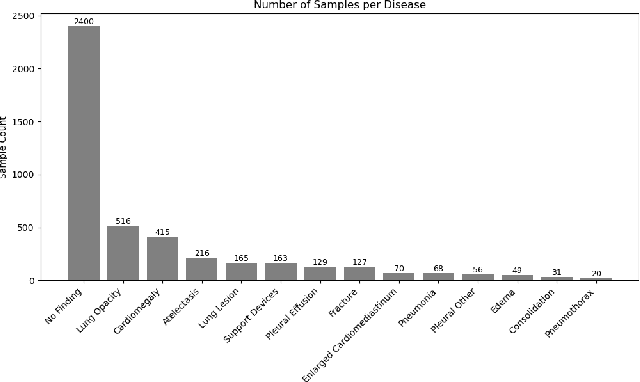
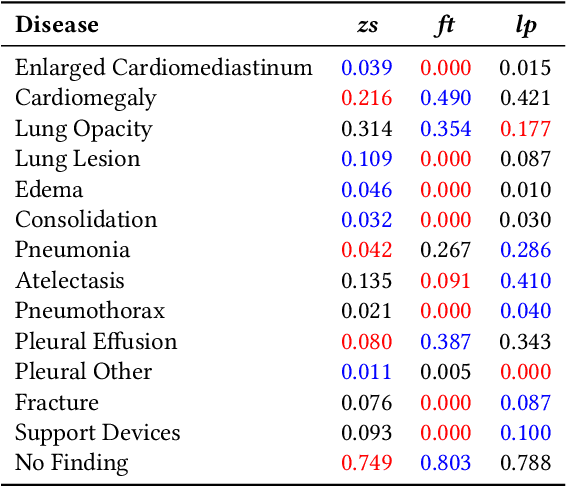
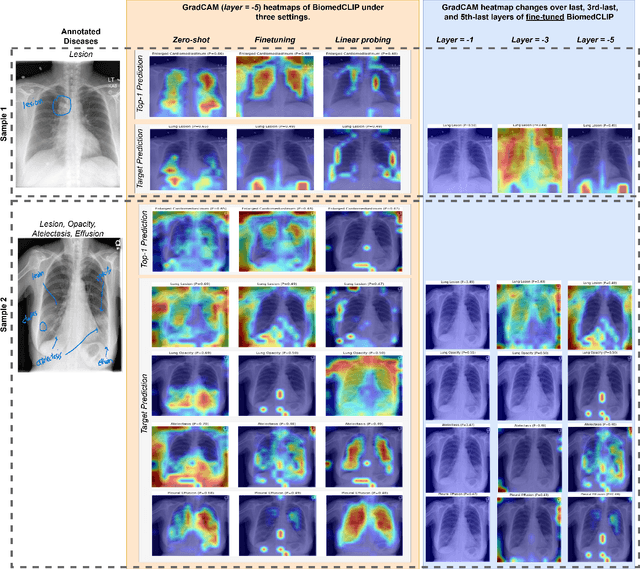
In this paper, we construct two research objectives: i) explore the learned embedding space of BiomedCLIP, an open-source large vision language model, to analyse meaningful class separations, and ii) quantify the limitations of BiomedCLIP when applied to a highly imbalanced, out-of-distribution multi-label medical dataset. We experiment on IU-xray dataset, which exhibits the aforementioned criteria, and evaluate BiomedCLIP in classifying images (radiographs) in three contexts: zero-shot inference, full finetuning, and linear probing. The results show that the model under zero-shot settings over-predicts all labels, leading to poor precision and inter-class separability. Full fine-tuning improves classification of distinct diseases, while linear probing detects overlapping features. We demonstrate visual understanding of the model using Grad-CAM heatmaps and compare with 15 annotations by a radiologist. We highlight the need for careful adaptations of the models to foster reliability and applicability in a real-world setting. The code for the experiments in this work is available and maintained on GitHub.