 Add to Chrome
 Add to Firefox
 Add to Edge
ENCORE: Efficient Noise Context-Aware Representation for Low-Dose CT Denoising
Aug 11, 2026
While deep learning-based denoising has become widely adopted in low-dose CT, conventional models use generic architectures designed for natural images, failing to account for non-stationary and spatially correlated CT noise characteristics. To address this, we propose an Efficient Noise COntext-aware REpresentation (ENCORE) framework that explicitly leverages CT noise characteristics and anatomical features. First, we reformulate the noise synthesis procedure based on a realistic noise distribution beyond the conventional Gaussian approximation, establishing a rigorous foundation for training pair generation. Next, we extract local noise power and correlation contexts to guide the denoising process. To fully leverage the potential of noise context, we propose a FlyingConv module, which adaptively changes convolution weights for each local image region. Notably, our approach demonstrates substantial gains in both denoising quality and computational efficiency. Furthermore, manipulating the intensity of the noise context maps at inference time enables zero-shot conditional denoising, allowing for dynamic control over the output image texture. The entire pipeline is available at https://github.com/minwoo-yu/ENCORE.git

An Analysis of Scatter Characteristics in X-ray CT Spectral Correction
Dec 30, 2020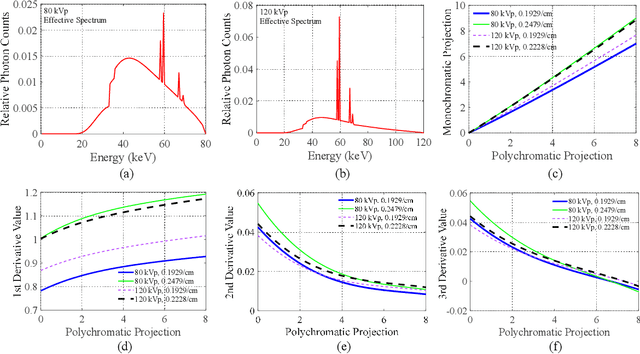
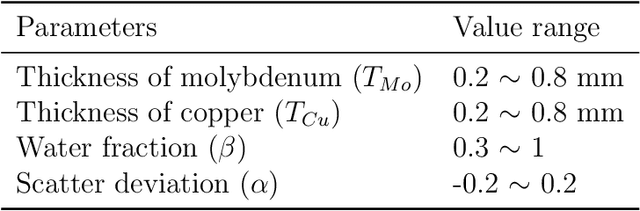
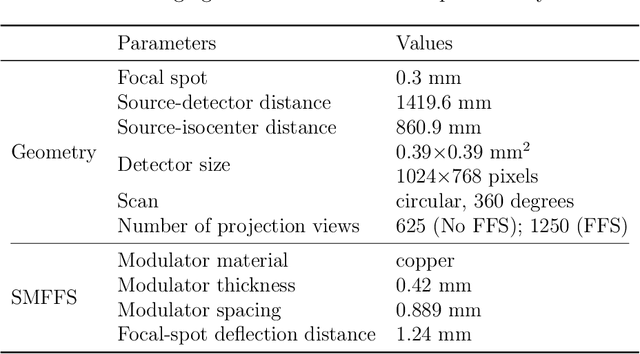
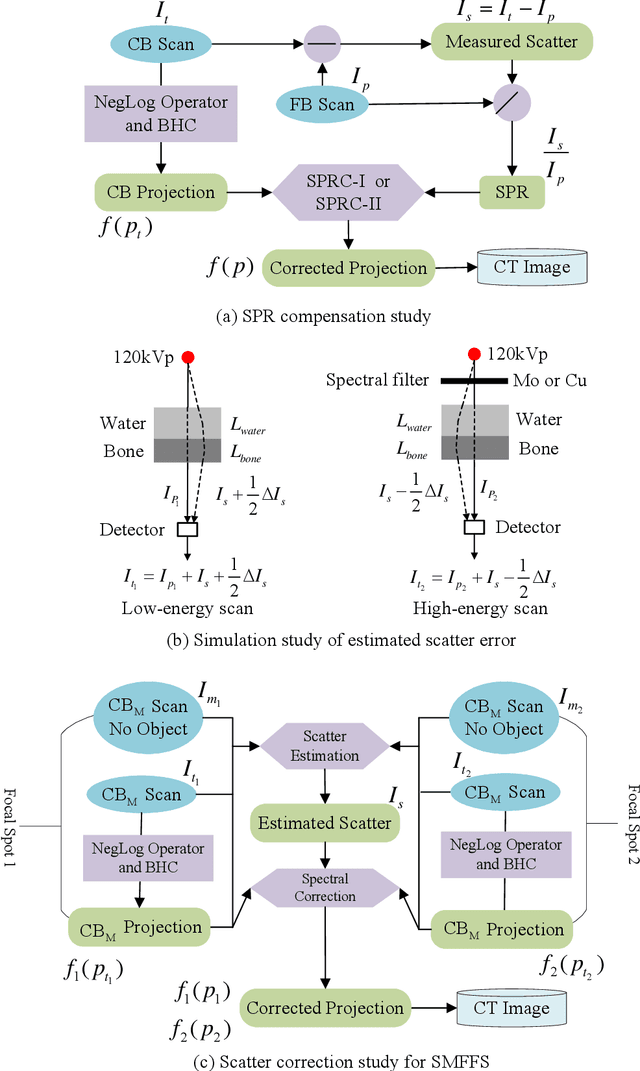
X-ray scatter remains a major physics challenge in volumetric computed tomography (CT), whose physical and statistical behaviors have been commonly leveraged in order to eliminate its impact on CT image quality. In this work, we conduct an in-depth derivation of how the scatter distribution and scatter to primary ratio (SPR) will change during the spectral correction, leading to an interesting finding on the property of scatter: when applying the spectral correction before scatter is removed, the impact of SPR on a CT projection will be scaled by the first derivative of the mapping function; while the scatter distribution in the transmission domain will be scaled by the product of the first derivative of the mapping function and a natural exponential of the projection difference before and after the mapping. Such a characterization of scatter's behavior provides an analytic approach of compensating for the SPR as well as approximating the change of scatter distribution after spectral correction, even though both of them might be significantly distorted as the linearization mapping function in spectral correction could vary a lot from one detector pixel to another. We conduct an evaluation of SPR compensations on a Catphan phantom and an anthropomorphic chest phantom to validate the characteristics of scatter. In addition, this scatter property is also directly adopted into CT imaging using a spectral modulator with flying focal spot technology (SMFFS) as an example to demonstrate its potential in practical applications.