 Add to Chrome
 Add to Firefox
 Add to Edge
PointAction: 3D Points as Universal Action Representations for Robot Control
Jun 02, 2026
Video-Action Models (VAMs) leverage the broad visual dynamics captured by pre-trained video diffusion models, offering a promising path toward generalizable robot manipulation. However, RGB-only video rollouts are not directly actionable: they leave metric 3D motion, contact geometry, and fine-grained spatial constraints under-specified, making action grounding ambiguous. Meanwhile, scaling action supervision across diverse tasks and embodiments remains costly. We present PointAction, a framework that bridges video predictions to robot actions through explicit point-based 4D modeling. PointAction fine-tunes a foundation video generation model to jointly predict future RGB frames and dynamic 3D pointmaps, producing temporally consistent 3D motion of task-relevant scene geometry. These point dynamics serve as a structured, embodiment-agnostic action interface, which a diffusion-based action decoder maps to executable robot actions. By using metric 3D point dynamics as the interface between video prediction and control, PointAction reduces the ambiguity of RGB-only action grounding and supports transfer across tasks and embodiments with limited action supervision. Experiments show that PointAction achieves state-of-the-art 4D generation quality on robot scenes, outperforms existing baselines in simulation, and generalizes to two real robot arms unseen during pretraining.

Spatiotemporally Consistent Indoor Lighting Estimation with Diffusion Priors
Aug 11, 2025
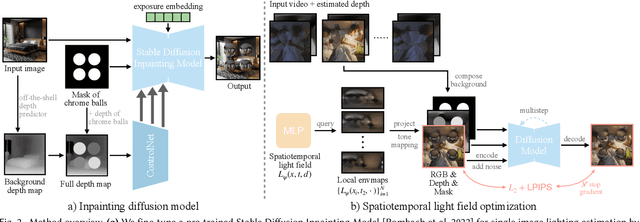
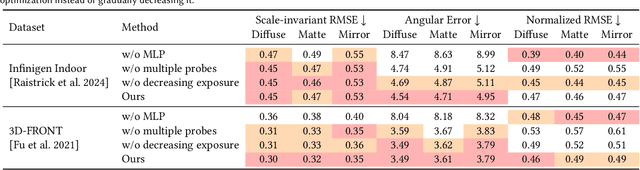
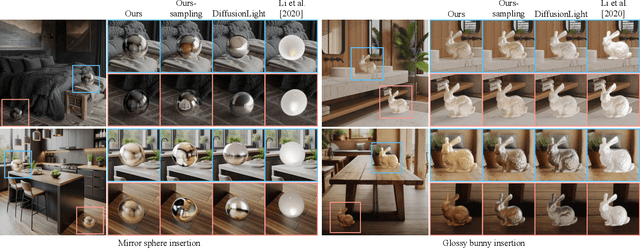
Indoor lighting estimation from a single image or video remains a challenge due to its highly ill-posed nature, especially when the lighting condition of the scene varies spatially and temporally. We propose a method that estimates from an input video a continuous light field describing the spatiotemporally varying lighting of the scene. We leverage 2D diffusion priors for optimizing such light field represented as a MLP. To enable zero-shot generalization to in-the-wild scenes, we fine-tune a pre-trained image diffusion model to predict lighting at multiple locations by jointly inpainting multiple chrome balls as light probes. We evaluate our method on indoor lighting estimation from a single image or video and show superior performance over compared baselines. Most importantly, we highlight results on spatiotemporally consistent lighting estimation from in-the-wild videos, which is rarely demonstrated in previous works.
* 11 pages. Accepted by SIGGRAPH 2025 as Conference Paper