 Add to Chrome
 Add to Firefox
 Add to Edge
Impression Share Prediction: An Offline Evaluation Task for Ranking Systems
Aug 17, 2026
Offline evaluation is a major gateway before online evaluation of ranking models in A/B testing. Standard offline metrics measure predictive accuracy, but are only a surrogate for downstream utility: a model can improve them while redistributing impressions across objective buckets in ways that degrade downstream utility. No offline method surfaces these impression share shifts before online evaluation. We propose \emph{impression share prediction} as an offline evaluation task: given a candidate ranking model, predict the distribution of impressions it would produce across objective buckets - impressions grouped by optimization goal (e.g., click, video view). The task is inherently counterfactual, since the candidate has never served live traffic. We propose a structural causal model of how model predictions and delivery capacity jointly determine impression allocation, and show the counterfactual effect is identified from observational data. Building on this, we develop a statistical learning framework that predicts impression shares from a candidate's early-interaction confidence signals and current system state, trained on historical data. On data from multiple ranking model families, a Random Forest reduces L1 error by 49\% over a constant baseline for models seen during training. For held-out models, evaluated by time since first appearance, the first hour is the closest analog to true online evaluation and the hardest: the Random Forest falls below the baseline because the capacity state still reflects the prior model. An encoder-conditioned architecture that simulates a 2-hour rollout over recent auction dynamics recovers $+$22\% L1 in this regime.

Counterfactual Evaluation of Ads Ranking Models through Domain Adaptation
Sep 29, 2024We propose a domain-adapted reward model that works alongside an Offline A/B testing system for evaluating ranking models. This approach effectively measures reward for ranking model changes in large-scale Ads recommender systems, where model-free methods like IPS are not feasible. Our experiments demonstrate that the proposed technique outperforms both the vanilla IPS method and approaches using non-generalized reward models.
Causal Transfer Random Forest: Combining Logged Data and Randomized Experiments for Robust Prediction
Oct 17, 2020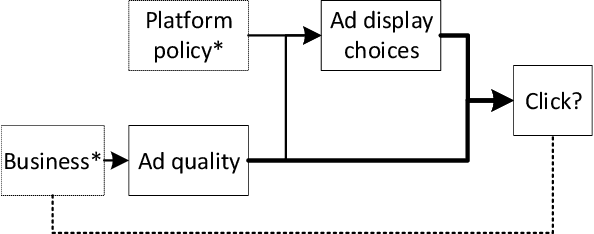
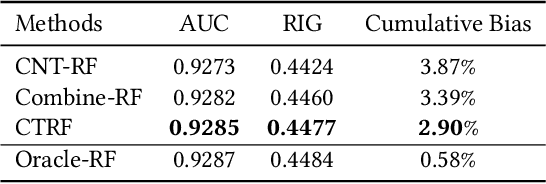
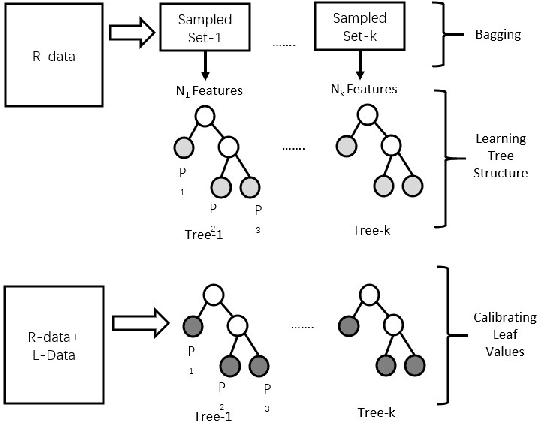
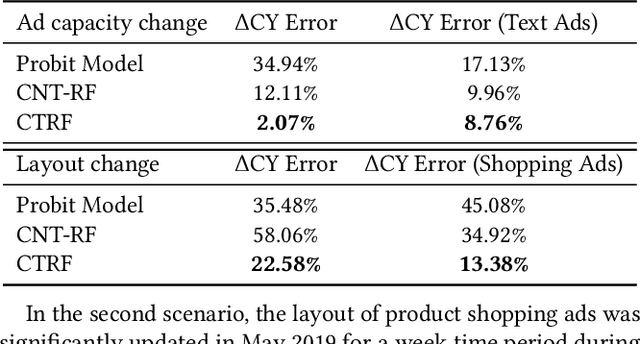
It is often critical for prediction models to be robust to distributional shifts between training and testing data. Viewed from a causal perspective, the challenge is to distinguish the stable causal relationships from the unstable spurious correlations across shifts. We describe a causal transfer random forest (CTRF) that combines existing training data with a small amount of data from a randomized experiment to train a model which is robust to the feature shifts and therefore transfers to a new targeting distribution. Theoretically, we justify the robustness of the approach against feature shifts with the knowledge from causal learning. Empirically, we evaluate the CTRF using both synthetic data experiments and real-world experiments in the Bing Ads platform, including a click prediction task and in the context of an end-to-end counterfactual optimization system. The proposed CTRF produces robust predictions and outperforms most baseline methods compared in the presence of feature shifts.
Causal Inference in the Presence of Interference in Sponsored Search Advertising
Oct 15, 2020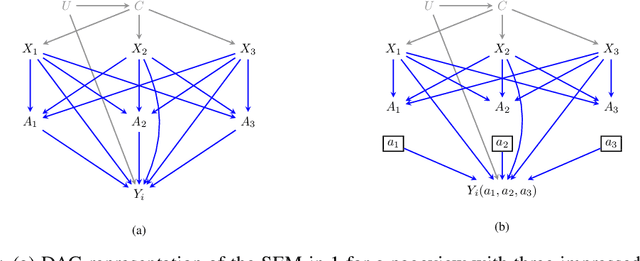

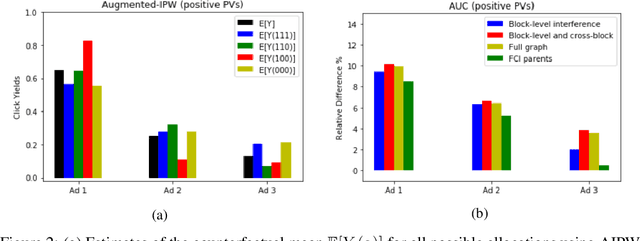
In classical causal inference, inferring cause-effect relations from data relies on the assumption that units are independent and identically distributed. This assumption is violated in settings where units are related through a network of dependencies. An example of such a setting is ad placement in sponsored search advertising, where the clickability of a particular ad is potentially influenced by where it is placed and where other ads are placed on the search result page. In such scenarios, confounding arises due to not only the individual ad-level covariates but also the placements and covariates of other ads in the system. In this paper, we leverage the language of causal inference in the presence of interference to model interactions among the ads. Quantification of such interactions allows us to better understand the click behavior of users, which in turn impacts the revenue of the host search engine and enhances user satisfaction. We illustrate the utility of our formalization through experiments carried out on the ad placement system of the Bing search engine.
Genie: An Open Box Counterfactual Policy Estimator for Optimizing Sponsored Search Marketplace
Aug 22, 2018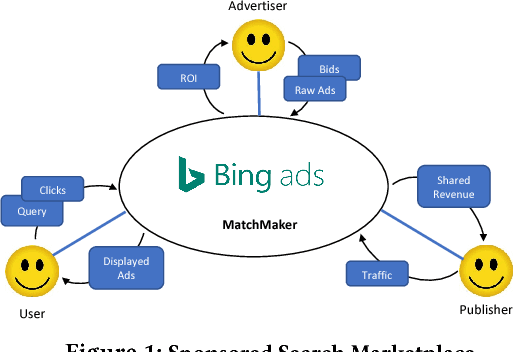
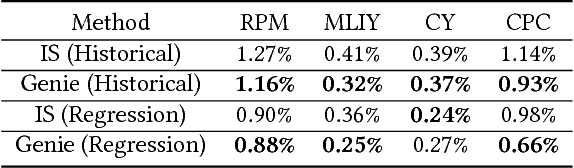
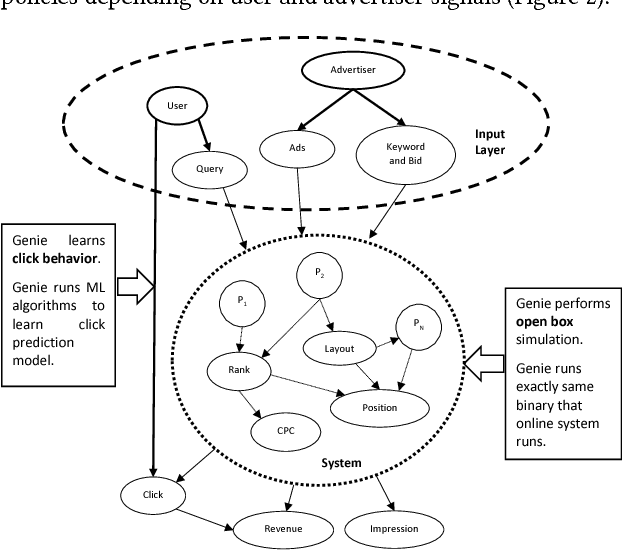
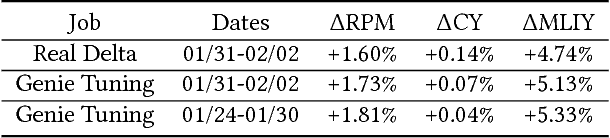
In this paper, we propose an offline counterfactual policy estimation framework called Genie to optimize Sponsored Search Marketplace. Genie employs an open box simulation engine with click calibration model to compute the KPI impact of any modification to the system. From the experimental results on Bing traffic, we showed that Genie performs better than existing observational approaches that employs randomized experiments for traffic slices that have frequent policy updates. We also show that Genie can be used to tune completely new policies efficiently without creating risky randomized experiments due to cold start problem. As time of today, Genie hosts more than 10000 optimization jobs yearly which runs more than 30 Million processing node hours of big data jobs for Bing Ads. For the last 3 years, Genie has been proven to be the one of the major platforms to optimize Bing Ads Marketplace due to its reliability under frequent policy changes and its efficiency to minimize risks in real experiments.