 Add to Chrome
 Add to Firefox
 Add to Edge
Safe Flow Q-Learning: Offline Safe Reinforcement Learning with Reachability-Based Flow Policies
Mar 16, 2026
Offline safe reinforcement learning (RL) seeks reward-maximizing policies from static datasets under strict safety constraints. Existing methods often rely on soft expected-cost objectives or iterative generative inference, which can be insufficient for safety-critical real-time control. We propose Safe Flow Q-Learning (SafeFQL), which extends FQL to safe offline RL by combining a Hamilton--Jacobi reachability-inspired safety value function with an efficient one-step flow policy. SafeFQL learns the safety value via a self-consistency Bellman recursion, trains a flow policy by behavioral cloning, and distills it into a one-step actor for reward-maximizing safe action selection without rejection sampling at deployment. To account for finite-data approximation error in the learned safety boundary, we add a conformal prediction calibration step that adjusts the safety threshold and provides finite-sample probabilistic safety coverage. Empirically, SafeFQL trades modestly higher offline training cost for substantially lower inference latency than diffusion-style safe generative baselines, which is advantageous for real-time safety-critical deployment. Across boat navigation, and Safety Gymnasium MuJoCo tasks, SafeFQL matches or exceeds prior offline safe RL performance while substantially reducing constraint violations.

Epigraph-Guided Flow Matching for Safe and Performant Offline Reinforcement Learning
Feb 08, 2026Offline reinforcement learning (RL) provides a compelling paradigm for training autonomous systems without the risks of online exploration, particularly in safety-critical domains. However, jointly achieving strong safety and performance from fixed datasets remains challenging. Existing safe offline RL methods often rely on soft constraints that allow violations, introduce excessive conservatism, or struggle to balance safety, reward optimization, and adherence to the data distribution. To address this, we propose Epigraph-Guided Flow Matching (EpiFlow), a framework that formulates safe offline RL as a state-constrained optimal control problem to co-optimize safety and performance. We learn a feasibility value function derived from an epigraph reformulation of the optimal control problem, thereby avoiding the decoupled objectives or post-hoc filtering common in prior work. Policies are synthesized by reweighting the behavior distribution based on this epigraph value function and fitting a generative policy via flow matching, enabling efficient, distribution-consistent sampling. Across various safety-critical tasks, including Safety-Gymnasium benchmarks, EpiFlow achieves competitive returns with near-zero empirical safety violations, demonstrating the effectiveness of epigraph-guided policy synthesis.
V-OCBF: Learning Safety Filters from Offline Data via Value-Guided Offline Control Barrier Functions
Dec 11, 2025Ensuring safety in autonomous systems requires controllers that satisfy hard, state-wise constraints without relying on online interaction. While existing Safe Offline RL methods typically enforce soft expected-cost constraints, they do not guarantee forward invariance. Conversely, Control Barrier Functions (CBFs) provide rigorous safety guarantees but usually depend on expert-designed barrier functions or full knowledge of the system dynamics. We introduce Value-Guided Offline Control Barrier Functions (V-OCBF), a framework that learns a neural CBF entirely from offline demonstrations. Unlike prior approaches, V-OCBF does not assume access to the dynamics model; instead, it derives a recursive finite-difference barrier update, enabling model-free learning of a barrier that propagates safety information over time. Moreover, V-OCBF incorporates an expectile-based objective that avoids querying the barrier on out-of-distribution actions and restricts updates to the dataset-supported action set. The learned barrier is then used with a Quadratic Program (QP) formulation to synthesize real-time safe control. Across multiple case studies, V-OCBF yields substantially fewer safety violations than baseline methods while maintaining strong task performance, highlighting its scalability for offline synthesis of safety-critical controllers without online interaction or hand-engineered barriers.
GenOSIL: Generalized Optimal and Safe Robot Control using Parameter-Conditioned Imitation Learning
Mar 15, 2025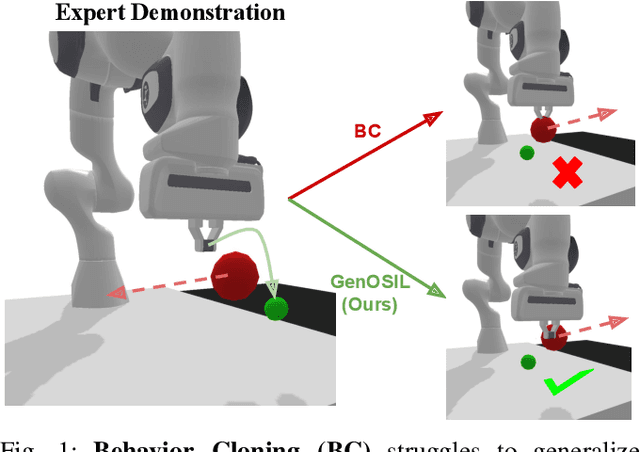
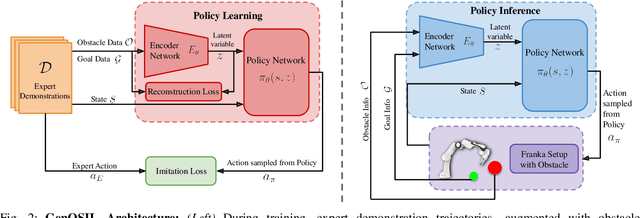
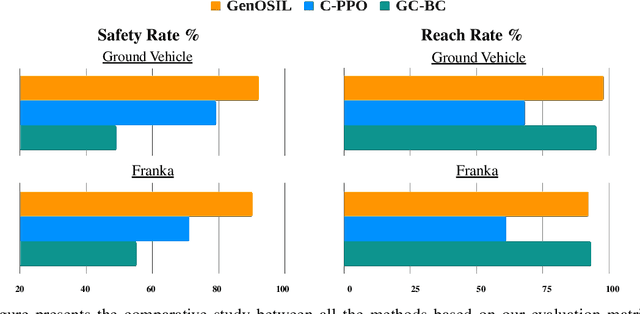
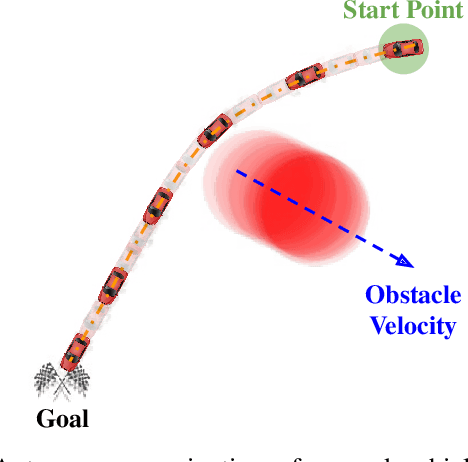
Ensuring safe and generalizable control remains a fundamental challenge in robotics, particularly when deploying imitation learning in dynamic environments. Traditional behavior cloning (BC) struggles to generalize beyond its training distribution, as it lacks an understanding of the safety critical reasoning behind expert demonstrations. To address this limitation, we propose GenOSIL, a novel imitation learning framework that explicitly incorporates environment parameters into policy learning via a structured latent representation. Unlike conventional methods that treat the environment as a black box, GenOSIL employs a variational autoencoder (VAE) to encode measurable safety parameters such as obstacle position, velocity, and geometry into a latent space that captures intrinsic correlations between expert behavior and environmental constraints. This enables the policy to infer the rationale behind expert trajectories rather than merely replicating them. We validate our approach on two robotic platforms an autonomous ground vehicle and a Franka Emika Panda manipulator demonstrating superior safety and goal reaching performance compared to baseline methods. The simulation and hardware videos can be viewed on the project webpage: https://mumukshtayal.github.io/GenOSIL/.