 Add to Chrome
 Add to Firefox
 Add to Edge
Ontological grounding for sound and natural robot explanations via large language models
Feb 14, 2026
Building effective human-robot interaction requires robots to derive conclusions from their experiences that are both logically sound and communicated in ways aligned with human expectations. This paper presents a hybrid framework that blends ontology-based reasoning with large language models (LLMs) to produce semantically grounded and natural robot explanations. Ontologies ensure logical consistency and domain grounding, while LLMs provide fluent, context-aware and adaptive language generation. The proposed method grounds data from human-robot experiences, enabling robots to reason about whether events are typical or atypical based on their properties. We integrate a state-of-the-art algorithm for retrieving and constructing static contrastive ontology-based narratives with an LLM agent that uses them to produce concise, clear, interactive explanations. The approach is validated through a laboratory study replicating an industrial collaborative task. Empirical results show significant improvements in the clarity and brevity of ontology-based narratives while preserving their semantic accuracy. Initial evaluations further demonstrate the system's ability to adapt explanations to user feedback. Overall, this work highlights the potential of ontology-LLM integration to advance explainable agency, and promote more transparent human-robot collaboration.

Faithful Counterfactual Visual Explanations (FCVE)
Jan 12, 2025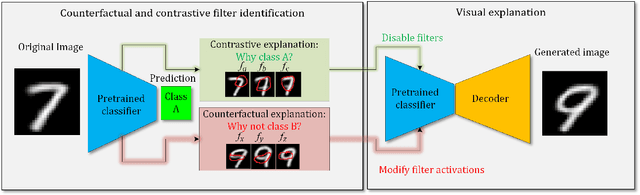



Deep learning models in computer vision have made remarkable progress, but their lack of transparency and interpretability remains a challenge. The development of explainable AI can enhance the understanding and performance of these models. However, existing techniques often struggle to provide convincing explanations that non-experts easily understand, and they cannot accurately identify models' intrinsic decision-making processes. To address these challenges, we propose to develop a counterfactual explanation (CE) model that balances plausibility and faithfulness. This model generates easy-to-understand visual explanations by making minimum changes necessary in images without altering the pixel data. Instead, the proposed method identifies internal concepts and filters learned by models and leverages them to produce plausible counterfactual explanations. The provided explanations reflect the internal decision-making process of the model, thus ensuring faithfulness to the model.
Classification of freshwater snails of the genus \emph{Radomaniola} with multimodal triplet networks
Jul 29, 2024In this paper, we present our first proposal of a machine learning system for the classification of freshwater snails of the genus \emph{Radomaniola}. We elaborate on the specific challenges encountered during system design, and how we tackled them; namely a small, very imbalanced dataset with a high number of classes and high visual similarity between classes. We then show how we employed triplet networks and the multiple input modalities of images, measurements, and genetic information to overcome these challenges and reach a performance comparable to that of a trained domain expert.