 Add to Chrome
 Add to Firefox
 Add to Edge
Ontological grounding for sound and natural robot explanations via large language models
Feb 14, 2026
Building effective human-robot interaction requires robots to derive conclusions from their experiences that are both logically sound and communicated in ways aligned with human expectations. This paper presents a hybrid framework that blends ontology-based reasoning with large language models (LLMs) to produce semantically grounded and natural robot explanations. Ontologies ensure logical consistency and domain grounding, while LLMs provide fluent, context-aware and adaptive language generation. The proposed method grounds data from human-robot experiences, enabling robots to reason about whether events are typical or atypical based on their properties. We integrate a state-of-the-art algorithm for retrieving and constructing static contrastive ontology-based narratives with an LLM agent that uses them to produce concise, clear, interactive explanations. The approach is validated through a laboratory study replicating an industrial collaborative task. Empirical results show significant improvements in the clarity and brevity of ontology-based narratives while preserving their semantic accuracy. Initial evaluations further demonstrate the system's ability to adapt explanations to user feedback. Overall, this work highlights the potential of ontology-LLM integration to advance explainable agency, and promote more transparent human-robot collaboration.

Ontological foundations for contrastive explanatory narration of robot plans
Sep 26, 2025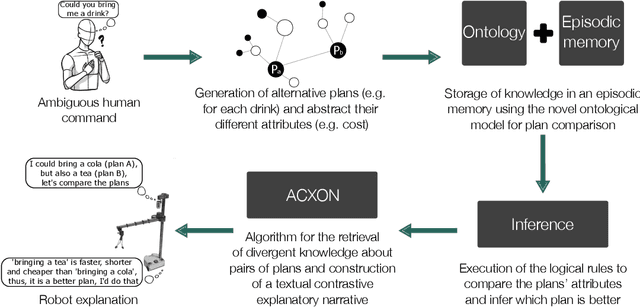
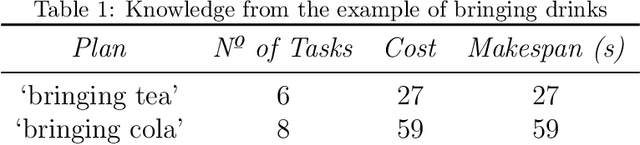
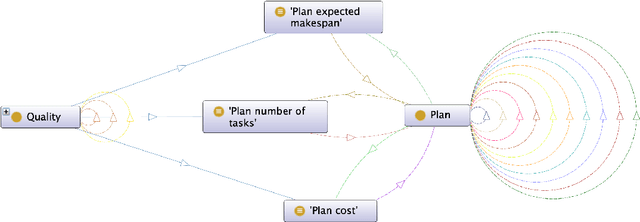
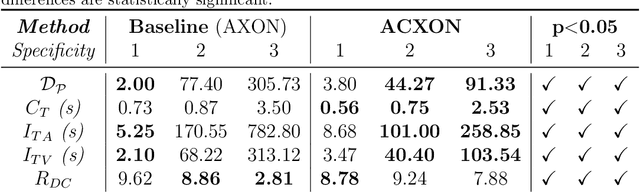
Mutual understanding of artificial agents' decisions is key to ensuring a trustworthy and successful human-robot interaction. Hence, robots are expected to make reasonable decisions and communicate them to humans when needed. In this article, the focus is on an approach to modeling and reasoning about the comparison of two competing plans, so that robots can later explain the divergent result. First, a novel ontological model is proposed to formalize and reason about the differences between competing plans, enabling the classification of the most appropriate one (e.g., the shortest, the safest, the closest to human preferences, etc.). This work also investigates the limitations of a baseline algorithm for ontology-based explanatory narration. To address these limitations, a novel algorithm is presented, leveraging divergent knowledge between plans and facilitating the construction of contrastive narratives. Through empirical evaluation, it is observed that the explanations excel beyond the baseline method.