 Add to Chrome
 Add to Firefox
 Add to Edge
ReConText3D: Replay-based Continual Text-to-3D Generation
Apr 15, 2026
Continual learning enables models to acquire new knowledge over time while retaining previously learned capabilities. However, its application to text-to-3D generation remains unexplored. We present ReConText3D, the first framework for continual text-to-3D generation. We first demonstrate that existing text-to-3D models suffer from catastrophic forgetting under incremental training. ReConText3D enables generative models to incrementally learn new 3D categories from textual descriptions while preserving the ability to synthesize previously seen assets. Our method constructs a compact and diverse replay memory through text-embedding k-Center selection, allowing representative rehearsal of prior knowledge without modifying the underlying architecture. To systematically evaluate continual text-to-3D learning, we introduce Toys4K-CL, a benchmark derived from the Toys4K dataset that provides balanced and semantically diverse class-incremental splits. Extensive experiments on the Toys4K-CL benchmark show that ReConText3D consistently outperforms all baselines across different generative backbones, maintaining high-quality generation for both old and new classes. To the best of our knowledge, this work establishes the first continual learning framework and benchmark for text-to-3D generation, opening a new direction for incremental 3D generative modeling. Project page is available at: https://mauk95.github.io/ReConText3D/.

EMF: Event Meta Formers for Event-based Real-time Traffic Object Detection
Apr 05, 2025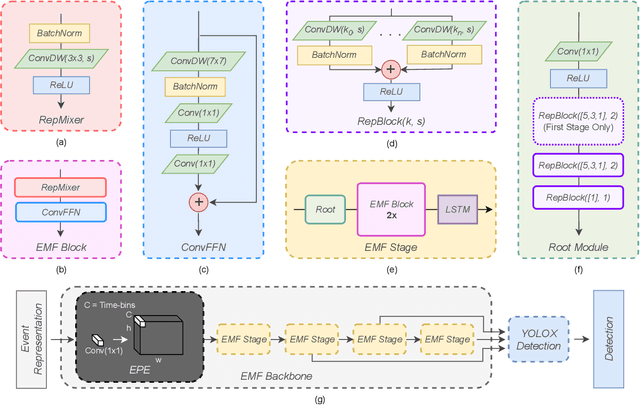
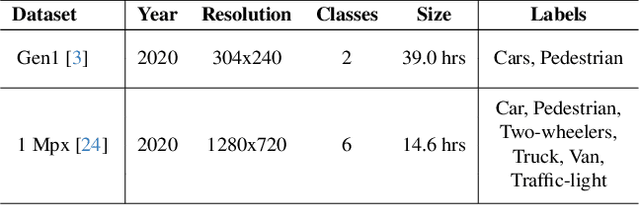
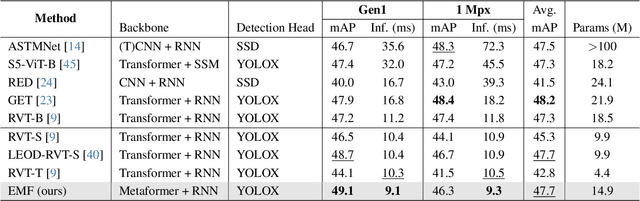
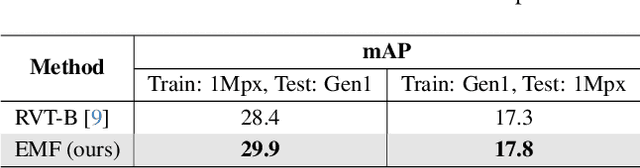
Event cameras have higher temporal resolution, and require less storage and bandwidth compared to traditional RGB cameras. However, due to relatively lagging performance of event-based approaches, event cameras have not yet replace traditional cameras in performance-critical applications like autonomous driving. Recent approaches in event-based object detection try to bridge this gap by employing computationally expensive transformer-based solutions. However, due to their resource-intensive components, these solutions fail to exploit the sparsity and higher temporal resolution of event cameras efficiently. Moreover, these solutions are adopted from the vision domain, lacking specificity to the event cameras. In this work, we explore efficient and performant alternatives to recurrent vision transformer models and propose a novel event-based object detection backbone. The proposed backbone employs a novel Event Progression Extractor module, tailored specifically for event data, and uses Metaformer concept with convolution-based efficient components. We evaluate the resultant model on well-established traffic object detection benchmarks and conduct cross-dataset evaluation to test its ability to generalize. The proposed model outperforms the state-of-the-art on Prophesee Gen1 dataset by 1.6 mAP while reducing inference time by 14%. Our proposed EMF becomes the fastest DNN-based architecture in the domain by outperforming most efficient event-based object detectors. Moreover, the proposed model shows better ability to generalize to unseen data and scales better with the abundance of data.
Continual Human Pose Estimation for Incremental Integration of Keypoints and Pose Variations
Sep 30, 2024This paper reformulates cross-dataset human pose estimation as a continual learning task, aiming to integrate new keypoints and pose variations into existing models without losing accuracy on previously learned datasets. We benchmark this formulation against established regularization-based methods for mitigating catastrophic forgetting, including EWC, LFL, and LwF. Moreover, we propose a novel regularization method called Importance-Weighted Distillation (IWD), which enhances conventional LwF by introducing a layer-wise distillation penalty and dynamic temperature adjustment based on layer importance for previously learned knowledge. This allows for a controlled adaptation to new tasks that respects the stability-plasticity balance critical in continual learning. Through extensive experiments across three datasets, we demonstrate that our approach outperforms existing regularization-based continual learning strategies. IWD shows an average improvement of 3.60\% over the state-of-the-art LwF method. The results highlight the potential of our method to serve as a robust framework for real-world applications where models must evolve with new data without forgetting past knowledge.