 Add to Chrome
 Add to Firefox
 Add to Edge
PersistentKV: Page-Aware Decode Scheduling for Long-Context LLM Serving on Commodity GPUs
Jun 25, 2026
Autoregressive large language model (LLM) serving is increasingly limited by key-value (KV) cache movement rather than dense matrix multiplication. Modern paged-attention systems reduce KV-cache fragmentation and mature kernels such as FlashInfer provide highly optimized native-paged decode attention. However, the best single-kernel implementation is not always the best serving schedule: low-active long-context decode can under-utilize commodity GPUs, while mixed sequence lengths introduce a tension between many exact-length launches and coarse padded batches. We present PersistentKV, a native block-table decode attention engine and page-aware scheduling study for grouped-query attention (GQA). PersistentKV maps work by KV-head group, is designed to reuse K,V tiles across grouped query heads, supports native page tables, and adds a compact workqueue schedule that executes only non-empty row-KV-head-sequence-split tasks. On an RTX 3060 with FP16, page size 16, Hq=32, Hkv=8, d=128, and identical correctness tolerance against FlashInfer, a calibrated adaptive policy selects FlashInfer for small active batches, PersistentKV sequence splitting for B1 long-context steps, and PersistentKV workqueue scheduling for B8 long-context steps. With thresholds and split counts fixed on calibration traces, one held-out trace seed improves synchronized wall throughput by 1.063-1.265x on B8 bimodal, uniform, and Zipf-like workloads and by 1.399x on a B1 bucketed trace. On the B4 bimodal boundary case, the policy avoids the PersistentKV regression by selecting FlashInfer. These results identify a concrete systems niche for adaptive page-aware decode scheduling and show that work assignment, not only attention math, is a decisive serving-system variable.

Parallel Causal Associative Fields: Gated Sparse Memory for Long-Context Language Modeling
Jun 09, 2026Transformers achieve strong language modeling performance by providing direct token-to-token communication paths, but causal self-attention scales quadratically with context length. Recurrent and state-space models reduce this cost, yet compress history into sequentially updated fixed-size states. This paper studies a third primitive: a parallel content-addressed memory over causal successor records. The proposed Parallel Causal Associative Field (PCAF) writes local records from a context window into hash buckets, retrieves a bounded candidate set for the current query, forms a sparse cache distribution over successor tokens, and mixes that cache with a parametric local language model through a learned gate. The resulting model maintains sparse long-context access while avoiding a single fixed recurrent state bottleneck. We evaluate PCAF under full autoregressive pretraining on WikiText-103 and PG-19 using a distributed Google Cloud TPU v4-32 pod. At 303M parameters and context length T = 2048, PCAF-semantic reaches 36.31 perplexity on WikiText-103 and 52.45 perplexity on PG-19, compared with 47.49 and 53.84 for a matched dense Transformer. PCAF-semantic simultaneously processes 0.61-0.62M tokens/s across the TPU pod, versus 0.43M tokens/s for dense and local attention baselines. Supporting 41M-parameter multi-seed sweeps and single-GPU component ablations show that the associative cache, retrieval capacity, and learned gate materially affect the speed-quality trade-off.
From Knowledge to Action: Outcomes of the 2025 Large Language Model (LLM) Hackathon for Applications in Materials Science and Chemistry
May 04, 2026Large language models (LLMs) are rapidly changing how researchers in materials science and chemistry discover, organize, and act on scientific knowledge. This paper analyzes a broad set of community-developed LLM applications in an effort to identify emerging patterns in how these systems can be used across the scientific research lifecycle. We organize the projects into two complementary categories: Knowledge Infrastructure, systems that structure, retrieve, synthesize, and validate scientific information; and Action Systems, systems that execute, coordinate, or automate scientific work across computational and experimental environments. The submissions reveal a shift from single-purpose LLM tools toward integrated, multi-agent workflows that combine retrieval, reasoning, tool use, and domain-specific validation. Prominent themes include retrieval-augmented generation as grounding infrastructure, persistent structured knowledge representations, multimodal and multilingual scientific inputs, and early progress toward laboratory-integrated closed-loop systems. Together, these results suggest that LLMs are evolving from general-purpose assistants into composable infrastructure for scientific reasoning and action. This work provides a community snapshot of that transition and a practical taxonomy for understanding emerging LLM-enabled workflows in materials science and chemistry.
Learning by Aligning 2D Skeleton Sequences in Time
May 31, 2023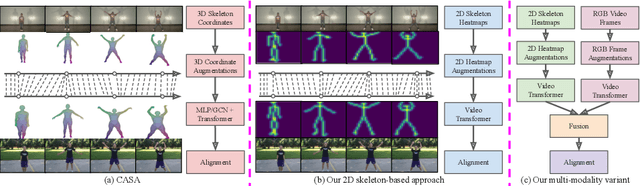

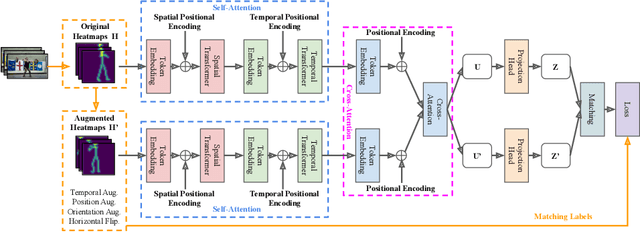
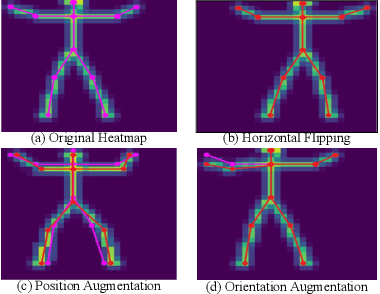
This paper presents a novel self-supervised temporal video alignment framework which is useful for several fine-grained human activity understanding applications. In contrast with the state-of-the-art method of CASA, where sequences of 3D skeleton coordinates are taken directly as input, our key idea is to use sequences of 2D skeleton heatmaps as input. Given 2D skeleton heatmaps, we utilize a video transformer which performs self-attention in the spatial and temporal domains for extracting effective spatiotemporal and contextual features. In addition, we introduce simple heatmap augmentation techniques based on 2D skeletons for self-supervised learning. Despite the lack of 3D information, our approach achieves not only higher accuracy but also better robustness against missing and noisy keypoints than CASA. Extensive evaluations on three public datasets, i.e., Penn Action, IKEA ASM, and H2O, demonstrate that our approach outperforms previous methods in different fine-grained human activity understanding tasks, i.e., phase classification, phase progression, video alignment, and fine-grained frame retrieval.
Permutation-Aware Action Segmentation via Unsupervised Frame-to-Segment Alignment
May 31, 2023This paper presents a novel transformer-based framework for unsupervised activity segmentation which leverages not only frame-level cues but also segment-level cues. This is in contrast with previous methods which often rely on frame-level information only. Our approach begins with a frame-level prediction module which estimates framewise action classes via a transformer encoder. The frame-level prediction module is trained in an unsupervised manner via temporal optimal transport. To exploit segment-level information, we introduce a segment-level prediction module and a frame-to-segment alignment module. The former includes a transformer decoder for estimating video transcripts, while the latter matches frame-level features with segment-level features, yielding permutation-aware segmentation results. Moreover, inspired by temporal optimal transport, we develop simple-yet-effective pseudo labels for unsupervised training of the above modules. Our experiments on four public datasets, i.e., 50 Salads, YouTube Instructions, Breakfast, and Desktop Assembly show that our approach achieves comparable or better performance than previous methods in unsupervised activity segmentation.
Sequential Embedding-based Attentive (SEA) classifier for malware classification
Feb 11, 2023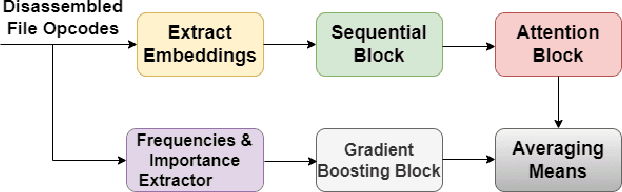
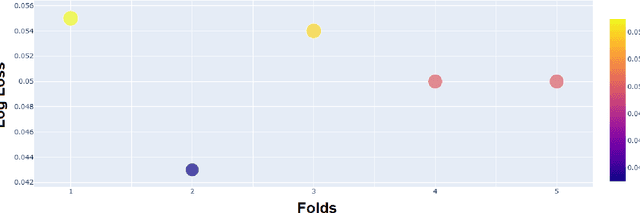
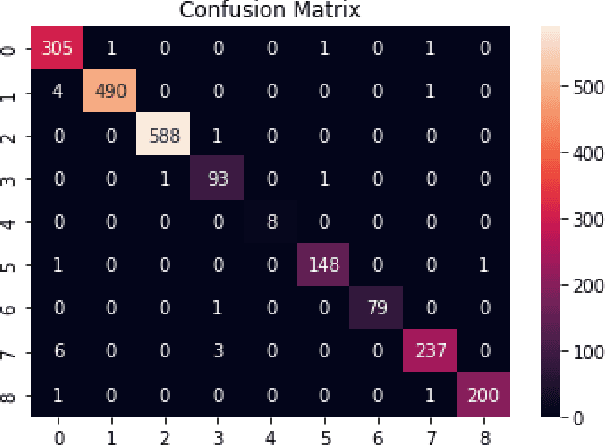
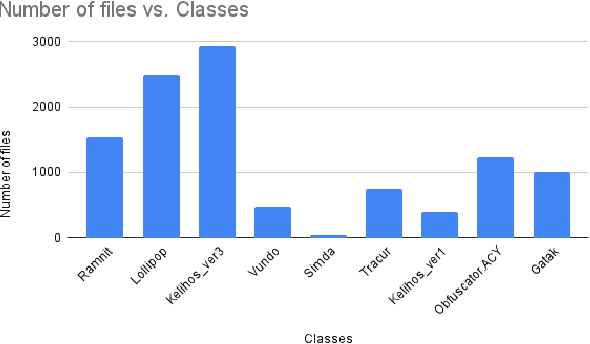
The tremendous growth in smart devices has uplifted several security threats. One of the most prominent threats is malicious software also known as malware. Malware has the capability of corrupting a device and collapsing an entire network. Therefore, its early detection and mitigation are extremely important to avoid catastrophic effects. In this work, we came up with a solution for malware detection using state-of-the-art natural language processing (NLP) techniques. Our main focus is to provide a lightweight yet effective classifier for malware detection which can be used for heterogeneous devices, be it a resource constraint device or a resourceful machine. Our proposed model is tested on the benchmark data set with an accuracy and log loss score of 99.13 percent and 0.04 respectively.