 Add to Chrome
 Add to Firefox
 Add to Edge
Neuro-Symbolic Control with Large Language Models for Language-Guided Spatial Tasks
Dec 19, 2025
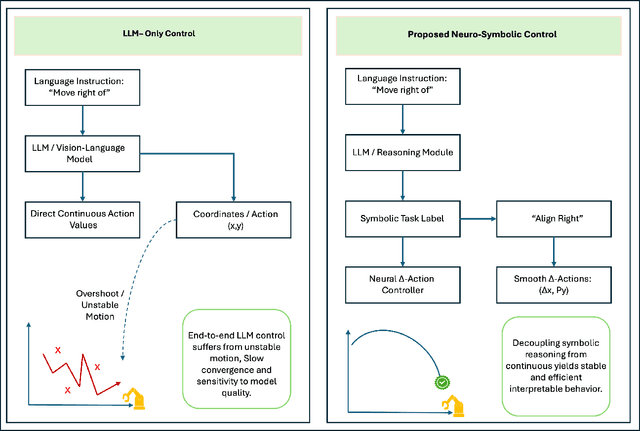
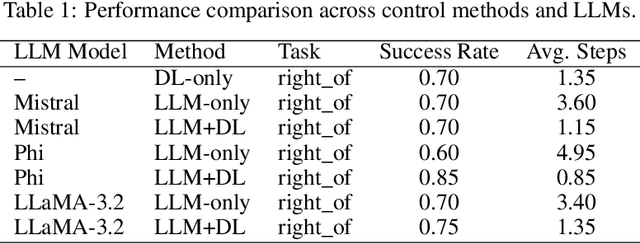
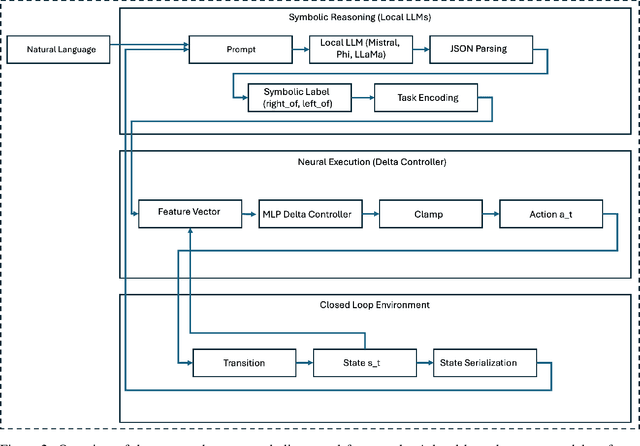
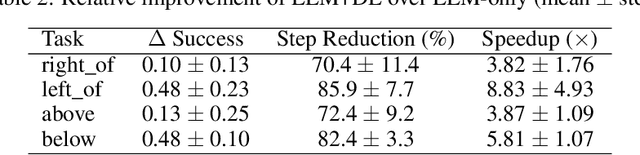
Although large language models (LLMs) have recently become effective tools for language-conditioned control in embodied systems, instability, slow convergence, and hallucinated actions continue to limit their direct application to continuous control. A modular neuro-symbolic control framework that clearly distinguishes between low-level motion execution and high-level semantic reasoning is proposed in this work. While a lightweight neural delta controller performs bounded, incremental actions in continuous space, a locally deployed LLM interprets symbolic tasks. We assess the suggested method in a planar manipulation setting with spatial relations between objects specified by language. Numerous tasks and local language models, such as Mistral, Phi, and LLaMA-3.2, are used in extensive experiments to compare LLM-only control, neural-only control, and the suggested LLM+DL framework. In comparison to LLM-only baselines, the results show that the neuro-symbolic integration consistently increases both success rate and efficiency, achieving average step reductions exceeding 70% and speedups of up to 8.83x while remaining robust to language model quality. The suggested framework enhances interpretability, stability, and generalization without any need of reinforcement learning or costly rollouts by controlling the LLM to symbolic outputs and allocating uninterpreted execution to a neural controller trained on artificial geometric data. These outputs show empirically that neuro-symbolic decomposition offers a scalable and principled way to integrate language understanding with ongoing control, this approach promotes the creation of dependable and effective language-guided embodied systems.

CB-HVTNet: A channel-boosted hybrid vision transformer network for lymphocyte assessment in histopathological images
May 16, 2023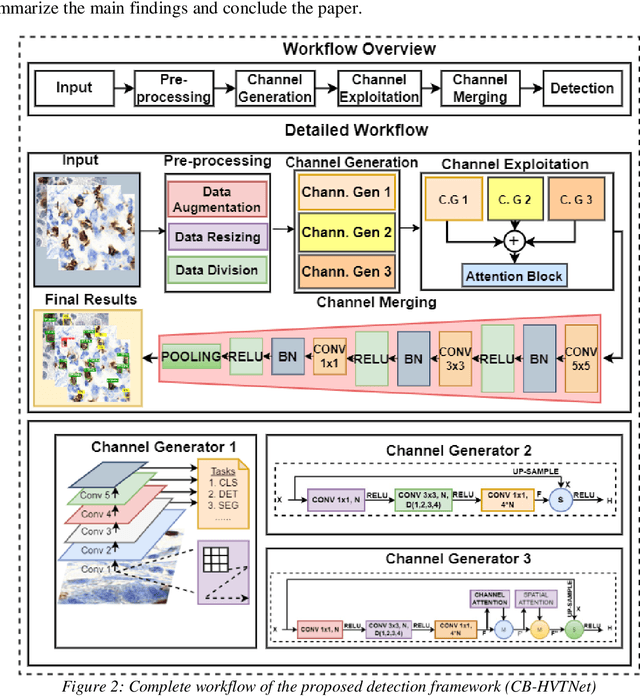

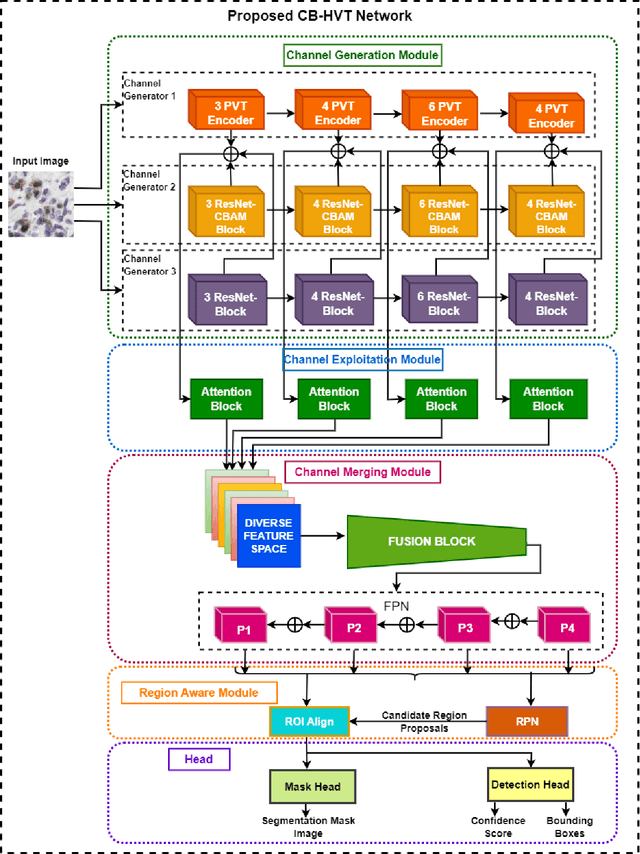
Transformers, due to their ability to learn long range dependencies, have overcome the shortcomings of convolutional neural networks (CNNs) for global perspective learning. Therefore, they have gained the focus of researchers for several vision related tasks including medical diagnosis. However, their multi-head attention module only captures global level feature representations, which is insufficient for medical images. To address this issue, we propose a Channel Boosted Hybrid Vision Transformer (CB HVT) that uses transfer learning to generate boosted channels and employs both transformers and CNNs to analyse lymphocytes in histopathological images. The proposed CB HVT comprises five modules, including a channel generation module, channel exploitation module, channel merging module, region-aware module, and a detection and segmentation head, which work together to effectively identify lymphocytes. The channel generation module uses the idea of channel boosting through transfer learning to extract diverse channels from different auxiliary learners. In the CB HVT, these boosted channels are first concatenated and ranked using an attention mechanism in the channel exploitation module. A fusion block is then utilized in the channel merging module for a gradual and systematic merging of the diverse boosted channels to improve the network's learning representations. The CB HVT also employs a proposal network in its region aware module and a head to effectively identify objects, even in overlapping regions and with artifacts. We evaluated the proposed CB HVT on two publicly available datasets for lymphocyte assessment in histopathological images. The results show that CB HVT outperformed other state of the art detection models, and has good generalization ability, demonstrating its value as a tool for pathologists.