 Add to Chrome
 Add to Firefox
 Add to Edge
TCP-SSM: Efficient Vision State Space Models with Token-Conditioned Poles
May 12, 2026
State Space Models (SSMs) have emerged as a compelling alternative to attention models for long-range vision tasks, offering input-dependent recurrence with linear complexity. However, most efficient SSM variants reduce computation cost by modifying scan routes, resolutions, or traversal patterns, while largely leaving the recurrent dynamics implicit. Consequently, the model's state-dependent memory behavior is difficult to control, particularly in compact backbones where long scan paths can exceed the effective memory horizon. We propose Token-Conditioned Poles SSM (TCP-SSM), a structured selective SSM framework that improves efficiency while making recurrence dynamics explicit and interpretable through stable poles. TCP-SSM builds each scan operator with 1) real poles that model monotone or sign-alternating decay, and 2) complex-conjugate poles that capture damped oscillatory responses. Using bounded radius and angle modulation, TCP-SSM converts shared base poles into token-dependent poles, allowing each scan step to adapt its memory behavior to the current visual token while preserving pole stability. For practical scalability, we integrate grouped pole sharing with a lightweight low-rank input pathway, yielding an efficient scan operator that preserves linear-time scan complexity. Across image classification, semantic segmentation, and object detection, TCP-SSM reduces SSM computation complexity up to 44% in Vision Mamba-style models while maintaining or surpassing baseline accuracy.

FuNToM: Functional Modeling of RF Circuits Using a Neural Network Assisted Two-Port Analysis Method
Aug 03, 2023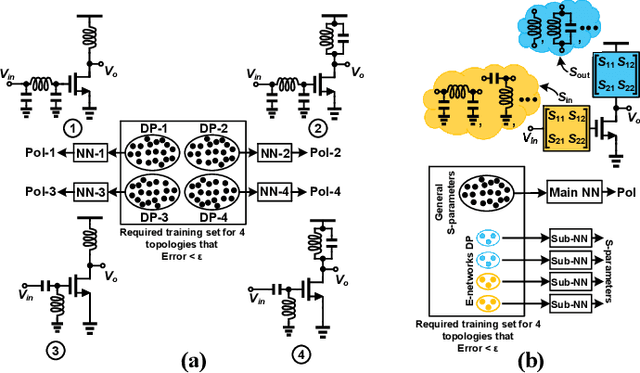
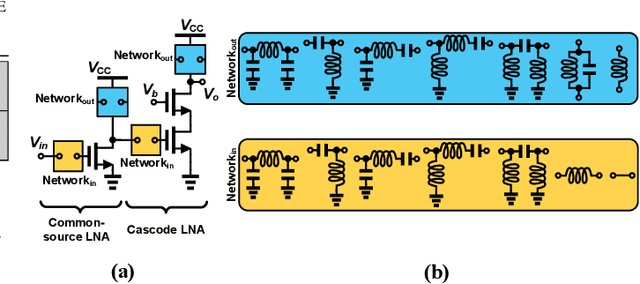
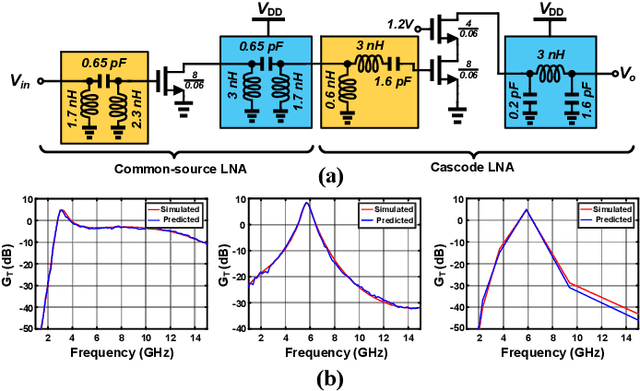
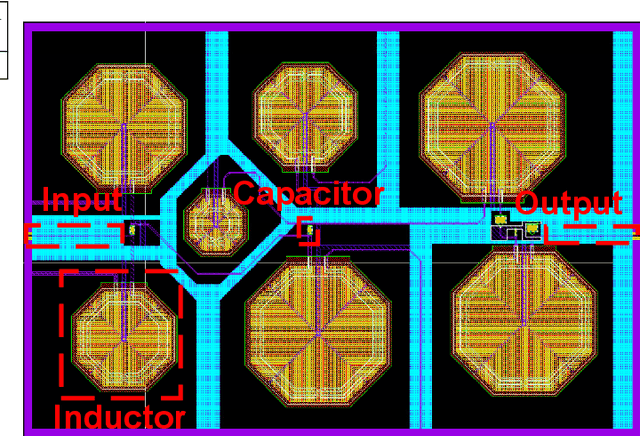
Automatic synthesis of analog and Radio Frequency (RF) circuits is a trending approach that requires an efficient circuit modeling method. This is due to the expensive cost of running a large number of simulations at each synthesis cycle. Artificial intelligence methods are promising approaches for circuit modeling due to their speed and relative accuracy. However, existing approaches require a large amount of training data, which is still collected using simulation runs. In addition, such approaches collect a whole separate dataset for each circuit topology even if a single element is added or removed. These matters are only exacerbated by the need for post-layout modeling simulations, which take even longer. To alleviate these drawbacks, in this paper, we present FuNToM, a functional modeling method for RF circuits. FuNToM leverages the two-port analysis method for modeling multiple topologies using a single main dataset and multiple small datasets. It also leverages neural networks which have shown promising results in predicting the behavior of circuits. Our results show that for multiple RF circuits, in comparison to the state-of-the-art works, while maintaining the same accuracy, the required training data is reduced by 2.8x - 10.9x. In addition, FuNToM needs 176.8x - 188.6x less time for collecting the training set in post-layout modeling.