 Add to Chrome
 Add to Firefox
 Add to Edge
RIS-Aided Sensing: Experimental Validation of Radar 3D Imaging in the mmWave Band
Apr 14, 2026
The transition toward 6G networks demands energy-efficient hardware capable of active interaction with the environment. Reconfigurable Intelligent Surfaces (RIS) have emerged as a key technology for Integrated Sensing and Communications (ISAC), enabling geometric environment recognition with minimal power consumption. However, achieving targeted 3D spatial mapping in a fully autonomous, closed-loop system remains a significant challenge. In this work, we validate experimentally an autonomous mmWave 3D imaging framework that integrates an Frequency-Modulated Continuous Wave (FMCW) radar with a 1-bit RIS and a Vector Network Analyzer (VNA) to perform targeted 3D reconstruction. The FMCW radar acts as a coarse localizer, providing real-time spatial priors to define dynamic Regions of Interest (ROI). These coordinates are translated into optimized RIS phase profiles to perform Stepped-Frequency Continuous-Wave (SFCW) measurements. We experimentally validate the system through three diverse scenarios, including metallic mannequins, calibration spheres, and a complex multi-target environment containing human subjects and an Automated Guided Vehicle (AGV). The results demonstrate accurate 3D voxel-based reconstruction of targets even at reduced angular resolutions, advancing the feasibility of RIS-based sensing for industrial and security applications.
* 7 pages, 7 figures, 3 tables. This work has been accepted for publication in 2026 IEEE Joint European Conference on Networks and Communications & 6G Summit (EuCNC/6G Summit). The final published version will be available via IEEE Xplore

Frequency-responsive RCS characteristics and scaling implications for ISAC development
Jul 16, 2025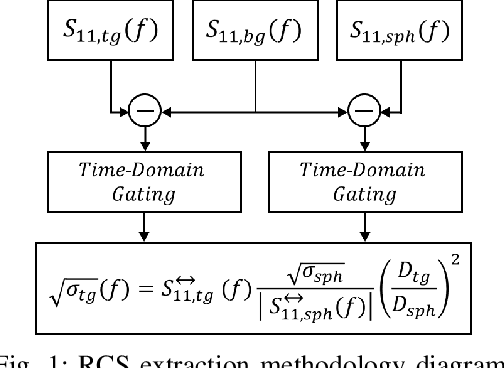
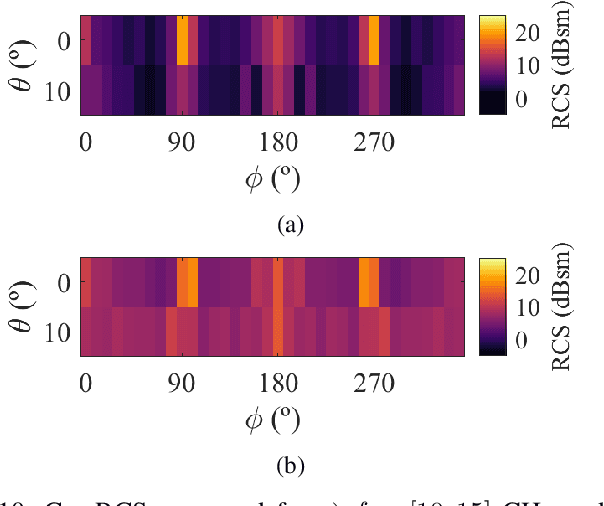
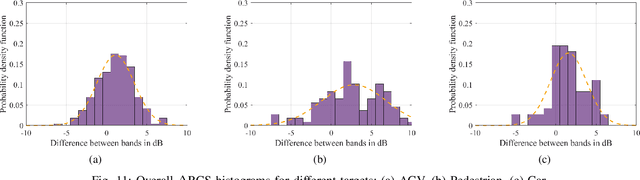
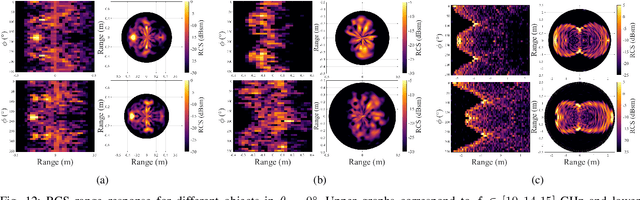
This paper presents an investigation on the Radar Cross-Section (RCS) of various targets, with the objective of analysing how RCS properties vary with frequency. Targets such as an Automated Guided Vehicle (AGV), a pedestrian, and a full-scale car were measured in the frequency bands referred to in industry standards as FR2 and FR3. Measurements were taken in diverse environments, indoors and outdoors, to ensure comprehensive scenario coverage. The methodology employed in RCS extraction performs background subtraction, followed by time-domain gating to isolate the influence of the target. This analysis compares the RCS values and how the points of greatest contribution are distributed across different bands based on the range response of the RCS. Analysis of the results demonstrated how RCS values change with frequency and target shape, providing insights into the electromagnetic behaviour of these targets. Key findings highlight how much scaling RCS values based on frequency and geometry is complex and varies among different types of materials and shapes. These insights are instrumental for advancing sensing systems and enhancing 3GPP channel models, particularly for Integrated Sensing and Communications (ISAC) techniques proposed for 6G standards.
* 6 pages, 12 figures, 3 tables. Accepted for publication at the 2024 IEEE Global Communications Conference (GLOBECOM), WS-02: Workshop on Propagation Channel Models and Evaluation Methodologies for 6G
Novel Approach to Dual-Channel Estimation in Integrated Sensing and Communications for 6G
Jul 16, 2025Integrated Sensing and Communication (ISAC) design is crucial for 6G and harmonizes environmental data sensing with communication, emphasizing the need to understand and model these elements. This paper delves into dual-channel models for ISAC, employing channel extraction techniques to validate and enhance accuracy. Focusing on millimeter wave (mmWave) radars, it explores the extraction of the bistatic sensing channel from monostatic measurements and subsequent communication channel estimation. The proposed methods involve interference extraction, module and phase correlation analyses, chirp clustering, and auto-clutter reduction. A comprehensive set-up in an anechoic chamber with controlled scenarios evaluates the proposed techniques, demonstrating successful channel extraction and validation through Root Mean Square Delay Spread (RMS DS), Power Delay Profile (PDP), and Angle of Arrival (AoA) analysis. Comparison with Ray-Tracing (RT) simulations confirms the effectiveness of the proposed approach, presenting an innovative stride towards fully integrated sensing and communication in future networks.
* 6 pages, 13 figures. Accepted for publication at the 2024 IEEE 35th International Symposium on Personal, Indoor and Mobile Radio Communications (PIMRC)