 Add to Chrome
 Add to Firefox
 Add to Edge
Self Paced Gaussian Contextual Reinforcement Learning
Mar 24, 2026
Curriculum learning improves reinforcement learning (RL) efficiency by sequencing tasks from simple to complex. However, many self-paced curriculum methods rely on computationally expensive inner-loop optimizations, limiting their scalability in high-dimensional context spaces. In this paper, we propose Self-Paced Gaussian Curriculum Learning (SPGL), a novel approach that avoids costly numerical procedures by leveraging a closed-form update rule for Gaussian context distributions. SPGL maintains the sample efficiency and adaptability of traditional self-paced methods while substantially reducing computational overhead. We provide theoretical guarantees on convergence and validate our method across several contextual RL benchmarks, including the Point Mass, Lunar Lander, and Ball Catching environments. Experimental results show that SPGL matches or outperforms existing curriculum methods, especially in hidden context scenarios, and achieves more stable context distribution convergence. Our method offers a scalable, principled alternative for curriculum generation in challenging continuous and partially observable domains.

Entropy-Aware Task Offloading in Mobile Edge Computing
Mar 16, 2026Mobile Edge Computing (MEC) technology has been introduced to enable could computing at the edge of the network in order to help resource limited mobile devices with time sensitive data processing tasks. In this paradigm, mobile devices can offload their computationally heavy tasks to more efficient nearby MEC servers via wireless communication. Consequently, the main focus of researches on the subject has been on development of efficient offloading schemes, leaving the privacy of mobile user out. While the Blockchain technology is used as the trust mechanism for secured sharing of the data, the privacy issues induced from wireless communication, namely, usage pattern and location privacy are the centerpiece of this work. The effects of these privacy concerns on the task offloading Markov Decision Process (MDP) is addressed and the MDP is solved using a Deep Recurrent Q-Netwrok (DRQN). The Numerical simulations are presented to show the effectiveness of the proposed method.
A Categorical Approach for Recognizing Emotional Effects of Music
Sep 17, 2017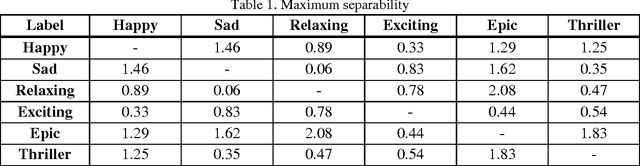
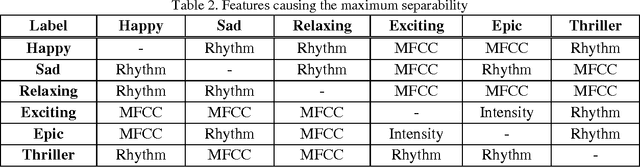


Recently, digital music libraries have been developed and can be plainly accessed. Latest research showed that current organization and retrieval of music tracks based on album information are inefficient. Moreover, they demonstrated that people use emotion tags for music tracks in order to search and retrieve them. In this paper, we discuss separability of a set of emotional labels, proposed in the categorical emotion expression, using Fisher's separation theorem. We determine a set of adjectives to tag music parts: happy, sad, relaxing, exciting, epic and thriller. Temporal, frequency and energy features have been extracted from the music parts. It could be seen that the maximum separability within the extracted features occurs between relaxing and epic music parts. Finally, we have trained a classifier using Support Vector Machines to automatically recognize and generate emotional labels for a music part. Accuracy for recognizing each label has been calculated; where the results show that epic music can be recognized more accurately (77.4%), comparing to the other types of music.