 Add to Chrome
 Add to Firefox
 Add to Edge
Decoding Market Emotions in Cryptocurrency Tweets via Predictive Statement Classification with Machine Learning and Transformers
Mar 26, 2026
The growing prominence of cryptocurrencies has triggered widespread public engagement and increased speculative activity, particularly on social media platforms. This study introduces a novel classification framework for identifying predictive statements in cryptocurrency-related tweets, focusing on five popular cryptocurrencies: Cardano, Matic, Binance, Ripple, and Fantom. The classification process is divided into two stages: Task 1 involves binary classification to distinguish between Predictive and Non-Predictive statements. Tweets identified as Predictive proceed to Task 2, where they are further categorized as Incremental, Decremental, or Neutral. To build a robust dataset, we combined manual and GPT-based annotation methods and utilized SenticNet to extract emotion features corresponding to each prediction category. To address class imbalance, GPT-generated paraphrasing was employed for data augmentation. We evaluated a wide range of machine learning, deep learning, and transformer-based models across both tasks. The results show that GPT-based balancing significantly enhanced model performance, with transformer models achieving the highest F1-score in Task 1, while traditional machine learning models performed best in Task 2. Furthermore, our emotion analysis revealed distinct emotional patterns associated with each prediction category across the different cryptocurrencies.

Exploring Sentiment Dynamics and Predictive Behaviors in Cryptocurrency Discussions by Few-Shot Learning with Large Language Models
Sep 04, 2024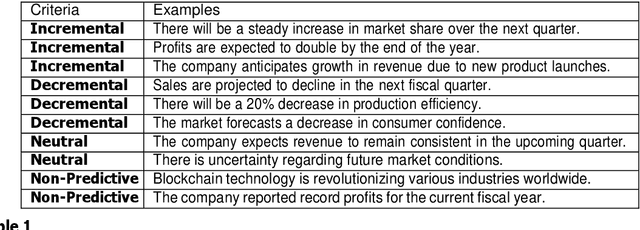
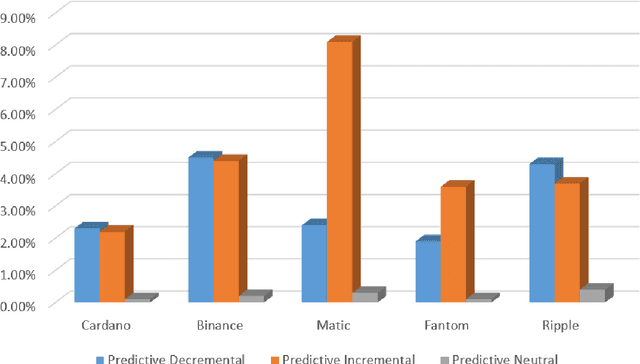
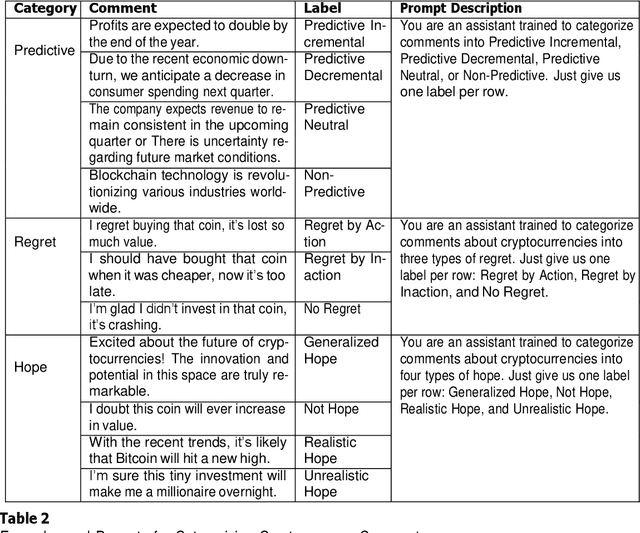
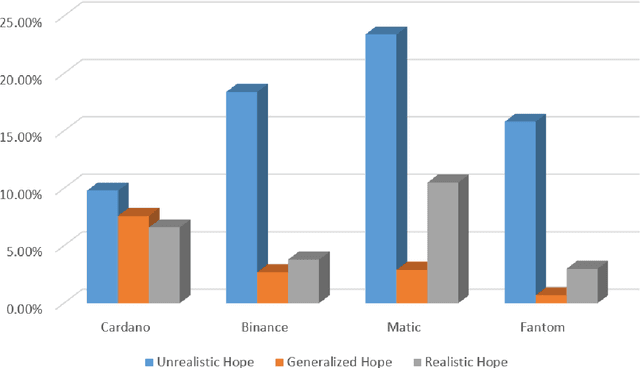
This study performs analysis of Predictive statements, Hope speech, and Regret Detection behaviors within cryptocurrency-related discussions, leveraging advanced natural language processing techniques. We introduce a novel classification scheme named "Prediction statements," categorizing comments into Predictive Incremental, Predictive Decremental, Predictive Neutral, or Non-Predictive categories. Employing GPT-4o, a cutting-edge large language model, we explore sentiment dynamics across five prominent cryptocurrencies: Cardano, Binance, Matic, Fantom, and Ripple. Our analysis reveals distinct patterns in predictive sentiments, with Matic demonstrating a notably higher propensity for optimistic predictions. Additionally, we investigate hope and regret sentiments, uncovering nuanced interplay between these emotions and predictive behaviors. Despite encountering limitations related to data volume and resource availability, our study reports valuable discoveries concerning investor behavior and sentiment trends within the cryptocurrency market, informing strategic decision-making and future research endeavors.