 Add to Chrome
 Add to Firefox
 Add to Edge
Exploiting Movable-Element STARS for Rate Splitting Multiple Access
Aug 17, 2026
This paper investigates a movable-element simultaneously transmitting and reflecting reconfigurable intelligent surface (ME-STARS) assisted rate-splitting multiple access (RSMA) system under imperfect channel state information (CSI). Unlike conventional STARS with fixed element positions, the elements of ME-STARS can be repositioned within a predefined region, providing additional spatial degrees of freedom for improving the cascaded transmitter--STARS--user channels. To exploit this flexibility while accounting for CSI uncertainty, we formulate a robust sum-rate maximization problem that jointly optimizes the transmit beamforming, common-rate allocation, reflection and transmission coefficients, and ME-STARS element positions, subject to transmit-power, user-rate, minimum inter-element spacing, and movement-region constraints. The resulting problem is highly non-convex due to the strong coupling among the design variables and the position-dependent channels. To address this challenge, an iterative optimization framework is developed in which the transmit beamforming, STARS coefficients, and element positions are successively optimized through tractable convex reformulations. In particular, the element positions are updated sequentially using a majorization--minimization (MM) framework, where quadratic surrogate functions are constructed from the first- and second-order derivatives of the position-dependent channels while preserving the minimum inter-element spacing constraint. Simulation results demonstrate that the proposed ME-STARS design consistently outperforms the considered benchmark schemes. Moreover, the performance gains remain significant under increasing CSI uncertainty, highlighting the effectiveness of element repositioning for robust RSMA transmission.

On the Performance of Dual RIS-assisted V2I Communication under Nakagami-m Fading
Jan 10, 2023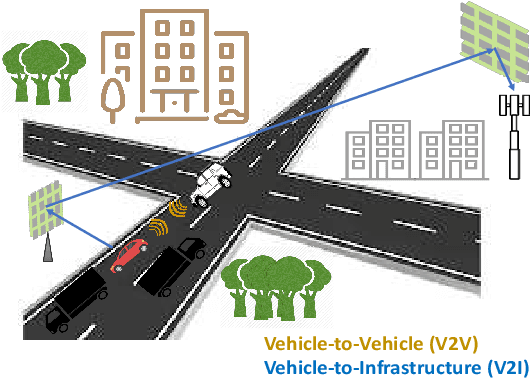

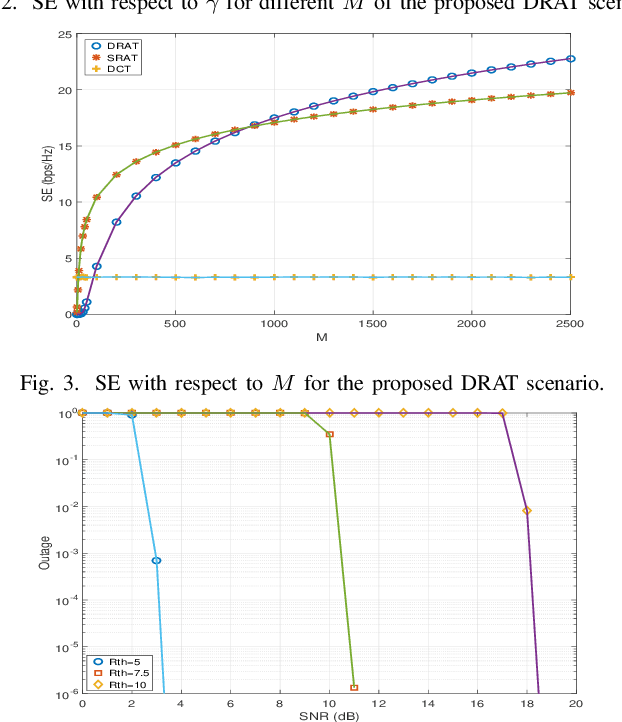

Vehicle-to-everything (V2X) connectivity in 5G-and-beyond communication networks supports the futuristic intelligent transportation system (ITS) by allowing vehicles to intelligently connect with everything. The advent of reconfigurable intelligent surfaces (RISs) has led to realizing the true potential of V2X communication. In this work, we propose a dual RIS-based vehicle-to-infrastructure (V2I) communication scheme. Following that, the performance of the proposed communication scheme is evaluated in terms of deriving the closed-form expressions for outage probability, spectral efficiency and energy efficiency. Finally, the analytical findings are corroborated with simulations which illustrate the superiority of the RIS-assisted vehicular networks.