 Add to Chrome
 Add to Firefox
 Add to Edge
Global-Local Feature Decoding with Adapter-Guided SAMv2 for Salient Object Detection
May 04, 2026
Salient Object Detection (SOD) remains an essential yet underexplored task in the era of large-scale vision models. Although foundation models like SAM exhibit strong generalization, their potential for SOD is not fully realized, and training or fully fine-tuning them is computationally expensive and prone to overfitting under limited data. To overcome these challenges, we introduce GLASSNet, a Global-Local feature decoding framework that uses SAMv2 as a frozen encoder paired with a lightweight, spatially aware convolutional adapter-reducing learnable encoder parameters by over 97%. To enhance saliency quality, GLASSNet employs a dual-decoder architecture: one decoder captures global, long-range semantics with an expanded receptive field, while the other captures fine local details such as edges and textures. Fusing these complementary cues yields saliency maps that combine global coherence with local precision, producing accurate final masks. Extensive experiments on standard SOD and camouflaged object detection benchmarks show that GLASSNet surpasses state-of-the-art methods, demonstrating the power of frozen foundation models combined with targeted adaptation and global-local decoding.

Brain-Grasp: Graph-based Saliency Priors for Improved fMRI-based Visual Brain Decoding
Apr 12, 2026Recent progress in brain-guided image generation has improved the quality of fMRI-based reconstructions; however, fundamental challenges remain in preserving object-level structure and semantic fidelity. Many existing approaches overlook the spatial arrangement of salient objects, leading to conceptually inconsistent outputs. We propose a saliency-driven decoding framework that employs graph-informed saliency priors to translate structural cues from brain signals into spatial masks. These masks, together with semantic information extracted from embeddings, condition a diffusion model to guide image regeneration, helping preserve object conformity while maintaining natural scene composition. In contrast to pipelines that invoke multiple diffusion stages, our approach relies on a single frozen model, offering a more lightweight yet effective design. Experiments show that this strategy improves both conceptual alignment and structural similarity to the original stimuli, while also introducing a new direction for efficient, interpretable, and structurally grounded brain decoding.
SalFoM: Dynamic Saliency Prediction with Video Foundation Models
Apr 03, 2024
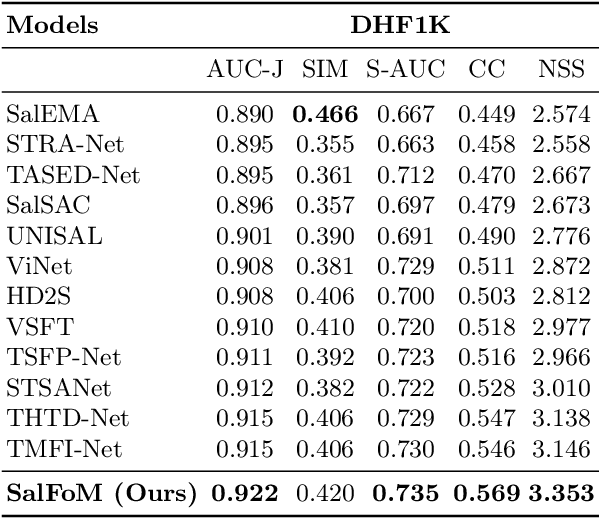

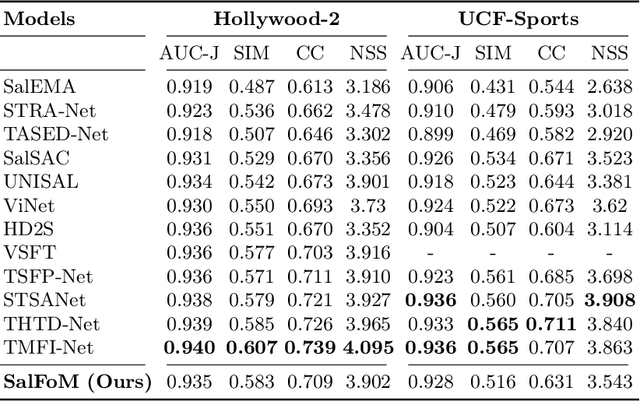
Recent advancements in video saliency prediction (VSP) have shown promising performance compared to the human visual system, whose emulation is the primary goal of VSP. However, current state-of-the-art models employ spatio-temporal transformers trained on limited amounts of data, hindering generalizability adaptation to downstream tasks. The benefits of vision foundation models present a potential solution to improve the VSP process. However, adapting image foundation models to the video domain presents significant challenges in modeling scene dynamics and capturing temporal information. To address these challenges, and as the first initiative to design a VSP model based on video foundation models, we introduce SalFoM, a novel encoder-decoder video transformer architecture. Our model employs UnMasked Teacher (UMT) as feature extractor and presents a heterogeneous decoder which features a locality-aware spatio-temporal transformer and integrates local and global spatio-temporal information from various perspectives to produce the final saliency map. Our qualitative and quantitative experiments on the challenging VSP benchmark datasets of DHF1K, Hollywood-2 and UCF-Sports demonstrate the superiority of our proposed model in comparison with the state-of-the-art methods.