 Add to Chrome
 Add to Firefox
 Add to Edge
Brain-Grasp: Graph-based Saliency Priors for Improved fMRI-based Visual Brain Decoding
Apr 12, 2026
Recent progress in brain-guided image generation has improved the quality of fMRI-based reconstructions; however, fundamental challenges remain in preserving object-level structure and semantic fidelity. Many existing approaches overlook the spatial arrangement of salient objects, leading to conceptually inconsistent outputs. We propose a saliency-driven decoding framework that employs graph-informed saliency priors to translate structural cues from brain signals into spatial masks. These masks, together with semantic information extracted from embeddings, condition a diffusion model to guide image regeneration, helping preserve object conformity while maintaining natural scene composition. In contrast to pipelines that invoke multiple diffusion stages, our approach relies on a single frozen model, offering a more lightweight yet effective design. Experiments show that this strategy improves both conceptual alignment and structural similarity to the original stimuli, while also introducing a new direction for efficient, interpretable, and structurally grounded brain decoding.

Beyond MMD: Evaluating Graph Generative Models with Geometric Deep Learning
Dec 16, 2025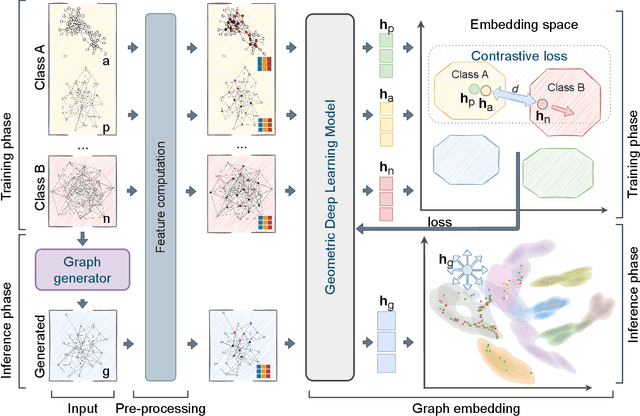
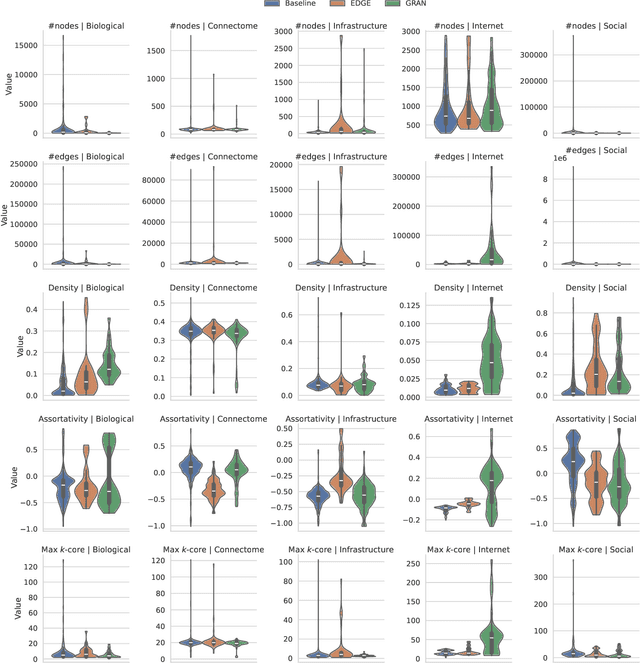
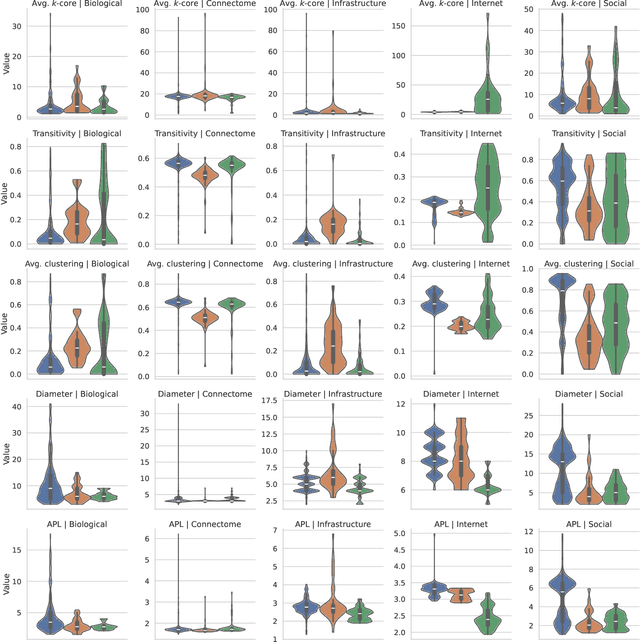
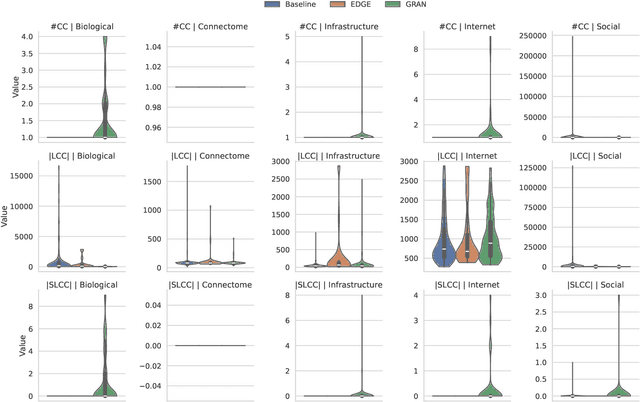
Graph generation is a crucial task in many fields, including network science and bioinformatics, as it enables the creation of synthetic graphs that mimic the properties of real-world networks for various applications. Graph Generative Models (GGMs) have emerged as a promising solution to this problem, leveraging deep learning techniques to learn the underlying distribution of real-world graphs and generate new samples that closely resemble them. Examples include approaches based on Variational Auto-Encoders, Recurrent Neural Networks, and more recently, diffusion-based models. However, the main limitation often lies in the evaluation process, which typically relies on Maximum Mean Discrepancy (MMD) as a metric to assess the distribution of graph properties in the generated ensemble. This paper introduces a novel methodology for evaluating GGMs that overcomes the limitations of MMD, which we call RGM (Representation-aware Graph-generation Model evaluation). As a practical demonstration of our methodology, we present a comprehensive evaluation of two state-of-the-art Graph Generative Models: Graph Recurrent Attention Networks (GRAN) and Efficient and Degree-guided graph GEnerative model (EDGE). We investigate their performance in generating realistic graphs and compare them using a Geometric Deep Learning model trained on a custom dataset of synthetic and real-world graphs, specifically designed for graph classification tasks. Our findings reveal that while both models can generate graphs with certain topological properties, they exhibit significant limitations in preserving the structural characteristics that distinguish different graph domains. We also highlight the inadequacy of Maximum Mean Discrepancy as an evaluation metric for GGMs and suggest alternative approaches for future research.
mGNN: Generalizing the Graph Neural Networks to the Multilayer Case
Sep 25, 2021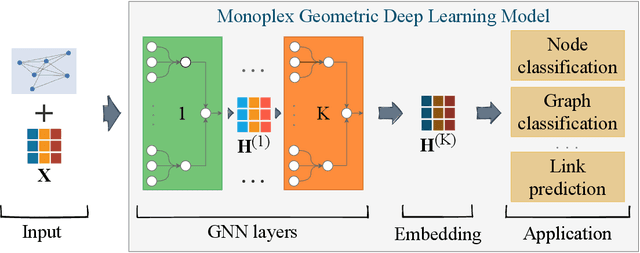
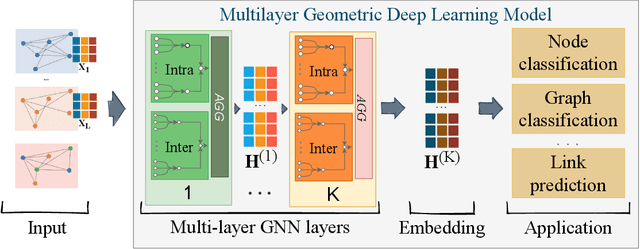
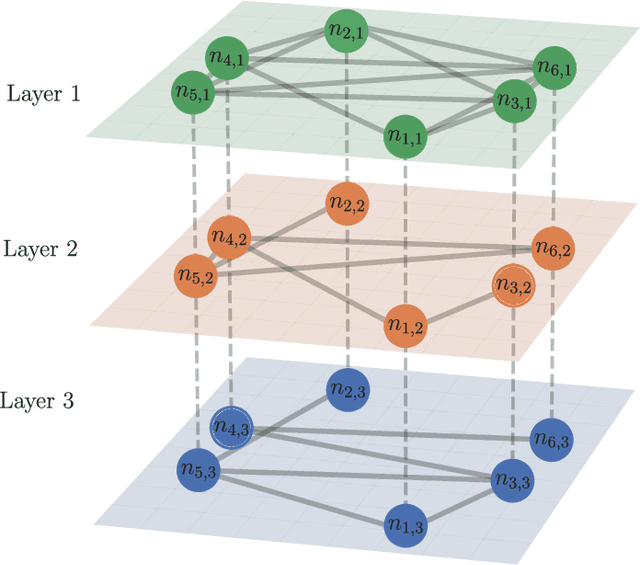
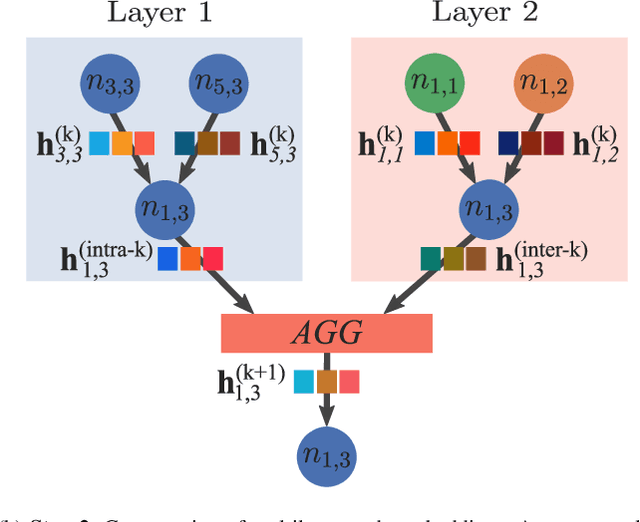
Networks are a powerful tool to model complex systems, and the definition of many Graph Neural Networks (GNN), Deep Learning algorithms that can handle networks, has opened a new way to approach many real-world problems that would be hardly or even untractable. In this paper, we propose mGNN, a framework meant to generalize GNNs to the case of multi-layer networks, i.e., networks that can model multiple kinds of interactions and relations between nodes. Our approach is general (i.e., not task specific) and has the advantage of extending any type of GNN without any computational overhead. We test the framework into three different tasks (node and network classification, link prediction) to validate it.
wsGAT: Weighted and Signed Graph Attention Networks for Link Prediction
Sep 21, 2021



Graph Neural Networks (GNNs) have been widely used to learn representations on graphs and tackle many real-world problems from a wide range of domains. In this paper we propose wsGAT, an extension of the Graph Attention Network (GAT) layers, meant to address the lack of GNNs that can handle graphs with signed and weighted links, which are ubiquitous, for instance, in trust and correlation networks. We first evaluate the performance of our proposal by comparing against GCNII in the weighed link prediction task, and against SGCN in the link sign prediction task. After that, we combine the two tasks and show their performance on predicting the signed weight of links, and their existence. Our results on real-world networks show that models with wsGAT layers outperform the ones with GCNII and SGCN layers, and that there is no loss in performance when signed weights are predicted.
Machine learning dismantling and early-warning signals of disintegration in complex systems
Jan 07, 2021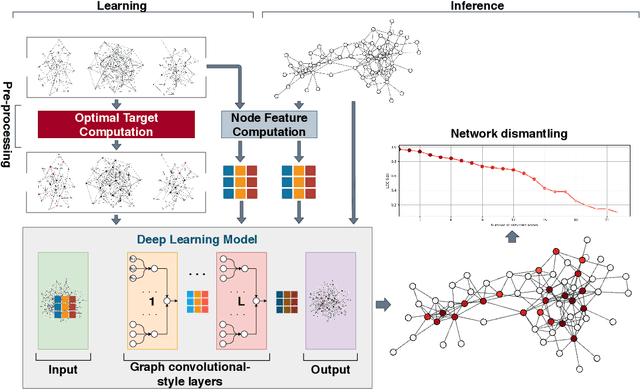
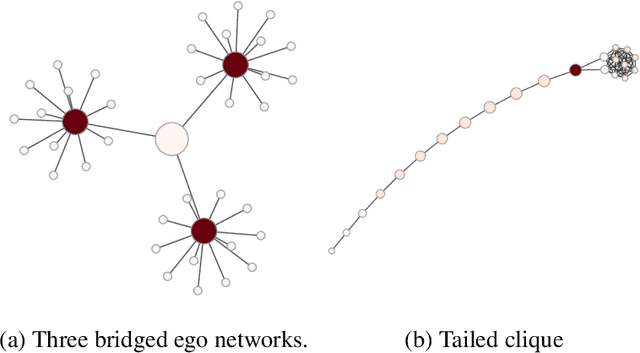
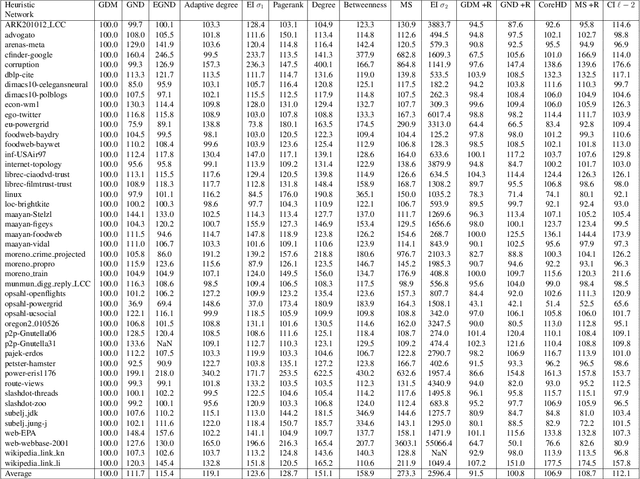
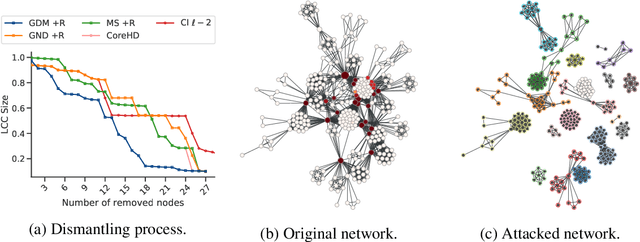
From physics to engineering, biology and social science, natural and artificial systems are characterized by interconnected topologies whose features - e.g., heterogeneous connectivity, mesoscale organization, hierarchy - affect their robustness to external perturbations, such as targeted attacks to their units. Identifying the minimal set of units to attack to disintegrate a complex network, i.e. network dismantling, is a computationally challenging (NP-hard) problem which is usually attacked with heuristics. Here, we show that a machine trained to dismantle relatively small systems is able to identify higher-order topological patterns, allowing to disintegrate large-scale social, infrastructural and technological networks more efficiently than human-based heuristics. Remarkably, the machine assesses the probability that next attacks will disintegrate the system, providing a quantitative method to quantify systemic risk and detect early-warning signals of system's collapse. This demonstrates that machine-assisted analysis can be effectively used for policy and decision making to better quantify the fragility of complex systems and their response to shocks.