 Add to Chrome
 Add to Firefox
 Add to Edge
A Low-Power Wearable Respiratory Sensor for Non-Invasive Stress Monitoring
Aug 06, 2026
Respiration provides a continuously available window into physiological state and behavior. However, monitoring it outside controlled settings remains challenging because a wearable system must capture small body deformations while remaining comfortable, low power, and robust to changes in posture and motion. We present a compact non-invasive respiratory sensing system based on a force-sensitive resistor (FSR) embedded in an abdominal belt and integrated with a custom Bluetooth Low Energy acquisition board. The system combines a simple piezoresistive readout with a mechanical holder designed to transfer abdominal expansion to the sensor without analog amplification. We evaluate the complete sensing pipeline across multiple breathing patterns and body positions. In stationary settings, the recorded signals exhibit consistent amplitude changes and recurring peak-to-peak timing across breathing maneuvers; under light movement, these variations remain visible despite motion-induced baseline shifts. We further design a five-phase stress-induction protocol and collect respiratory recordings from 12 participants. Using interpretable time-domain features and standard classifiers, we examine whether the acquired signals distinguish relaxation from stress-induction phases. In this preliminary experiment, the best-performing model achieves 88.0% test accuracy, indicating that the extracted respiratory features distinguish stress-induced phases from relaxation phases in this dataset. Overall, our results show that the proposed platform enables real-time respiratory monitoring across diverse daily-life scenarios and captures respiratory changes that distinguish stress-induction from relaxation phases, supporting its potential for affective-computing applications.

Cross-Subject Modeling for Widefield Calcium Imaging via Atlas-Aligned Spatiotemporal Tokenization
Jul 05, 2026Large-scale, multi-subject widefield calcium imaging provides unprecedented access to brain-wide cortical dynamics. However, the high dimensionality, complex spatiotemporal structure, and substantial task-irrelevant activity in widefield recordings have largely restricted modeling efforts to single-session analyses, limiting scalability and generalization. While multi-subject pretrained models have been explored for some neural modalities, multi-subject models for widefield calcium imaging have not yet been demonstrated; further, subject-invariant zero-shot behavior decoding remains elusive for multi-subject models across neural modalities more broadly. As a first step toward foundation modeling of widefield data, we introduce WiCAT, a multi-subject model that leverages self-supervised pretraining to both outperform single-session models and enable zero-shot behavior decoding on unseen subjects. WiCAT introduces an atlas-grounded tokenization scheme without session-specific components and learns globally shared spatiotemporal representations. Across multiple widefield datasets, the pretrained model supports lightweight downstream decoding, transfers across subjects, tasks, and datasets, and outperforms baseline models. Notably, the model also achieves robust zero-shot continuous behavior decoding and left-out brain region reconstruction on unseen subjects.
* Published at the 43rd International Conference on Machine Learning (ICML) 2026. Code available at: https://github.com/ShanechiLab/WiCAT
Revolutionizing Traffic Management with AI-Powered Machine Vision: A Step Toward Smart Cities
Mar 04, 2025The rapid urbanization of cities and increasing vehicular congestion have posed significant challenges to traffic management and safety. This study explores the transformative potential of artificial intelligence (AI) and machine vision technologies in revolutionizing traffic systems. By leveraging advanced surveillance cameras and deep learning algorithms, this research proposes a system for real-time detection of vehicles, traffic anomalies, and driver behaviors. The system integrates geospatial and weather data to adapt dynamically to environmental conditions, ensuring robust performance in diverse scenarios. Using YOLOv8 and YOLOv11 models, the study achieves high accuracy in vehicle detection and anomaly recognition, optimizing traffic flow and enhancing road safety. These findings contribute to the development of intelligent traffic management solutions and align with the vision of creating smart cities with sustainable and efficient urban infrastructure.
GREI Data Repository AI Taxonomy
Nov 07, 2024The Generalist Repository Ecosystem Initiative (GREI), funded by the NIH, developed an AI taxonomy tailored to data repository roles to guide AI integration across repository management. It categorizes the roles into stages, including acquisition, validation, organization, enhancement, analysis, sharing, and user support, providing a structured framework for implementing AI in repository workflows.
Faster, Lighter, More Accurate: A Deep Learning Ensemble for Content Moderation
Sep 10, 2023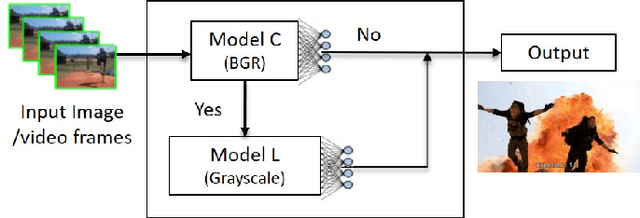


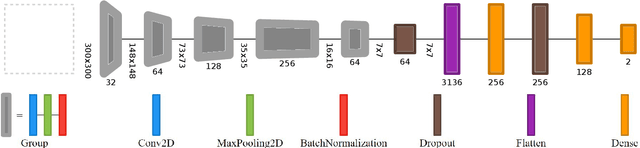
To address the increasing need for efficient and accurate content moderation, we propose an efficient and lightweight deep classification ensemble structure. Our approach is based on a combination of simple visual features, designed for high-accuracy classification of violent content with low false positives. Our ensemble architecture utilizes a set of lightweight models with narrowed-down color features, and we apply it to both images and videos. We evaluated our approach using a large dataset of explosion and blast contents and compared its performance to popular deep learning models such as ResNet-50. Our evaluation results demonstrate significant improvements in prediction accuracy, while benefiting from 7.64x faster inference and lower computation cost. While our approach is tailored to explosion detection, it can be applied to other similar content moderation and violence detection use cases as well. Based on our experiments, we propose a "think small, think many" philosophy in classification scenarios. We argue that transforming a single, large, monolithic deep model into a verification-based step model ensemble of multiple small, simple, and lightweight models with narrowed-down visual features can possibly lead to predictions with higher accuracy.
Deep Live Video Ad Placement on the 5G Edge
Sep 03, 2022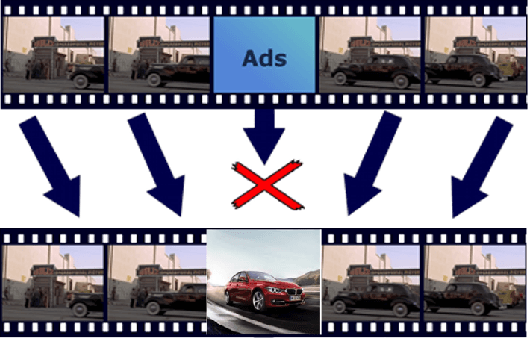

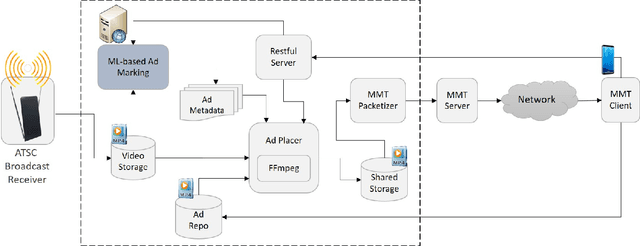
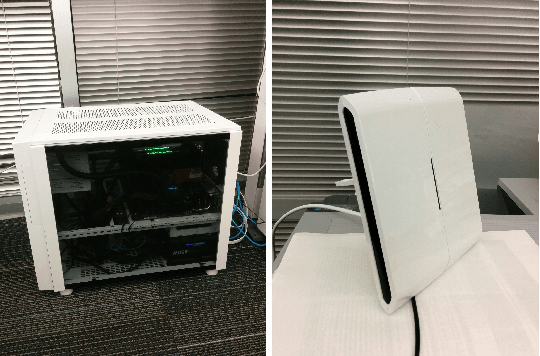
The video broadcasting industry has been growing significantly in the recent years, specially on delivering personalized contents to the end users. While video broadcasting has continued to grow beyond TV, video adverting has become a key marketing tool to deliver targeted messages directly to the audience. However, unfortunately for broadband TV, a key problem is that the TV commercials target the broad audience, therefore lacking user-specific and personalized ad contents. In this paper, we propose a deep edge-cloud ad-placement system, and briefly describe our methodologies and the architecture of our designed ad placement system for delivering both the Video on Demand (VoD) and live broadcast TV contents over MMT streaming protocol. The aim of our paper is to showcase how to enable targeted, personalized, and user-specific advertising services deployed on the future 5G MEC platforms, which in turn can have high potentials to increase ad revenues for the mobile operator industry.
The Case for High-Accuracy Classification: Think Small, Think Many!
Mar 18, 2021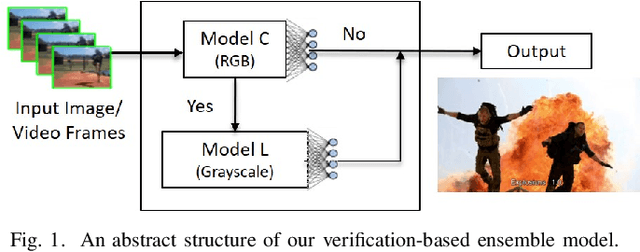

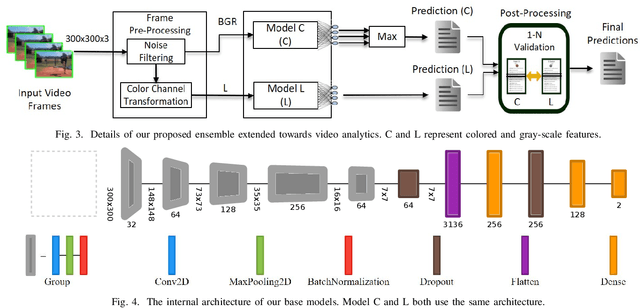
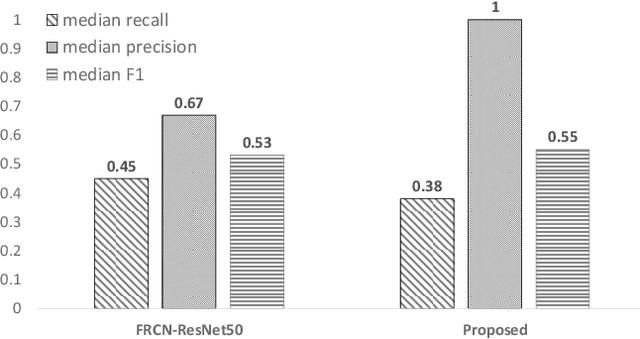
To facilitate implementation of high-accuracy deep neural networks especially on resource-constrained devices, maintaining low computation requirements is crucial. Using very deep models for classification purposes not only decreases the neural network training speed and increases the inference time, but also need more data for higher prediction accuracy and to mitigate false positives. In this paper, we propose an efficient and lightweight deep classification ensemble structure based on a combination of simple color features, which is particularly designed for "high-accuracy" image classifications with low false positives. We designed, implemented, and evaluated our approach for explosion detection use-case applied to images and videos. Our evaluation results based on a large test test show considerable improvements on the prediction accuracy compared to the popular ResNet-50 model, while benefiting from 7.64x faster inference and lower computation cost. While we applied our approach to explosion detection, our approach is general and can be applied to other similar classification use cases as well. Given the insight gained from our experiments, we hence propose a "think small, think many" philosophy in classification scenarios: that transforming a single, large, monolithic deep model into a verification-based step model ensemble of multiple small, simple, lightweight models with narrowed-down color spaces can possibly lead to predictions with higher accuracy.