 Add to Chrome
 Add to Firefox
 Add to Edge
Semantic Multiplexing
Nov 16, 2025
Mobile devices increasingly require the parallel execution of several computing tasks offloaded at the wireless edge. Existing communication systems only support parallel transmissions at the bit level, which fundamentally limits the number of tasks that can be concurrently processed. To address this bottleneck, this paper introduces the new concept of Semantic Multiplexing. Our approach shifts stream multiplexing from bits to tasks by merging multiple task-related compressed representations into a single semantic representation. As such, Semantic Multiplexing can multiplex more tasks than the number of physical channels without adding antennas or widening bandwidth by extending the effective degrees of freedom at the semantic layer, without contradicting Shannon capacity rules. We have prototyped Semantic Multiplexing on an experimental testbed with Jetson Orin Nano and millimeter-wave software-defined radios and tested its performance on image classification and sentiment analysis while comparing to several existing baselines in semantic communications. Our experiments demonstrate that Semantic Multiplexing allows jointly processing multiple tasks at the semantic level while maintaining sufficient task accuracy. For example, image classification accuracy drops by less than 4% when increasing from 2 to 8 the number of tasks multiplexed over a 4$\times$4 channel. Semantic Multiplexing reduces latency, energy consumption, and communication load respectively by up to 8$\times$, 25$\times$, and 54$\times$ compared to the baselines while keeping comparable performance. We pledge to publicly share the complete software codebase and the collected datasets for reproducibility.

Semantic Edge Computing and Semantic Communications in 6G Networks: A Unifying Survey and Research Challenges
Nov 27, 2024Semantic Edge Computing (SEC) and Semantic Communications (SemComs) have been proposed as viable approaches to achieve real-time edge-enabled intelligence in sixth-generation (6G) wireless networks. On one hand, SemCom leverages the strength of Deep Neural Networks (DNNs) to encode and communicate the semantic information only, while making it robust to channel distortions by compensating for wireless effects. Ultimately, this leads to an improvement in the communication efficiency. On the other hand, SEC has leveraged distributed DNNs to divide the computation of a DNN across different devices based on their computational and networking constraints. Although significant progress has been made in both fields, the literature lacks a systematic view to connect both fields. In this work, we fulfill the current gap by unifying the SEC and SemCom fields. We summarize the research problems in these two fields and provide a comprehensive review of the state of the art with a focus on their technical strengths and challenges.
Resilience of Entropy Model in Distributed Neural Networks
Mar 01, 2024Distributed deep neural networks (DNNs) have emerged as a key technique to reduce communication overhead without sacrificing performance in edge computing systems. Recently, entropy coding has been introduced to further reduce the communication overhead. The key idea is to train the distributed DNN jointly with an entropy model, which is used as side information during inference time to adaptively encode latent representations into bit streams with variable length. To the best of our knowledge, the resilience of entropy models is yet to be investigated. As such, in this paper we formulate and investigate the resilience of entropy models to intentional interference (e.g., adversarial attacks) and unintentional interference (e.g., weather changes and motion blur). Through an extensive experimental campaign with 3 different DNN architectures, 2 entropy models and 4 rate-distortion trade-off factors, we demonstrate that the entropy attacks can increase the communication overhead by up to 95%. By separating compression features in frequency and spatial domain, we propose a new defense mechanism that can reduce the transmission overhead of the attacked input by about 9% compared to unperturbed data, with only about 2% accuracy loss. Importantly, the proposed defense mechanism is a standalone approach which can be applied in conjunction with approaches such as adversarial training to further improve robustness. Code will be shared for reproducibility.
Adversarial Machine Learning in Latent Representations of Neural Networks
Sep 29, 2023
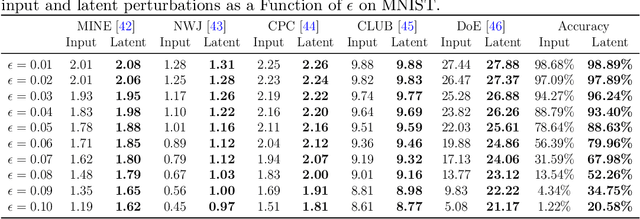

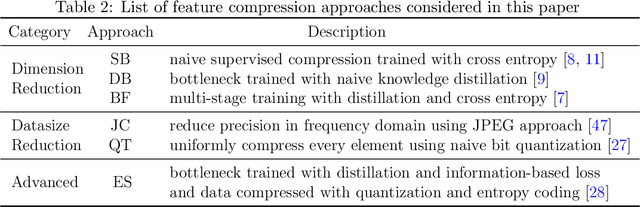
Distributed deep neural networks (DNNs) have been shown to reduce the computational burden of mobile devices and decrease the end-to-end inference latency in edge computing scenarios. While distributed DNNs have been studied, to the best of our knowledge the resilience of distributed DNNs to adversarial action still remains an open problem. In this paper, we fill the existing research gap by rigorously analyzing the robustness of distributed DNNs against adversarial action. We cast this problem in the context of information theory and introduce two new measurements for distortion and robustness. Our theoretical findings indicate that (i) assuming the same level of information distortion, latent features are always more robust than input representations; (ii) the adversarial robustness is jointly determined by the feature dimension and the generalization capability of the DNN. To test our theoretical findings, we perform extensive experimental analysis by considering 6 different DNN architectures, 6 different approaches for distributed DNN and 10 different adversarial attacks to the ImageNet-1K dataset. Our experimental results support our theoretical findings by showing that the compressed latent representations can reduce the success rate of adversarial attacks by 88% in the best case and by 57% on the average compared to attacks to the input space.