 Add to Chrome
 Add to Firefox
 Add to Edge
YTClickbait21K: Human-Annotated Multimodal Dataset for YouTube Clickbait Detection Across Diverse Channels and Content Categories
Jun 10, 2026
Clickbait content on video-sharing platforms poses a significant challenge to information reliability, yet progress in automated detection has been constrained by the lack of large-scale, high-quality multimodal datasets. We present YTClickbait21K, a human-annotated YouTube clickbait dataset comprising 21,238 videos collected from 40 channels across 29 countries, covering diverse content categories such as news, entertainment, education, and gaming. Each sample includes structured metadata (title, description, engagement statistics) along with associated thumbnail images, enabling comprehensive multimodal analysis. To ensure annotation quality, every video was independently labeled by three annotators using a standardized decision framework that incorporates textual, visual, and cross-modal consistency cues, with final labels determined through majority voting. The dataset exhibits substantial inter-annotator agreement (k=0.65), confirming reliable labeling despite the inherent subjectivity of clickbait detection. By combining scale, annotation rigor, and multimodal richness, this dataset provides a robust benchmark for developing and evaluating machine learning models, facilitating research in cross-modal semantic understanding, and advancing automated content moderation systems.

Harnessing Smartphone Sensors for Enhanced Road Safety: A Comprehensive Dataset and Review
Nov 13, 2024Severe collisions can result from aggressive driving and poor road conditions, emphasizing the need for effective monitoring to ensure safety. Smartphones, with their array of built-in sensors, offer a practical and affordable solution for road-sensing. However, the lack of reliable, standardized datasets has hindered progress in assessing road conditions and driving patterns. This study addresses this gap by introducing a comprehensive dataset derived from smartphone sensors, which surpasses existing datasets by incorporating a diverse range of sensors including accelerometer, gyroscope, magnetometer, GPS, gravity, orientation, and uncalibrated sensors. These sensors capture extensive parameters such as acceleration force, gravitation, rotation rate, magnetic field strength, and vehicle speed, providing a detailed understanding of road conditions and driving behaviors. The dataset is designed to enhance road safety, infrastructure maintenance, traffic management, and urban planning. By making this dataset available to the community, the study aims to foster collaboration, inspire further research, and facilitate the development of innovative solutions in intelligent transportation systems.
Reliable Tuberculosis Detection using Chest X-ray with Deep Learning, Segmentation and Visualization
Jul 29, 2020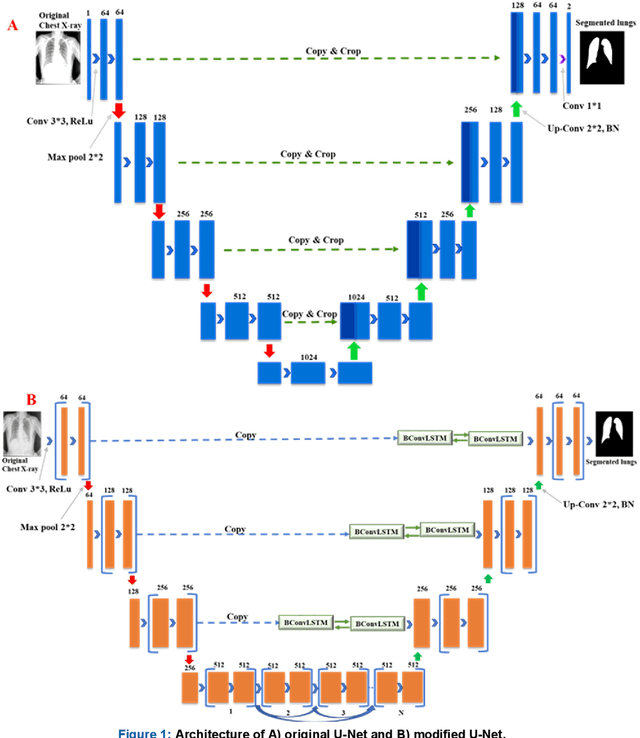
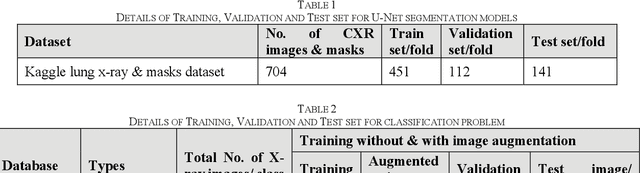
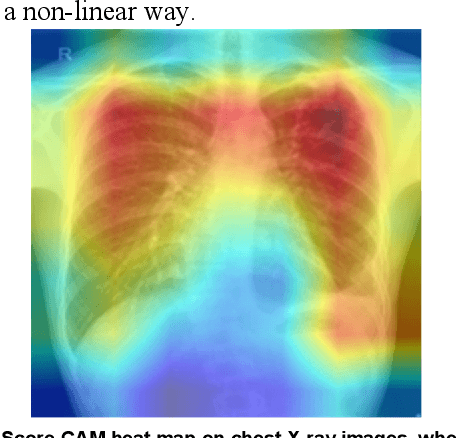
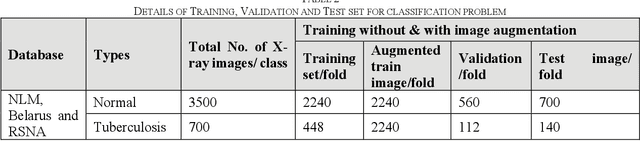
Tuberculosis (TB) is a chronic lung disease that occurs due to bacterial infection and is one of the top 10 leading causes of death. Accurate and early detection of TB is very important, otherwise, it could be life-threatening. In this work, we have detected TB reliably from the chest X-ray images using image pre-processing, data augmentation, image segmentation, and deep-learning classification techniques. Several public databases were used to create a database of 700 TB infected and 3500 normal chest X-ray images for this study. Nine different deep CNNs (ResNet18, ResNet50, ResNet101, ChexNet, InceptionV3, Vgg19, DenseNet201, SqueezeNet, and MobileNet), which were used for transfer learning from their pre-trained initial weights and trained, validated and tested for classifying TB and non-TB normal cases. Three different experiments were carried out in this work: segmentation of X-ray images using two different U-net models, classification using X-ray images, and segmented lung images. The accuracy, precision, sensitivity, F1-score, specificity in the detection of tuberculosis using X-ray images were 97.07 %, 97.34 %, 97.07 %, 97.14 % and 97.36 % respectively. However, segmented lungs for the classification outperformed than whole X-ray image-based classification and accuracy, precision, sensitivity, F1-score, specificity were 99.9 %, 99.91 %, 99.9 %, 99.9 %, and 99.52 % respectively. The paper also used a visualization technique to confirm that CNN learns dominantly from the segmented lung regions results in higher detection accuracy. The proposed method with state-of-the-art performance can be useful in the computer-aided faster diagnosis of tuberculosis.