 Add to Chrome
 Add to Firefox
 Add to Edge
Developing and Validating the Spanish Version of the Large Language Models Dependency Scale (LLM-D12-SP)
Jul 24, 2026
There is a growing need for reliable and culturally validated instruments to assess psychological dependency on large language models (LLMs), particularly as LLMs are increasingly used for task execution, decision-making, and communication in organizational and work-related settings. This need is especially relevant for Spanish-speaking populations, where LLM adoption is rapidly expanding, yet validated psychometric tools remain scarce. The present study reports the first validation of the Spanish version of the Large Language Model Dependency Scale (LLM-D12-SP), extending prior validations conducted in English- and Arabic-speaking samples. The LLM-D12 is a two-dimensional instrument assessing Instrumental Dependency (reliance on LLMs for performing tasks and supporting decisions) and Relationship Dependency (psychological reliance on LLMs for companionship and social interaction). A total of 386 Spanish-speaking participants (M = 28.0 years, SD = 6.1; 55% male) completed the LLM-D12-SP. Confirmatory factor analysis supported the original two-factor structure. The scale demonstrated good internal consistency (Cronbach's alpha = 0.89 total; 0.86 Instrumental; 0.85 Relationship). Discriminant validity analyses indicated that the two subscales represent related but distinct constructs. External validation showed that both dependency dimensions were positively associated with internet addiction and perceived trustworthiness of LLMs, while showing weak or no association with need for cognition. Together with prior English and Arabic validations, these findings establish cross-linguistic support for the scale's structure and provide a psychometrically sound tool for investigating psychological aspects of LLM use in organizational contexts.
* 32 pages

Transformer-Assisted LLM-Based Source Code Summarisation: to Enable More Secure Software Development
Jul 23, 2026Neural Source Code Summarisation (NSCS) aims to generate natural language summaries of source code to improve developers' and maintainers' understanding of code. Source code summaries are vital during the maintenance phase of the Secure Software Development Lifecycle (SSDLC), as they improve maintainers' understanding of code and help reduce the number of bugs and vulnerabilities in a software system. However, summaries are often missing, incomplete, or outdated in many software systems. Solutions to this problem use small, task-specific Transformer models or code-aware Large Language Models (LLMs). Task-specific Transformer-generated summaries often score well across many natural language generation (NLG) metrics, but these metrics reward lexical overlap rather than summary quality. Conversely, the ability of LLMs to capture semantics and produce high-quality summaries presents an exciting solution to this problem. This is especially relevant given the increased availability of LLMs and improvements in workstation hardware in recent years, which mean that some LLMs can now be run on developers' workstations. However, because of their abstractive nature, LLM-generated code summaries often differ greatly from developer-written summaries in the words and phrases they use, resulting in low scores across NLG metrics. We show how combining these two methods, by using Transformer-generated summaries in prompt engineering, may enable LLMs to create better source code summaries and help software practitioners maintain secure systems. We prompt four LLMs using four different prompts, with a task-specific Transformer used to assist the LLMs within the prompts. We present "Transformer-Assisted LLM-Based Source Code Summarisation", a method through which we observe an improvement of 7.8% in BLEU-4 and 5%.
* 10 pages
Structured Prompting for Arabic Essay Proficiency: A Trait-Centric Evaluation Approach
Mar 20, 2026This paper presents a novel prompt engineering framework for trait specific Automatic Essay Scoring (AES) in Arabic, leveraging large language models (LLMs) under zero-shot and few-shot configurations. Addressing the scarcity of scalable, linguistically informed AES tools for Arabic, we introduce a three-tier prompting strategy (standard, hybrid, and rubric-guided) that guides LLMs in evaluating distinct language proficiency traits such as organization, vocabulary, development, and style. The hybrid approach simulates multi-agent evaluation with trait specialist raters, while the rubric-guided method incorporates scored exemplars to enhance model alignment. In zero and few-shot settings, we evaluate eight LLMs on the QAES dataset, the first publicly available Arabic AES resource with trait level annotations. Experimental results using Quadratic Weighted Kappa (QWK) and Confidence Intervals show that Fanar-1-9B-Instruct achieves the highest trait level agreement in both zero and few-shot prompting (QWK = 0.28 and CI = 0.41), with rubric-guided prompting yielding consistent gains across all traits and models. Discourse-level traits such as Development and Style showed the greatest improvements. These findings confirm that structured prompting, not model scale alone, enables effective AES in Arabic. Our study presents the first comprehensive framework for proficiency oriented Arabic AES and sets the foundation for scalable assessment in low resource educational contexts.
* 13 pages
Tarab: A Multi-Dialect Corpus of Arabic Lyrics and Poetry
Mar 17, 2026We introduce the Tarab Corpus, a large-scale cultural and linguistic resource that brings together Arabic song lyrics and poetry within a unified analytical framework. The corpus comprises 2.56 million verses and more than 13.5 million tokens, making it, to our knowledge, the largest open Arabic corpus of creative text spanning both classical and contemporary production. Tarab is broadly balanced between songs and poems and covers Classical Arabic, Modern Standard Arabic (MSA), and six major regional varieties: Egyptian, Gulf, Levantine, Iraqi, Sudanese, and Maghrebi Arabic. The artists and poets represented in the corpus are associated with 28 modern nation states and multiple historical eras, covering over fourteen centuries of Arabic creative expression from the Pre-Islamic period to the twenty-first century. Each verse is accompanied by structured metadata describing linguistic variety, geographic origin, and historical or cultural context, enabling comparative linguistic, stylistic, and diachronic analysis across genres and time. We describe the data collection, normalisation, and validation pipeline and present baseline analyses for variety identification and genre differentiation. The dataset is publicly available on HuggingFace at https://huggingface.co/datasets/drelhaj/Tarab.
* 10 pages
VietJobs: A Vietnamese Job Advertisement Dataset
Mar 05, 2026VietJobs is the first large-scale, publicly available corpus of Vietnamese job advertisements, comprising 48,092 postings and over 15 million words collected from all 34 provinces and municipalities across Vietnam. The dataset provides extensive linguistic and structured information, including job titles, categories, salaries, skills, and employment conditions, covering 16 occupational domains and multiple employment types (full-time, part-time, and internship). Designed to support research in natural language processing and labour market analytics, VietJobs captures substantial linguistic, regional, and socio-economic diversity. We benchmark several generative large language models (LLMs) on two core tasks: job category classification and salary estimation. Instruction-tuned models such as Qwen2.5-7B-Instruct and Llama-SEA-LION-v3-8B-IT demonstrate notable gains under few-shot and fine-tuned settings, while highlighting challenges in multilingual and Vietnamese-specific modelling for structured labour market prediction. VietJobs establishes a new benchmark for Vietnamese NLP and offers a valuable foundation for future research on recruitment language, socio-economic representation, and AI-driven labour market analysis. All code and resources are available at: https://github.com/VinNLP/VietJobs.
* 10 pages
ArabJobs: A Multinational Corpus of Arabic Job Ads
Sep 26, 2025ArabJobs is a publicly available corpus of Arabic job advertisements collected from Egypt, Jordan, Saudi Arabia, and the United Arab Emirates. Comprising over 8,500 postings and more than 550,000 words, the dataset captures linguistic, regional, and socio-economic variation in the Arab labour market. We present analyses of gender representation and occupational structure, and highlight dialectal variation across ads, which offers opportunities for future research. We also demonstrate applications such as salary estimation and job category normalisation using large language models, alongside benchmark tasks for gender bias detection and profession classification. The findings show the utility of ArabJobs for fairness-aware Arabic NLP and labour market research. The dataset is publicly available on GitHub: https://github.com/drelhaj/ArabJobs.
AraFinNLP 2024: The First Arabic Financial NLP Shared Task
Jul 13, 2024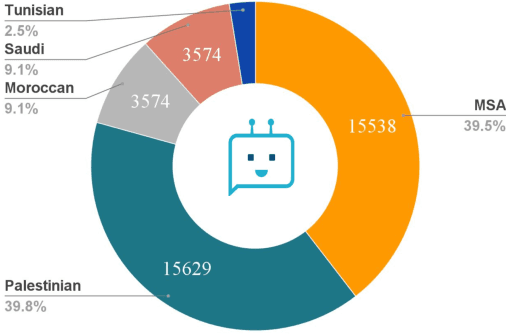
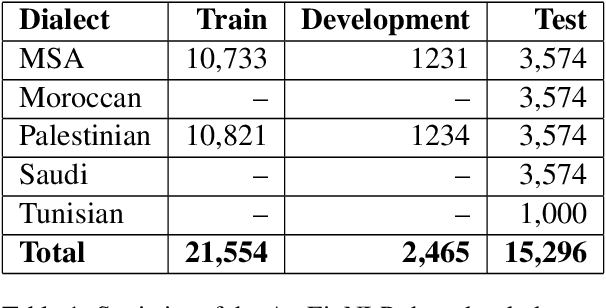
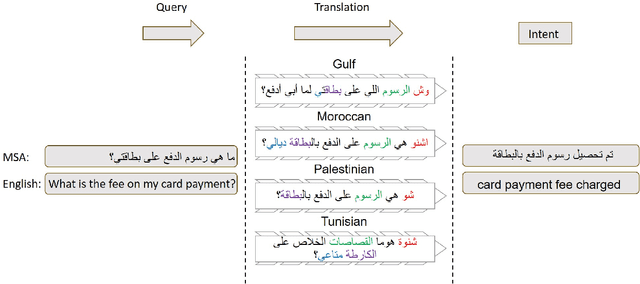

The expanding financial markets of the Arab world require sophisticated Arabic NLP tools. To address this need within the banking domain, the Arabic Financial NLP (AraFinNLP) shared task proposes two subtasks: (i) Multi-dialect Intent Detection and (ii) Cross-dialect Translation and Intent Preservation. This shared task uses the updated ArBanking77 dataset, which includes about 39k parallel queries in MSA and four dialects. Each query is labeled with one or more of a common 77 intents in the banking domain. These resources aim to foster the development of robust financial Arabic NLP, particularly in the areas of machine translation and banking chat-bots. A total of 45 unique teams registered for this shared task, with 11 of them actively participated in the test phase. Specifically, 11 teams participated in Subtask 1, while only 1 team participated in Subtask 2. The winning team of Subtask 1 achieved F1 score of 0.8773, and the only team submitted in Subtask 2 achieved a 1.667 BLEU score.