 Add to Chrome
 Add to Firefox
 Add to Edge
Lotka-Sharpe Neural Operators for Control of Population PDEs
Apr 04, 2026
Age-structured predator-prey integro-partial differential equations provide models of interacting populations in ecology, epidemiology, and biotechnology. A key challenge in feedback design for these systems is the scalar $ζ$, defined implicitly by the Lotka-Sharpe nonlinear integral condition, as a mapping from fertility and mortality rates to $ζ$. To solve this challenge with operator learning, we first prove that the Lotka-Sharpe operator is Lipschitz continuous, guaranteeing the existence of arbitrarily accurate neural operator approximations over a compact set of fertility and mortality functions. We then show that the resulting approximate feedback law preserves semi-global practical asymptotic stability under propagation of the operator approximation error through various other nonlinear operators, all the way through to the control input. In the numerical results, not only do we learn ``once-and-for-all'' the canonical Lotka-Sharpe (LS) operator, and thus make it available for future uses in control of other age-structured population interconnections, but we demonstrate the online usage of the neural LS operator under estimation of the fertility and mortality functions.

Moving-Horizon Estimators for Hyperbolic and Parabolic PDEs in 1-D
Jan 04, 2024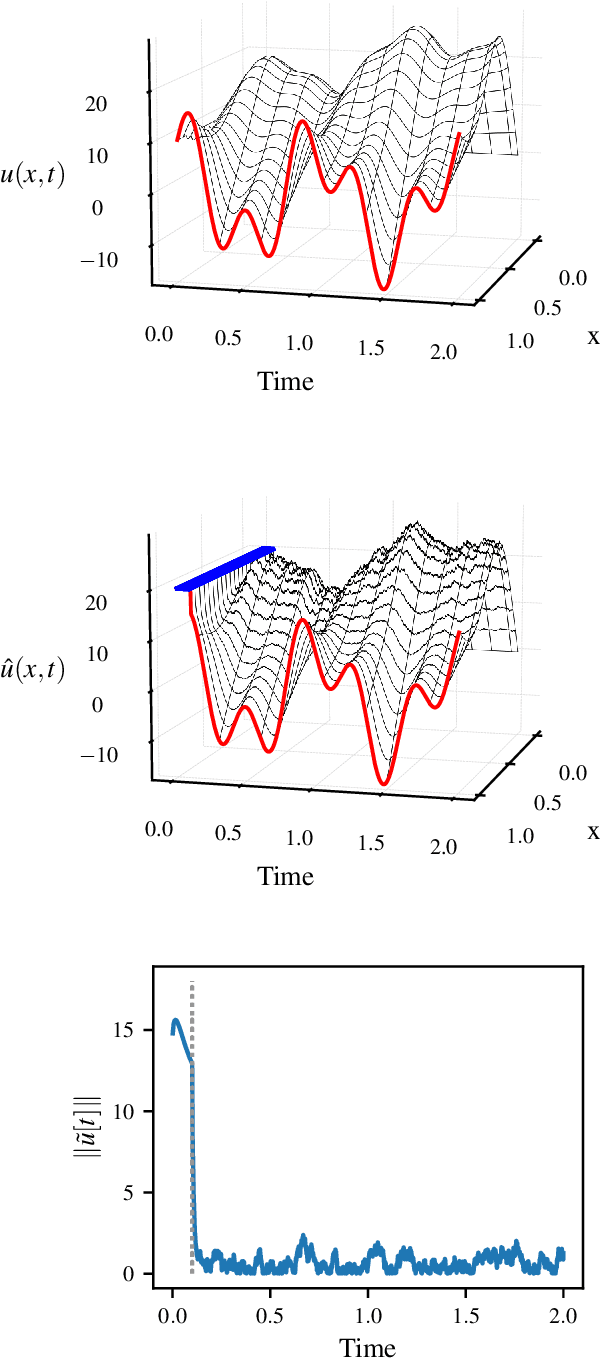
Observers for PDEs are themselves PDEs. Therefore, producing real time estimates with such observers is computationally burdensome. For both finite-dimensional and ODE systems, moving-horizon estimators (MHE) are operators whose output is the state estimate, while their inputs are the initial state estimate at the beginning of the horizon as well as the measured output and input signals over the moving time horizon. In this paper we introduce MHEs for PDEs which remove the need for a numerical solution of an observer PDE in real time. We accomplish this using the PDE backstepping method which, for certain classes of both hyperbolic and parabolic PDEs, produces moving-horizon state estimates explicitly. Precisely, to explicitly produce the state estimates, we employ a backstepping transformation of a hard-to-solve observer PDE into a target observer PDE, which is explicitly solvable. The MHEs we propose are not new observer designs but simply the explicit MHE realizations, over a moving horizon of arbitrary length, of the existing backstepping observers. Our PDE MHEs lack the optimality of the MHEs that arose as duals of MPC, but they are given explicitly, even for PDEs. In the paper we provide explicit formulae for MHEs for both hyperbolic and parabolic PDEs, as well as simulation results that illustrate theoretically guaranteed convergence of the MHEs.