 Add to Chrome
 Add to Firefox
 Add to Edge
A Comparative Study of INDI and NDI with Nonlinear Disturbance Observer for Aerial Robotics
May 07, 2026
This work presents a simulation-based comparative robustness analysis of Incremental Nonlinear Dynamic Inversion (INDI) and Nonlinear Dynamic Inversion augmented with a nonlinear disturbance observer (NDI+NDO) for fully actuated aerial robots. A systematic simulation campaign across representative operating scenarios is conducted, where we compare tracking performance, robustness, control effort, under parametric variations, external disturbances, and measurement noise. Results show that INDI demonstrates stronger robustness in several model-mismatch and combined-stress cases, while NDI+NDO primarily matches nominal performance but exhibits greater sensitivity under several non-ideal conditions. These findings provide practical guidance on the relative strengths and limitations of incremental and observer-based inversion strategies for aerial robotic applications.

Stability Analysis of Geometric Control for a Canonical Class of Underactuated Aerial Vehicles with Spurious Forces
Feb 12, 2026Standard geometric control relies on force-moment decoupling, an assumption that breaks down in many aerial platforms due to spurious forces naturally induced by control moments. While strategies for such coupled systems have been validated experimentally, a rigorous theoretical certification of their stability is currently missing. This work fills this gap by providing the first formal stability analysis for a generic class of floating rigid bodies subject to spurious forces. We introduce a canonical model and construct a Lyapunov-based proof establishing local exponential stability of the hovering equilibrium. Crucially, the analysis explicitly addresses the structural challenges - specifically the induced non-minimum-phase behavior - that prevent the application of standard cascade arguments.
Unified Feedback Linearization for Nonlinear Systems with Dexterous and Energy-Saving Modes
Feb 27, 2025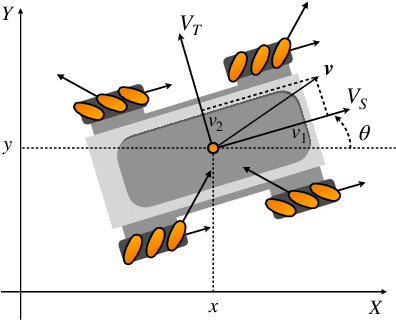
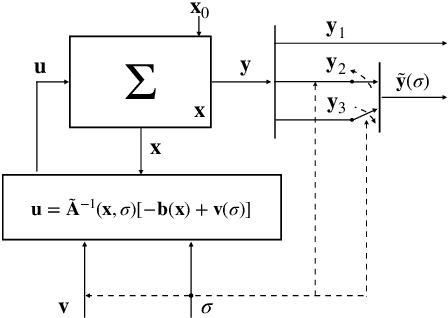
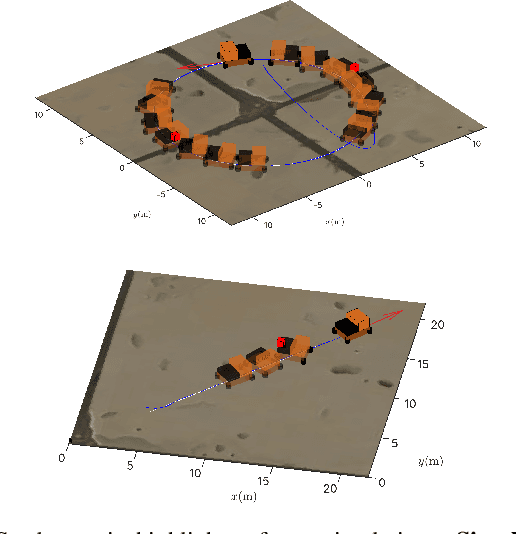
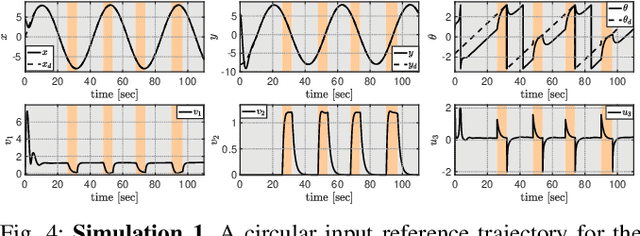
Systems with a high number of inputs compared to the degrees of freedom (e.g. a mobile robot with Mecanum wheels) often have a minimal set of energy-efficient inputs needed to achieve a main task (e.g. position tracking) and a set of energy-intense inputs needed to achieve an additional auxiliary task (e.g. orientation tracking). This letter presents a unified control scheme, derived through feedback linearization, that can switch between two modes: an energy-saving mode, which tracks the main task using only the energy-efficient inputs while forcing the energy-intense inputs to zero, and a dexterous mode, which also uses the energy-intense inputs to track the auxiliary task as needed. The proposed control guarantees the exponential tracking of the main task and that the dynamics associated with the main task evolve independently of the a priori unknown switching signal. When the control is operating in dexterous mode, the exponential tracking of the auxiliary task is also guaranteed. Numerical simulations on an omnidirectional Mecanum wheel robot validate the effectiveness of the proposed approach and demonstrate the effect of the switching signal on the exponential tracking behavior of the main and auxiliary tasks.