 Add to Chrome
 Add to Firefox
 Add to Edge
Learning to Test: Physics-Informed Representation for Dynamical Instability Detection
Apr 13, 2026
Many safety-critical scientific and engineering systems evolve according to differential-algebraic equations (DAEs), where dynamical behavior is constrained by physical laws and admissibility conditions. In practice, these systems operate under stochastically varying environmental inputs, so stability is not a static property but must be reassessed as the context distribution shifts. Repeated large-scale DAE simulation, however, is computationally prohibitive in high-dimensional or real-time settings. This paper proposes a test-oriented learning framework for stability assessment under distribution shift. Rather than re-estimating physical parameters or repeatedly solving the underlying DAE, we learn a physics-informed latent representation of contextual variables that captures stability-relevant structure and is regularized toward a tractable reference distribution. Trained on baseline data from a certified safe regime, the learned representation enables deployment-time safety monitoring to be formulated as a distributional hypothesis test in latent space, with controlled Type I error. By integrating neural dynamical surrogates, uncertainty-aware calibration, and uniformity-based testing, our approach provides a scalable and statistically grounded method for detecting instability risk in stochastic constrained dynamical systems without repeated simulation.

Optimizing Probabilistic Conformal Prediction with Vectorized Non-Conformity Scores
Oct 17, 2024
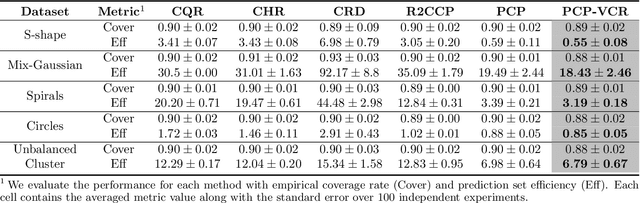
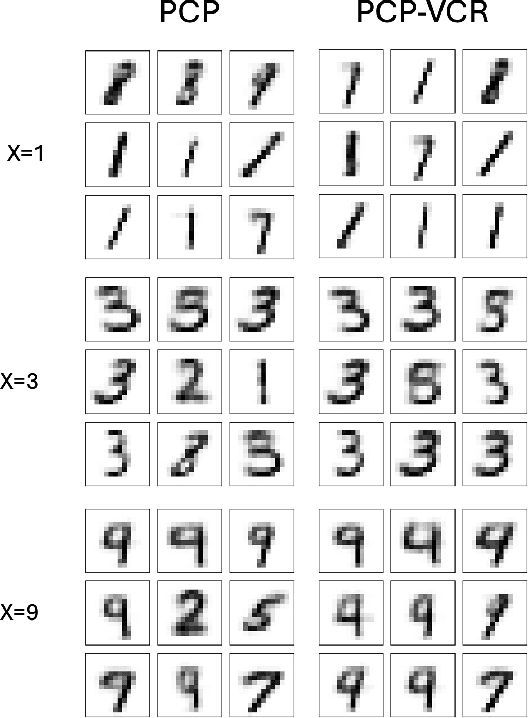

Generative models have shown significant promise in critical domains such as medical diagnosis, autonomous driving, and climate science, where reliable decision-making hinges on accurate uncertainty quantification. While probabilistic conformal prediction (PCP) offers a powerful framework for this purpose, its coverage efficiency -- the size of the uncertainty set -- is limited when dealing with complex underlying distributions and a finite number of generated samples. In this paper, we propose a novel PCP framework that enhances efficiency by first vectorizing the non-conformity scores with ranked samples and then optimizing the shape of the prediction set by varying the quantiles for samples at the same rank. Our method delivers valid coverage while producing discontinuous and more efficient prediction sets, making it particularly suited for high-stakes applications. We demonstrate the effectiveness of our approach through experiments on both synthetic and real-world datasets.
Interactive Visualization and Representation Analysis Applied to Glacier Segmentation
Dec 11, 2021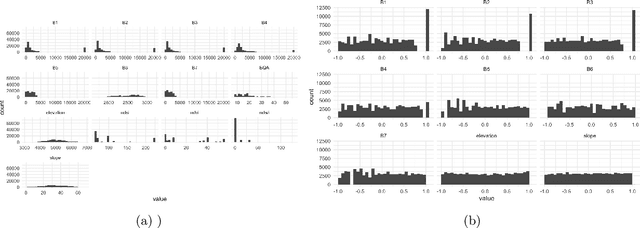
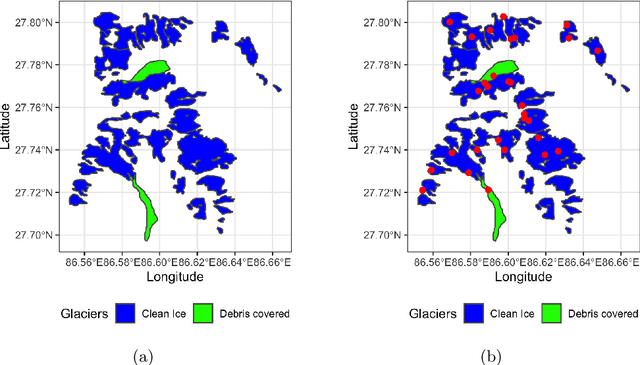
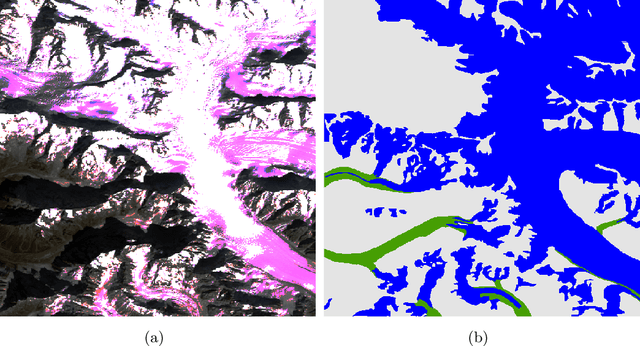
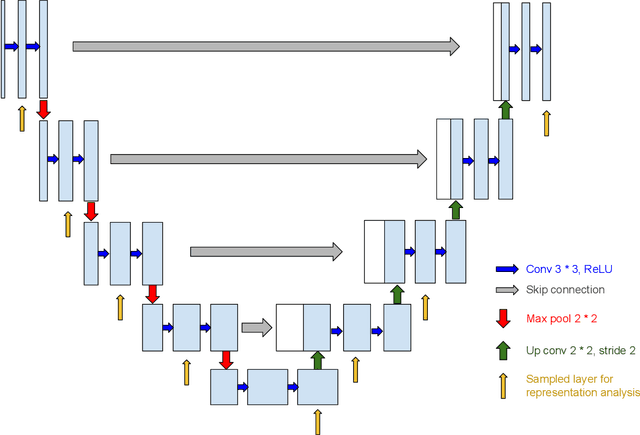
Interpretability has attracted increasing attention in earth observation problems. We apply interactive visualization and representation analysis to guide interpretation of glacier segmentation models. We visualize the activations from a U-Net to understand and evaluate the model performance. We build an online interface using the Shiny R package to provide comprehensive error analysis of the predictions. Users can interact with the panels and discover model failure modes. Further, we discuss how visualization can provide sanity checks during data preprocessing and model training.