 Add to Chrome
 Add to Firefox
 Add to Edge
Shape Deformation Networks for Automated Aortic Valve Finite Element Meshing from 3D CT Images
Nov 05, 2025


Accurate geometric modeling of the aortic valve from 3D CT images is essential for biomechanical analysis and patient-specific simulations to assess valve health or make a preoperative plan. However, it remains challenging to generate aortic valve meshes with both high-quality and consistency across different patients. Traditional approaches often produce triangular meshes with irregular topologies, which can result in poorly shaped elements and inconsistent correspondence due to inter-patient anatomical variation. In this work, we address these challenges by introducing a template-fitting pipeline with deep neural networks to generate structured quad (i.e., quadrilateral) meshes from 3D CT images to represent aortic valve geometries. By remeshing aortic valves of all patients with a common quad mesh template, we ensure a uniform mesh topology with consistent node-to-node and element-to-element correspondence across patients. This consistency enables us to simplify the learning objective of the deep neural networks, by employing a loss function with only two terms (i.e., a geometry reconstruction term and a smoothness regularization term), which is sufficient to preserve mesh smoothness and element quality. Our experiments demonstrate that the proposed approach produces high-quality aortic valve surface meshes with improved smoothness and shape quality, while requiring fewer explicit regularization terms compared to the traditional methods. These results highlight that using structured quad meshes for the template and neural network training not only ensures mesh correspondence and quality but also simplifies the training process, thus enhancing the effectiveness and efficiency of aortic valve modeling.

Robust automated calcification meshing for biomechanical cardiac digital twins
Mar 08, 2024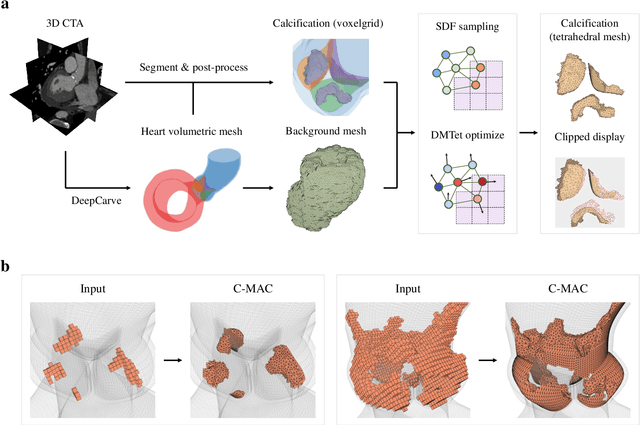
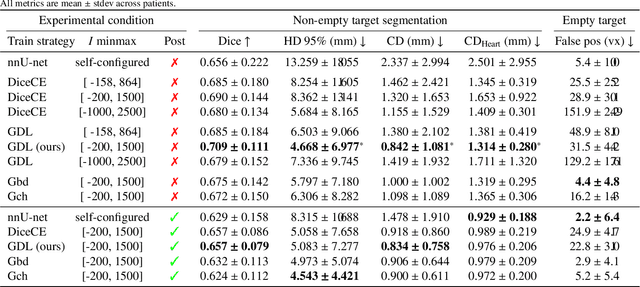
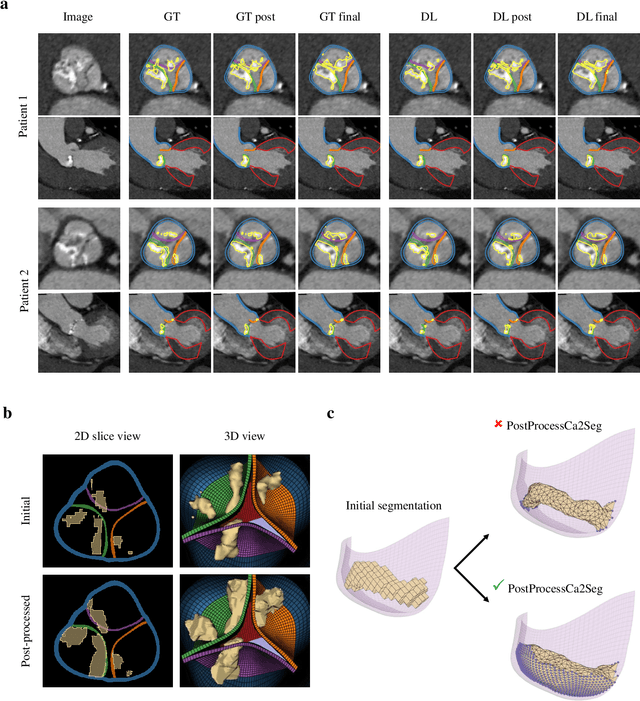
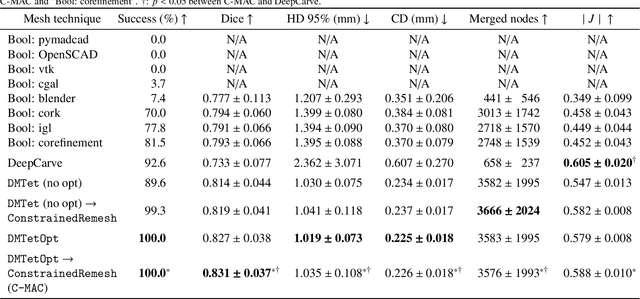
Calcification has significant influence over cardiovascular diseases and interventions. Detailed characterization of calcification is thus desired for predictive modeling, but calcified heart meshes for physics-driven simulations are still often reconstructed using manual operations. This poses a major bottleneck for large-scale adoption of computational simulations for research or clinical use. To address this, we propose an end-to-end automated meshing algorithm that enables robust incorporation of patient-specific calcification onto a given heart mesh. The algorithm provides a substantial speed-up from several hours of manual meshing to $\sim$1 minute of automated computation, and it solves an important problem that cannot be addressed with recent template registration-based heart meshing techniques. We validated our final calcified heart meshes with extensive simulations, demonstrating our ability to accurately model patient-specific aortic stenosis and Transcatheter Aortic Valve Replacement. Our method may serve as an important tool for accelerating the development and usage of physics-driven simulations for cardiac digital twins.