 Add to Chrome
 Add to Firefox
 Add to Edge
Enhancing Imaging Depth and Sensitivity in Reflectance Mode Near Infrared Optical Imaging with Scatter Reducing Agents
Jan 30, 2026
We investigate the role of scatter reducing agents in a continuous wave (CW) near infrared (NIR)reflectance mode imaging setting. We use food-grade dye Tartrazine as a scatter reducing agent to enhance depth sensitivity and weak-absorber detectability in CW diffuse reflectance measurements. We found that reflectance signal was enhanced when the dye was applied on chicken breast phantom. However, we saw reduced reflectance sensitivity when the dye was uniformly dissolved in intralipid phantom which is a commonly used for NIR imaging studies. This shows that the gradient of refractive index modulation created as the dye diffuses from the top layer allows increased reflectance signal sensitivity of optical photons. However, when the scatter reduction is uniform throughout the phantom (like in intralipid phantom), the improved reflectance sensitivity was not observed. Our study points to significant redistribution of photons with scatter modulation with Tartrazine dye. We show significant improvement in sensitivity to signals with reflectance imaging. To elucidate the underlying mechanism of dye induced scatter reduction in tissue, analytical diffusion models and Monte Carlo simulations were employed. Modeling results show the impact of refractive index gradient created due to dye diffusion in enhancing reflectance sensitivity. These findings demonstrate that dye induced scatter reduction provides a practical, low-complexity approach to improving depth sensitivity in CW diffuse reflectance measurements and extend the functional capabilities of CW-NIRS systems for deep-tissue sensing applications. Our preliminary studies shows up to five fold enhancement in signal sensitivity for signals between two and three cm depth.

A Novel Differential Pathlength Factor Model for Near-Infrared Diffuse Optical Imaging
Jan 30, 2026Near infrared diffuse optical imaging can be performed in reflectance and transmission mode and relies on physical models along with measurements to extract information on changes in chromophore concentration. Continuous-wave near-infrared diffuse optical imaging relies on accurate differential pathlength factors (DPFs) for quantitative chromophore estimation. Existing DPF definitions inherit formulation-dependent limitations that can introduce large errors in modified Beer--Lambert law analyses. These errors are significantly higher at smaller source-detector separations in a reflectance mode of measurement. This minimizes their applicability in situations where large area detection is used and also when signal depth is varying. Using Monte Carlo simulations, we derive two distance- and property-dependent DPF models one ideal and one experimentally practical and benchmark them against standard formulations. The proposed models achieve errors below 10 percent across broad optical conditions, whereas conventional DPFs can exceed 100 percent error. The theoretical predictions are further validated using controlled phantom experiments, demonstrating improved quantitative accuracy in CW-NIR imaging.
Changes in Visual Attention Patterns for Detection Tasks due to Dependencies on Signal and Background Spatial Frequencies
Jan 13, 2026We aim to investigate the impact of image and signal properties on visual attention mechanisms during a signal detection task in digital images. The application of insight yielded from this work spans many areas of digital imaging where signal or pattern recognition is involved in complex heterogenous background. We used simulated tomographic breast images as the platform to investigate this question. While radiologists are highly effective at analyzing medical images to detect and diagnose diseases, misdiagnosis still occurs. We selected digital breast tomosynthesis (DBT) images as a sample medical images with different breast densities and structures using digital breast phantoms (Bakic and XCAT). Two types of lesions (with distinct spatial frequency properties) were randomly inserted in the phantoms during projections to generate abnormal cases. Six human observers participated in observer study designed for a locating and detection of an 3-mm sphere lesion and 6-mm spicule lesion in reconstructed in-plane DBT slices. We collected eye-gaze data to estimate gaze metrics and to examine differences in visual attention mechanisms. We found that detection performance in complex visual environments is strongly constrained by later perceptual stages, with decision failures accounting for the largest proportion of errors. Signal detectability is jointly influenced by both target morphology and background complexity, revealing a critical interaction between local signal features and global anatomical noise. Increased fixation duration on spiculated lesions suggests that visual attention is differentially engaged depending on background and signal spatial frequency dependencies.
Predicting Region of Interest in Human Visual Search Based on Statistical Texture and Gabor Features
Jan 12, 2026Understanding human visual search behavior is a fundamental problem in vision science and computer vision, with direct implications for modeling how observers allocate attention in location-unknown search tasks. In this study, we investigate the relationship between Gabor-based features and gray-level co-occurrence matrix (GLCM) based texture features in modeling early-stage visual search behavior. Two feature-combination pipelines are proposed to integrate Gabor and GLCM features for narrowing the region of possible human fixations. The pipelines are evaluated using simulated digital breast tomosynthesis images. Results show qualitative agreement among fixation candidates predicted by the proposed pipelines and a threshold-based model observer. A strong correlation is observed between GLCM mean and Gabor feature responses, indicating that these features encode related image information despite their different formulations. Eye-tracking data from human observers further suggest consistency between predicted fixation regions and early-stage gaze behavior. These findings highlight the value of combining structural and texture-based features for modeling visual search and support the development of perceptually informed observer models.
Examining the Influence of Digital Phantom Models in Virtual Imaging Trials for Tomographic Breast Imaging
Feb 01, 2024Purpose: Digital phantoms are one of the key components of virtual imaging trials (VITs) that aim to assess and optimize new medical imaging systems and algorithms. However, these phantoms vary in their voxel resolution, appearance, and structural details. This study aims to examine whether and how variations between digital phantoms influence system optimization with digital breast tomosynthesis (DBT) as a chosen modality. Methods: We selected widely used and open-access digital breast phantoms generated with different methods. For each phantom type, we created an ensemble of DBT images to test acquisition strategies. Human observer localization ROC (LROC) was used to assess observer performance studies for each case. Noise power spectrum (NPS) was estimated to compare the phantom structural components. Further, we computed several gaze metrics to quantify the gaze pattern when viewing images generated from different phantom types. Results: Our LROC results show that the arc samplings for peak performance were approximately 2.5 degrees and 6 degrees in Bakic and XCAT breast phantoms respectively for 3-mm lesion detection tasks and indicate that system optimization outcomes from VITs can vary with phantom types and structural frequency components. Additionally, a significant correlation (p= 0.01) between gaze metrics and diagnostic performance suggests that gaze analysis can be used to understand and evaluate task difficulty in VITs.
Transport-of-Intensity Model for Single-Mask X-ray Differential Phase Contrast Imaging
Oct 29, 2023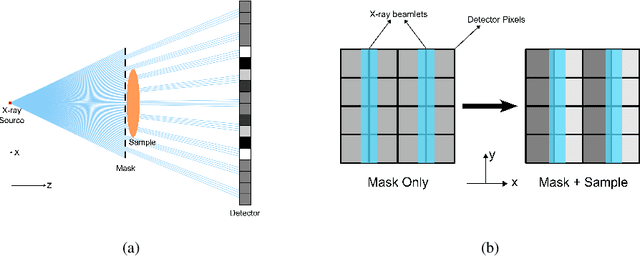
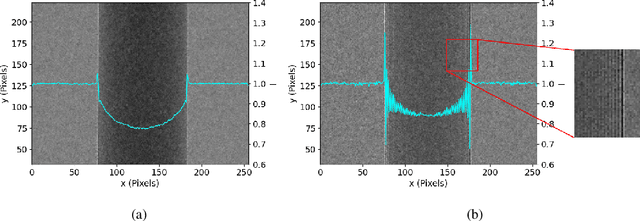
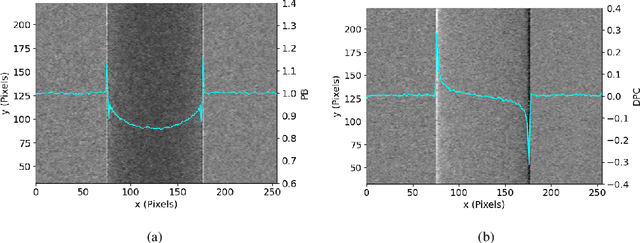
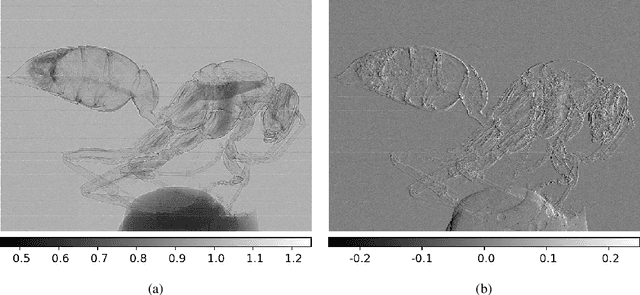
X-ray phase contrast imaging has emerged as a promising technique for enhancing contrast and visibility of light-element materials, including soft tissues and tumors. In this paper, we propose a novel model for a single-mask phase imaging system based on the transport-of-intensity equation. Our model offers an intuitive understanding of signal and contrast formation in single-mask phase imaging systems. We also demonstrate efficient retrieval of attenuation and differential phase contrast with just one intensity image without requiring spectral information or mask/detector movement. The model validity as well as the proposed retrieval method is demonstrated via both experimental results on a system developed in-house as well as with Monte Carlo simulations. Our proposed model overcomes the limitations of existing models by providing an intuitive visualization of the image formation process. It also allows optimizing differential phase imaging geometries for practical applications, further enhancing broader applicability. Furthermore, the general methodology described herein offers insight on deriving transport-of-intensity models for novel X-ray imaging systems with periodic structures in the beam path.
Iterative Clustering Material Decomposition Aided by Empirical Spectral Correction for High-Resolution Photon-Counting Detectors in Micro-CT
Oct 17, 2023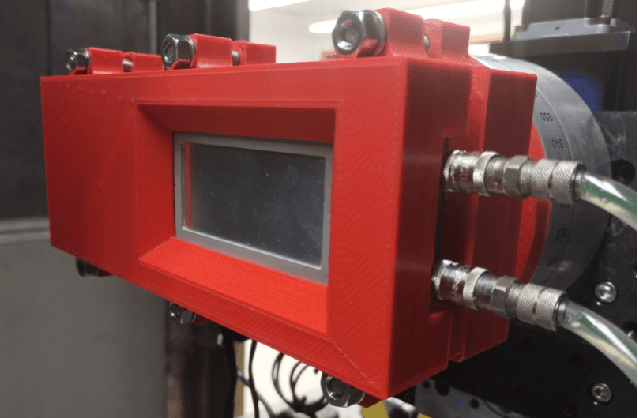
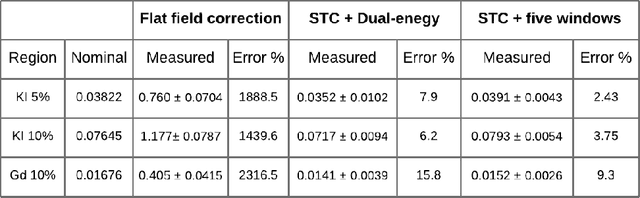
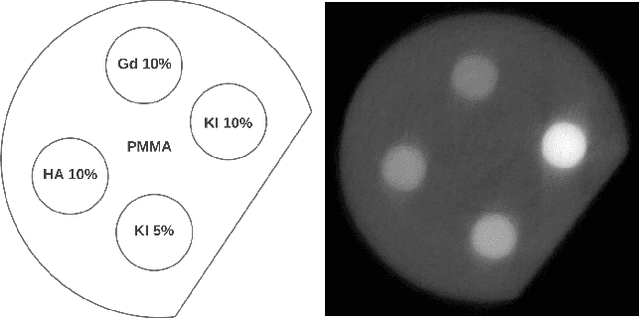
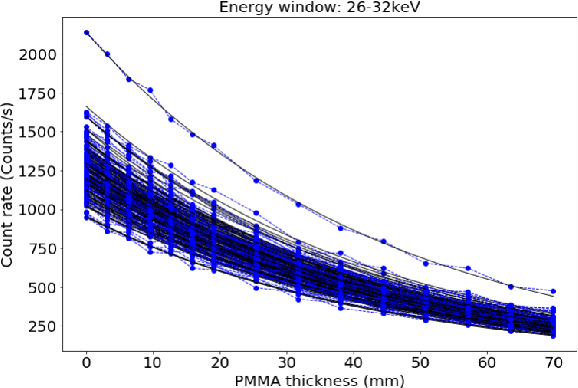
Photon counting detectors (PCDs) offer promising advancements in computed tomography (CT) imaging by enabling the quantification and 3D imaging of contrast agents and tissue types through multi-energy projections. However, the accuracy of these decomposition methods hinges on precise composite spectral attenuation values that one must reconstruct from spectral micro CT. Factors such as surface defects, local temperature, signal amplification, and impurity levels can cause variations in detector efficiency between pixels, leading to significant quantitative errors. In addition, some inaccuracies such as the charge-sharing effects in PCDs are amplified with a high Z sensor material and also with a smaller detector pixels that are preferred for micro CT. In this work, we propose a comprehensive approach that combines practical instrumentation and measurement strategies leading to the quantitation of multiple materials within an object in a spectral micro CT with a photon counting detector. Our Iterative Clustering Material Decomposition (ICMD) includes an empirical method for detector spectral response corrections, cluster analysis and multi-step iterative material decomposition. Utilizing a CdTe-1mm Medipix detector with a 55$\mu$m pitch, we demonstrate the quantitatively accurate decomposition of several materials in a phantom study, where the sample includes mixtures of material, soft material and K-edge materials. We also show an example of biological sample imaging and separating three distinct types of tissue in mouse: muscle, fat and bone. Our experimental results show that the combination of spectral correction and high-dimensional data clustering enhances decomposition accuracy and reduces noise in micro CT. This ICMD allows for quantitative separation of more than three materials including mixtures and also effectively separates multi-contrast agents.