 Add to Chrome
 Add to Firefox
 Add to Edge
AV-SQL: Decomposing Complex Text-to-SQL Queries with Agentic Views
Apr 08, 2026
Text-to-SQL is the task of translating natural language queries into executable SQL for a given database, enabling non-expert users to access structured data without writing SQL manually. Despite rapid advances driven by large language models (LLMs), existing approaches still struggle with complex queries in real-world settings, where database schemas are large and questions require multi-step reasoning over many interrelated tables. In such cases, providing the full schema often exceeds the context window, while one-shot generation frequently produces non-executable SQL due to syntax errors and incorrect schema linking. To address these challenges, we introduce AV-SQL, a framework that decomposes complex Text-to-SQL into a pipeline of specialized LLM agents. Central to AV-SQL is the concept of agentic views: agent-generated Common Table Expressions (CTEs) that encapsulate intermediate query logic and filter relevant schema elements from large schemas. AV-SQL operates in three stages: (1) a rewriter agent compresses and clarifies the input query; (2) a view generator agent processes schema chunks to produce agentic views; and (3) a planner, generator, and revisor agent collaboratively compose these views into the final SQL query. Extensive experiments show that AV-SQL achieves 70.38% execution accuracy on the challenging Spider 2.0 benchmark, outperforming state-of-the-art baselines, while remaining competitive on standard datasets with 85.59% on Spider, 72.16% on BIRD and 63.78% on KaggleDBQA. Our source code is available at https://github.com/pminhtam/AV-SQL.

A dual benchmarking study of facial forgery and facial forensics
Nov 25, 2021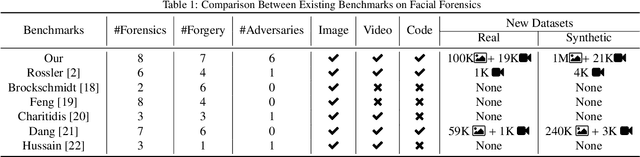
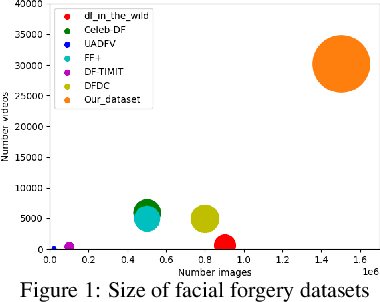
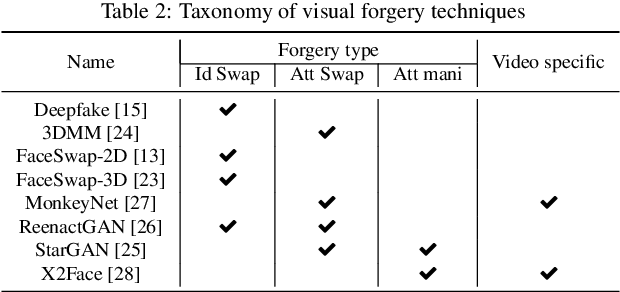
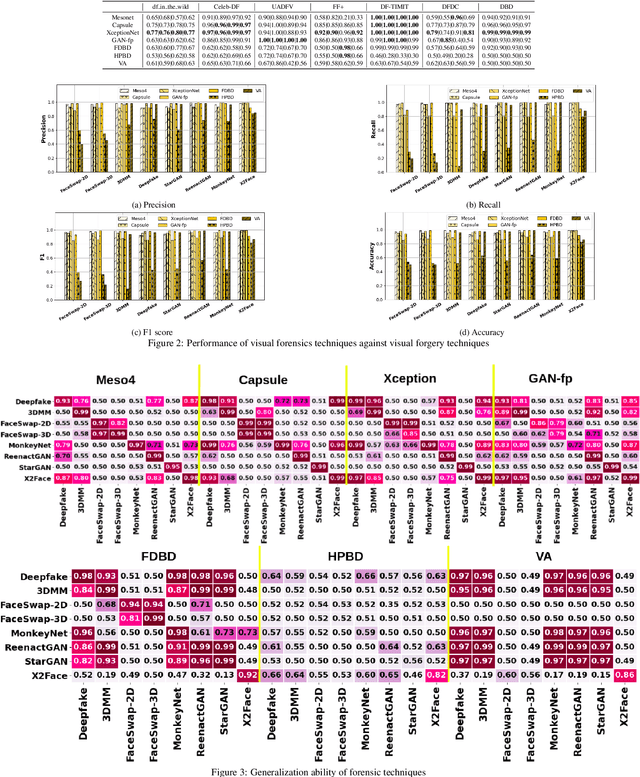
In recent years, visual forgery has reached a level of sophistication that humans cannot identify fraud, which poses a significant threat to information security. A wide range of malicious applications have emerged, such as fake news, defamation or blackmailing of celebrities, impersonation of politicians in political warfare, and the spreading of rumours to attract views. As a result, a rich body of visual forensic techniques has been proposed in an attempt to stop this dangerous trend. In this paper, we present a benchmark that provides in-depth insights into visual forgery and visual forensics, using a comprehensive and empirical approach. More specifically, we develop an independent framework that integrates state-of-the-arts counterfeit generators and detectors, and measure the performance of these techniques using various criteria. We also perform an exhaustive analysis of the benchmarking results, to determine the characteristics of the methods that serve as a comparative reference in this never-ending war between measures and countermeasures.