 Add to Chrome
 Add to Firefox
 Add to Edge
Teaching Code LLMs to Reason with Intermediate Formal Specifications
Jul 05, 2026
Unlike natural-language specifications, executable formal specifications provide machine-checkable constraints for verifying, debugging, and repairing code. However, writing such specifications is labor-intensive, and existing LLM-based methods mainly infer whole-program pre/postconditions, missing the intermediate semantic commitments that programmers rely on when reasoning about an algorithm. Our study further shows that prompting current CodeLLMs often produces executable assertions that are syntactically invalid, trivial, or too weak to reject behavior-changing faults. In this paper, we study executable checkpoint specification generation, where assertions are inserted at meaningful internal program points to describe expected intermediate states. We introduce SpecCoder, a verification-guided CodeLLM training framework that learns from validated reference programs, behavior-changing mutants, and multi-turn specification-refinement traces. SpecCoder selects specifications that hold on correct executions while rejecting faulty executions, turning specifications from passive annotations into executable evidence. To evaluate this setting, we introduce HumanExec, a benchmark built from recent Codeforces competitive programming problems with test suites, reference solutions, and human buggy submissions, supporting three tasks: specification generation, program correctness checking, and program repair. Experiments on HumanExec show that SpecCoder substantially improves checkpoint-specification quality over base CodeLLMs. Across Qwen2.5-Coder models, SpecCoder improves inline-specification correctness by up to 55.8%, completeness by up to 358.1%, and executable assertion validity by up to 26.6%. These gains further translate to downstream correctness reasoning and repair, showing that executable checkpoints provide fine-grained evidence for reliable verification.

FAID: Fine-grained AI-generated Text Detection using Multi-task Auxiliary and Multi-level Contrastive Learning
May 20, 2025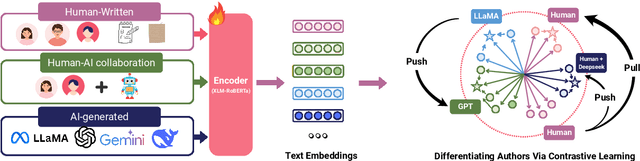
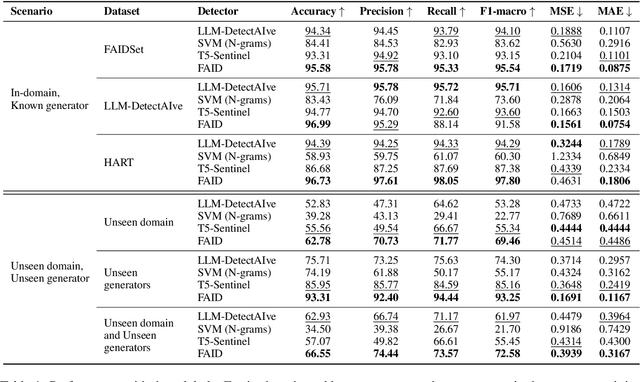
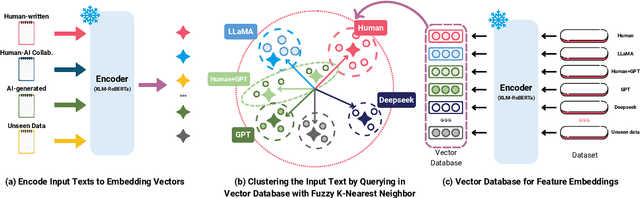
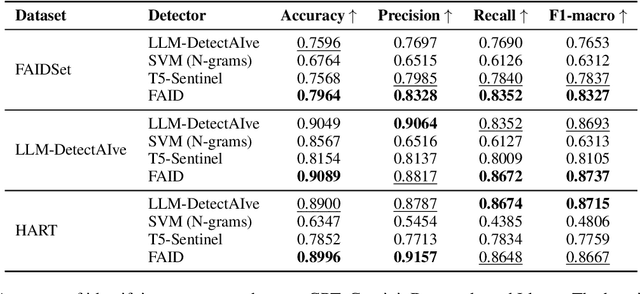
The growing collaboration between humans and AI models in generative tasks has introduced new challenges in distinguishing between human-written, AI-generated, and human-AI collaborative texts. In this work, we collect a multilingual, multi-domain, multi-generator dataset FAIDSet. We further introduce a fine-grained detection framework FAID to classify text into these three categories, meanwhile identifying the underlying AI model family. Unlike existing binary classifiers, FAID is built to capture both authorship and model-specific characteristics. Our method combines multi-level contrastive learning with multi-task auxiliary classification to learn subtle stylistic cues. By modeling AI families as distinct stylistic entities, FAID offers improved interpretability. We incorporate an adaptation to address distributional shifts without retraining for unseen data. Experimental results demonstrate that FAID outperforms several baseline approaches, particularly enhancing the generalization accuracy on unseen domains and new AI models. It provide a potential solution for improving transparency and accountability in AI-assisted writing.