 Add to Chrome
 Add to Firefox
 Add to Edge
TextFake: Benchmarking AI-Generated Image Detection on Text-Rich Images
May 31, 2026
Recent AI-generated image (AIGI) detectors perform well on natural-image benchmarks, but their behavior on text-rich forgeries, such as fabricated screenshots, documents, and news pages prevalent in misinformation, remains untested. We introduce TextFake, a 20,000-image benchmark for text-rich AIGI detection spanning 28 languages, 4 topic categories, and 2 scene modalities. Fake images are synthesized via a four-stage pipeline that annotates real images along three controlled dimensions and generates counterparts through distribution-aligned structured prompting, ruling out covariate shortcuts. Zero-shot evaluation of 14 specialized detectors and 3 frontier VLM APIs reveals a large systematic gap: no method exceeds 80% accuracy, with some dropping over 60% from natural-image benchmarks. Diagnostic evaluations identify three failure modes: the Text Density Curse, where dense glyphs overwhelm low-level detectors; Cloaking via Rendering Fidelity, where stronger text rendering suppresses enerative artifacts; and Threshold Collapse, where routine perturbations drive detectors toward chance-level performance.

BCDNet: A Convolutional Neural Network For Breast Cancer Detection
Aug 27, 2024
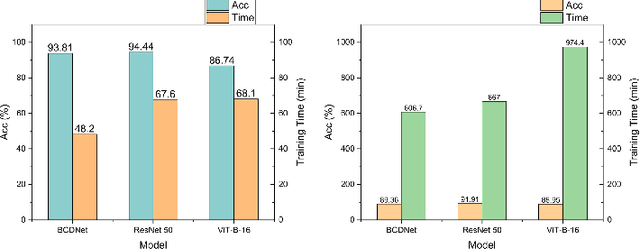


Previous research has established that breast cancer is a prevalent cancer type, with Invasive Ductal Carcinoma (IDC) being the most common subtype. The incidence of this dangerous cancer continues to rise, making accurate and rapid diagnosis, particularly in the early stages, critically important. While modern Computer-Aided Diagnosis (CAD) systems can address most cases, medical professionals still face challenges in using them in the field without powerful computing resources. In this paper, we propose a novel CNN model called BCDNet, which effectively detects IDC in histopathological images with an accuracy of up to 89.5% and reduces training time effectively.