 Add to Chrome
 Add to Firefox
 Add to Edge
SCDP: Learning Humanoid Locomotion from Partial Observations via Mixed-Observation Distillation
Mar 10, 2026
Distilling humanoid locomotion control from offline datasets into deployable policies remains a challenge, as existing methods rely on privileged full-body states that require complex and often unreliable state estimation. We present Sensor-Conditioned Diffusion Policies (SCDP) that enables humanoid locomotion using only onboard sensors, eliminating the need for explicit state estimation. SCDP decouples sensing from supervision through mixed-observation training: diffusion model conditions on sensor histories while being supervised to predict privileged future state-action trajectories, enforcing the model to infer the motion dynamics under partial observability. We further develop restricted denoising, context distribution alignment, and context-aware attention masking to encourage implicit state estimation within the model and to prevent train-deploy mismatch. We validate SCDP on velocity-commanded locomotion and motion reference tracking tasks. In simulation, SCDP achieves near-perfect success on velocity control (99-100%) and 93% tracking success in AMASS test set, performing comparable to privileged baselines while using only onboard sensors. Finally, we deploy the trained policy on a real G1 humanoid at 50 Hz, demonstrating robust real robot locomotion without external sensing or state estimation.

Agile and Versatile Robot Locomotion via Kernel-based Residual Learning
Feb 14, 2023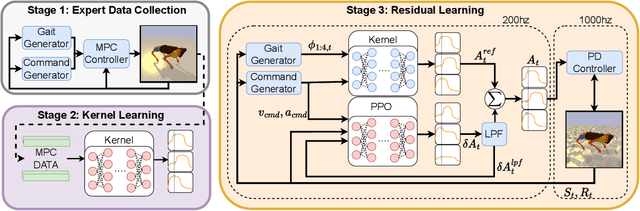
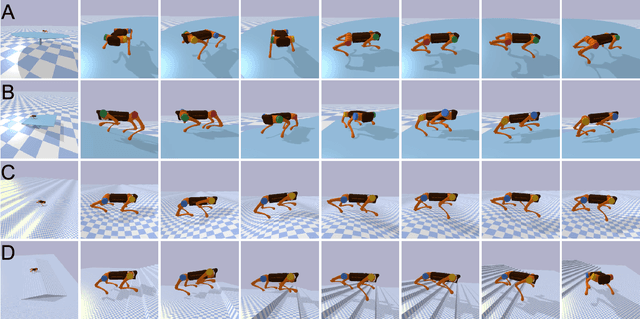
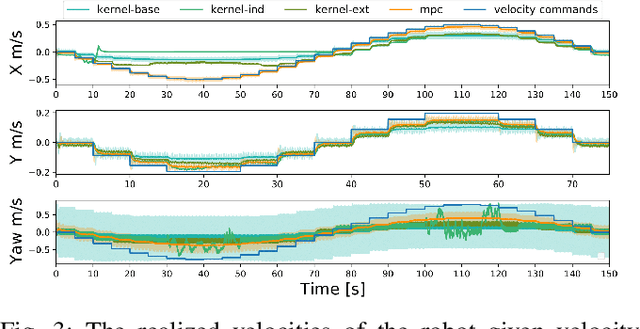
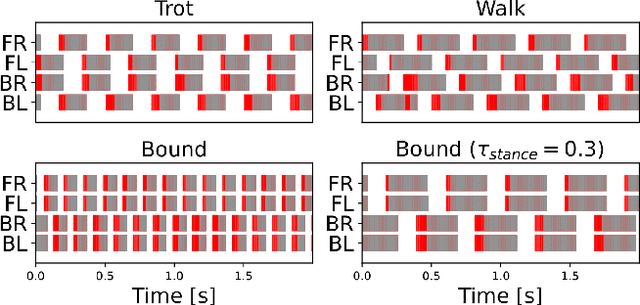
This work developed a kernel-based residual learning framework for quadrupedal robotic locomotion. Initially, a kernel neural network is trained with data collected from an MPC controller. Alongside a frozen kernel network, a residual controller network is trained via reinforcement learning to acquire generalized locomotion skills and resilience against external perturbations. With this proposed framework, a robust quadrupedal locomotion controller is learned with high sample efficiency and controllability, providing omnidirectional locomotion at continuous velocities. Its versatility and robustness are validated on unseen terrains that the expert MPC controller fails to traverse. Furthermore, the learned kernel can produce a range of functional locomotion behaviors and can generalize to unseen gaits.