 Add to Chrome
 Add to Firefox
 Add to Edge
Extending LLM Context via Associative Recurrent Memory
Jul 13, 2026
Extending the context length of large language models (LLMs) is critical for many real-world applications, yet standard transformers remain constrained by quadratic compute and linear memory scaling. In this work, we investigate the Associative Recurrent Memory Transformer (ARMT) as a practical approach for enabling long-context processing in LLMs, constant memory scaling, and better efficiency. We make three main contributions. First, we construct two domain-specific long-context datasets designed to evaluate realistic workloads, focusing on narrow-domain fine-tuning scenarios. Second, we propose a comprehensive training recipe for ARMT-based context extension, combining continued pre-training, synthetic long-context data generation, curriculum learning, and selective integration of associative memory into chosen model layers. Third, we present an extensive experimental study demonstrating that ARMT-augmented models: (i) process inputs well beyond their original context limits without degrading performance relative to in-limit baselines; (ii) generalize more effectively to out-of-distribution context lengths; and (iii) need 30% less FLOPs while preserving baseline performance within the original context window.

Semantic Chunking and the Entropy of Natural Language
Feb 13, 2026The entropy rate of printed English is famously estimated to be about one bit per character, a benchmark that modern large language models (LLMs) have only recently approached. This entropy rate implies that English contains nearly 80 percent redundancy relative to the five bits per character expected for random text. We introduce a statistical model that attempts to capture the intricate multi-scale structure of natural language, providing a first-principles account of this redundancy level. Our model describes a procedure of self-similarly segmenting text into semantically coherent chunks down to the single-word level. The semantic structure of the text can then be hierarchically decomposed, allowing for analytical treatment. Numerical experiments with modern LLMs and open datasets suggest that our model quantitatively captures the structure of real texts at different levels of the semantic hierarchy. The entropy rate predicted by our model agrees with the estimated entropy rate of printed English. Moreover, our theory further reveals that the entropy rate of natural language is not fixed but should increase systematically with the semantic complexity of corpora, which are captured by the only free parameter in our model.
Random Tree Model of Meaningful Memory
Dec 02, 2024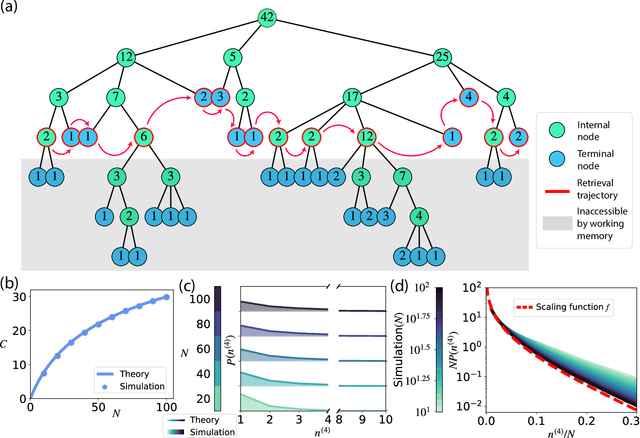
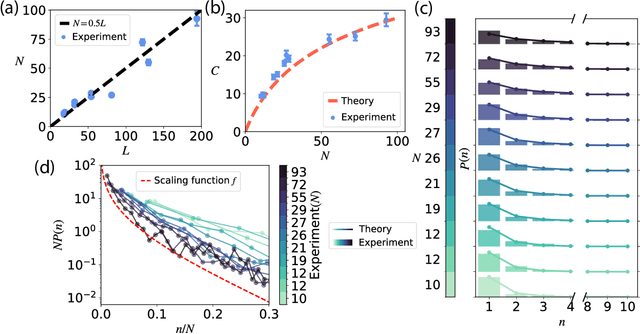
Traditional studies of memory for meaningful narratives focus on specific stories and their semantic structures but do not address common quantitative features of recall across different narratives. We introduce a statistical ensemble of random trees to represent narratives as hierarchies of key points, where each node is a compressed representation of its descendant leaves, which are the original narrative segments. Recall is modeled as constrained by working memory capacity from this hierarchical structure. Our analytical solution aligns with observations from large-scale narrative recall experiments. Specifically, our model explains that (1) average recall length increases sublinearly with narrative length, and (2) individuals summarize increasingly longer narrative segments in each recall sentence. Additionally, the theory predicts that for sufficiently long narratives, a universal, scale-invariant limit emerges, where the fraction of a narrative summarized by a single recall sentence follows a distribution independent of narrative length.
Hierarchical Working Memory and a New Magic Number
Aug 14, 2024The extremely limited working memory span, typically around four items, contrasts sharply with our everyday experience of processing much larger streams of sensory information concurrently. This disparity suggests that working memory can organize information into compact representations such as chunks, yet the underlying neural mechanisms remain largely unknown. Here, we propose a recurrent neural network model for chunking within the framework of the synaptic theory of working memory. We showed that by selectively suppressing groups of stimuli, the network can maintain and retrieve the stimuli in chunks, hence exceeding the basic capacity. Moreover, we show that our model can dynamically construct hierarchical representations within working memory through hierarchical chunking. A consequence of this proposed mechanism is a new limit on the number of items that can be stored and subsequently retrieved from working memory, depending only on the basic working memory capacity when chunking is not invoked. Predictions from our model were confirmed by analyzing single-unit responses in epileptic patients and memory experiments with verbal material. Our work provides a novel conceptual and analytical framework for understanding the on-the-fly organization of information in the brain that is crucial for cognition.
Using large language models to study human memory for meaningful narratives
Nov 28, 2023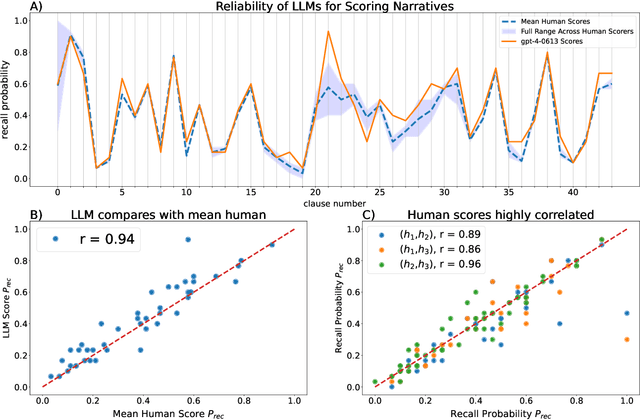
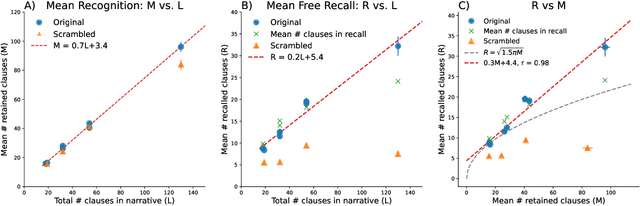
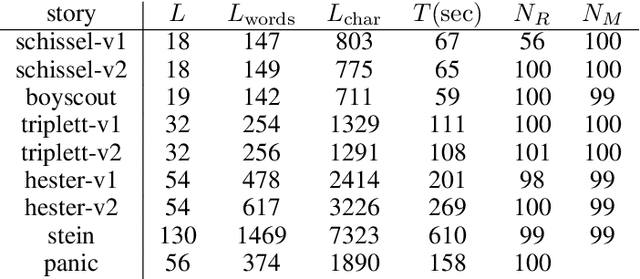
One of the most impressive achievements of the AI revolution is the development of large language models that can generate meaningful text and respond to instructions in plain English with no additional training necessary. Here we show that language models can be used as a scientific instrument for studying human memory for meaningful material. We developed a pipeline for designing large scale memory experiments and analyzing the obtained results. We performed online memory experiments with a large number of participants and collected recognition and recall data for narratives of different lengths. We found that both recall and recognition performance scale linearly with narrative length. Furthermore, in order to investigate the role of narrative comprehension in memory, we repeated these experiments using scrambled versions of the presented stories. We found that even though recall performance declined significantly, recognition remained largely unaffected. Interestingly, recalls in this condition seem to follow the original narrative order rather than the scrambled presentation, pointing to a contextual reconstruction of the story in memory.