 Add to Chrome
 Add to Firefox
 Add to Edge
Extending LLM Context via Associative Recurrent Memory
Jul 13, 2026
Extending the context length of large language models (LLMs) is critical for many real-world applications, yet standard transformers remain constrained by quadratic compute and linear memory scaling. In this work, we investigate the Associative Recurrent Memory Transformer (ARMT) as a practical approach for enabling long-context processing in LLMs, constant memory scaling, and better efficiency. We make three main contributions. First, we construct two domain-specific long-context datasets designed to evaluate realistic workloads, focusing on narrow-domain fine-tuning scenarios. Second, we propose a comprehensive training recipe for ARMT-based context extension, combining continued pre-training, synthetic long-context data generation, curriculum learning, and selective integration of associative memory into chosen model layers. Third, we present an extensive experimental study demonstrating that ARMT-augmented models: (i) process inputs well beyond their original context limits without degrading performance relative to in-limit baselines; (ii) generalize more effectively to out-of-distribution context lengths; and (iii) need 30% less FLOPs while preserving baseline performance within the original context window.

GradMem: Learning to Write Context into Memory with Test-Time Gradient Descent
Mar 14, 2026Many large language model applications require conditioning on long contexts. Transformers typically support this by storing a large per-layer KV-cache of past activations, which incurs substantial memory overhead. A desirable alternative is ompressive memory: read a context once, store it in a compact state, and answer many queries from that state. We study this in a context removal setting, where the model must generate an answer without access to the original context at inference time. We introduce GradMem, which writes context into memory via per-sample test-time optimization. Given a context, GradMem performs a few steps of gradient descent on a small set of prefix memory tokens while keeping model weights frozen. GradMem explicitly optimizes a model-level self-supervised context reconstruction loss, resulting in a loss-driven write operation with iterative error correction, unlike forward-only methods. On associative key--value retrieval, GradMem outperforms forward-only memory writers with the same memory size, and additional gradient steps scale capacity much more effectively than repeated forward writes. We further show that GradMem transfers beyond synthetic benchmarks: with pretrained language models, it attains competitive results on natural language tasks including bAbI and SQuAD variants, relying only on information encoded in memory.
Diagonal Batching Unlocks Parallelism in Recurrent Memory Transformers for Long Contexts
Jun 05, 2025Transformer models struggle with long-context inference due to their quadratic time and linear memory complexity. Recurrent Memory Transformers (RMTs) offer a solution by reducing the asymptotic cost to linear time and constant memory usage. However, their memory update mechanism leads to sequential execution, causing a performance bottleneck. We introduce Diagonal Batching, a scheduling scheme that unlocks parallelism across segments in RMTs while preserving exact recurrence. This approach eliminates the sequential constraint, enabling efficient GPU inference even for single long-context inputs without complex batching and pipelining techniques. Because the technique is purely a run-time computation reordering, existing RMT models adopt it with no retraining. Applied to a LLaMA-1B ARMT model, Diagonal Batching yields a 3.3x speedup over standard full-attention LLaMA-1B and a 1.8x speedup over the sequential RMT implementation on 131,072-token sequences. By removing sequential bottleneck, Diagonal Batching reduces inference cost and latency, thereby strengthening RMTs as a practical solution for real-world, long-context applications.
Associative Recurrent Memory Transformer
Jul 05, 2024
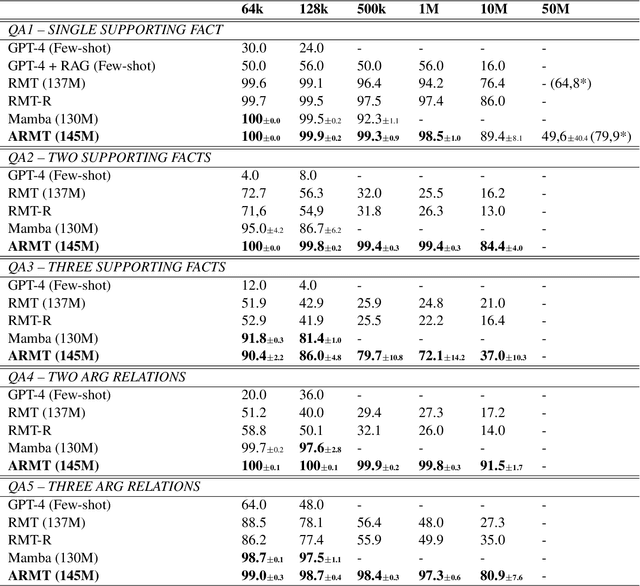
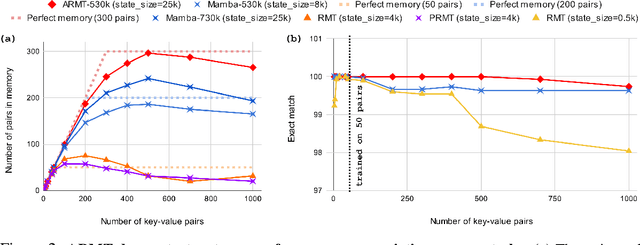

This paper addresses the challenge of creating a neural architecture for very long sequences that requires constant time for processing new information at each time step. Our approach, Associative Recurrent Memory Transformer (ARMT), is based on transformer self-attention for local context and segment-level recurrence for storage of task specific information distributed over a long context. We demonstrate that ARMT outperfors existing alternatives in associative retrieval tasks and sets a new performance record in the recent BABILong multi-task long-context benchmark by answering single-fact questions over 50 million tokens with an accuracy of 79.9%. The source code for training and evaluation is available on github.
BABILong: Testing the Limits of LLMs with Long Context Reasoning-in-a-Haystack
Jun 14, 2024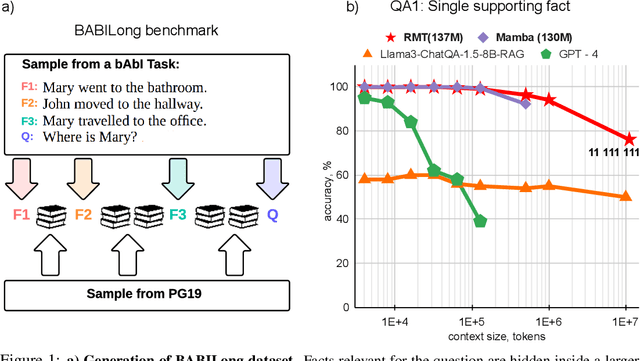
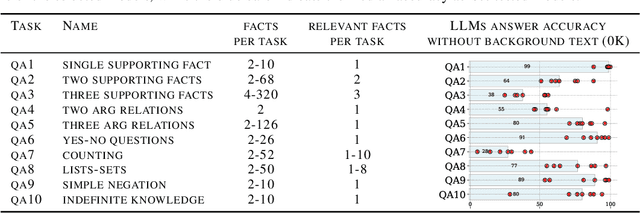
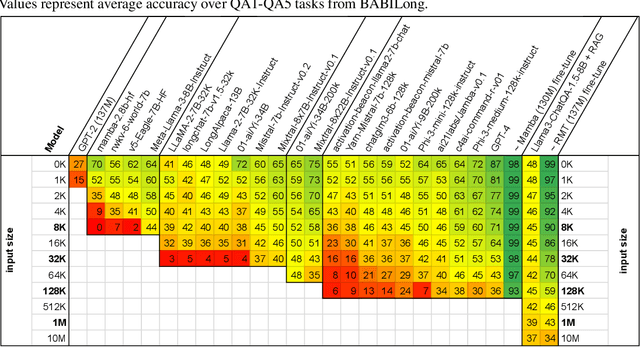
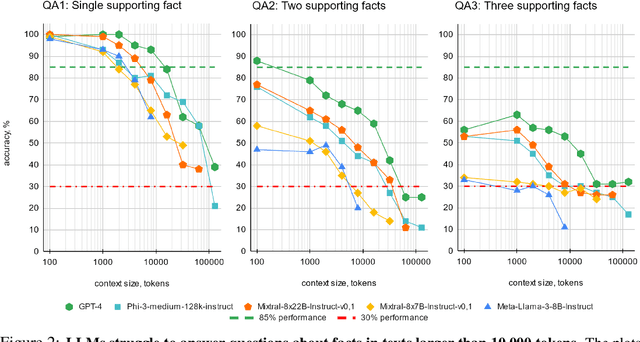
In recent years, the input context sizes of large language models (LLMs) have increased dramatically. However, existing evaluation methods have not kept pace, failing to comprehensively assess the efficiency of models in handling long contexts. To bridge this gap, we introduce the BABILong benchmark, designed to test language models' ability to reason across facts distributed in extremely long documents. BABILong includes a diverse set of 20 reasoning tasks, including fact chaining, simple induction, deduction, counting, and handling lists/sets. These tasks are challenging on their own, and even more demanding when the required facts are scattered across long natural text. Our evaluations show that popular LLMs effectively utilize only 10-20\% of the context and their performance declines sharply with increased reasoning complexity. Among alternatives to in-context reasoning, Retrieval-Augmented Generation methods achieve a modest 60\% accuracy on single-fact question answering, independent of context length. Among context extension methods, the highest performance is demonstrated by recurrent memory transformers, enabling the processing of lengths up to 11 million tokens. The BABILong benchmark is extendable to any length to support the evaluation of new upcoming models with increased capabilities, and we provide splits up to 1 million token lengths.