 Add to Chrome
 Add to Firefox
 Add to Edge
Conflict and Congruency Effects in Large Language Models: In-Weight and In-Context Competition in a Verbal Conflict Task
Aug 11, 2026
Congruency effects, observed in conflict tasks such as Stroop and flanker tasks, have been investigated for nearly a century in psychology and neuroscience, but their mechanistic basis is not fully understood. We introduce a verbal-only LLM conflict task in which a prompt stem elicits a default same-color completion and an explicit rule either agrees with (congruent condition) or conflicts with (incongruent condition) the completion. Gemma-2-2B and six Pythia models ranging from 410M to 12B parameters showed strong default same-color tendencies, and six of seven models showed strong congruency effects. Using causal attribution analysis, attention analysis, and attention ablations, we identified distinct processing pathways in these LLMs: a pathway involving short-range attention to a superficial color cue that is preferentially activated in the congruent condition, and a pathway involving long-range attention to the rule prefix that is preferentially activated in the incongruent condition. Fine-tuning that strengthened the default same-color tendency had divergent effects on task conditions, reducing incongruent performance while increasing congruent performance. In contrast, increasing rule set size selectively impaired incongruent performance. These converging findings support an account in which congruency effects in this task arise from competition between an in-weight default mapping and an in-context rule-based mapping. More broadly, our findings illustrate how LLMs can serve as model systems for mechanistic analysis of competition between default and rule-governed response tendencies within a single learned network.

A Domain Guided CNN Architecture for Predicting Age from Structural Brain Images
Aug 11, 2018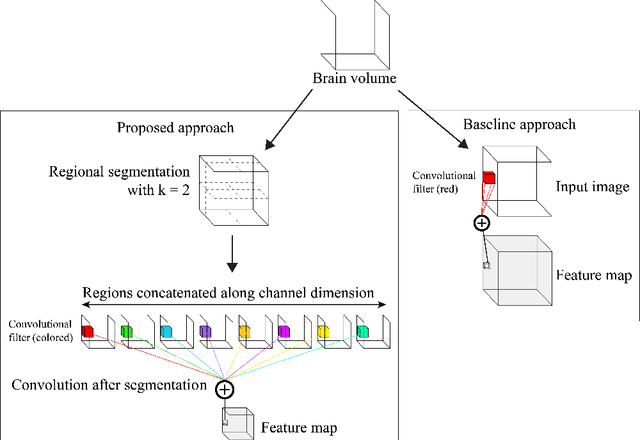

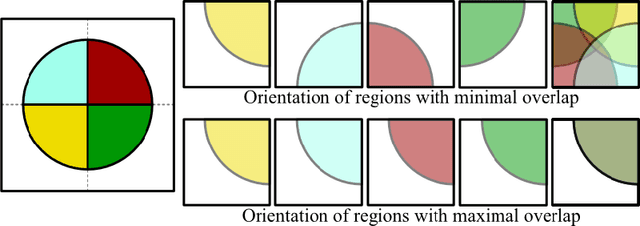
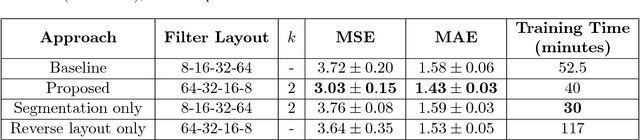
Given the wide success of convolutional neural networks (CNNs) applied to natural images, researchers have begun to apply them to neuroimaging data. To date, however, exploration of novel CNN architectures tailored to neuroimaging data has been limited. Several recent works fail to leverage the 3D structure of the brain, instead treating the brain as a set of independent 2D slices. Approaches that do utilize 3D convolutions rely on architectures developed for object recognition tasks in natural 2D images. Such architectures make assumptions about the input that may not hold for neuroimaging. For example, existing architectures assume that patterns in the brain exhibit translation invariance. However, a pattern in the brain may have different meaning depending on where in the brain it is located. There is a need to explore novel architectures that are tailored to brain images. We present two simple modifications to existing CNN architectures based on brain image structure. Applied to the task of brain age prediction, our network achieves a mean absolute error (MAE) of 1.4 years and trains 30% faster than a CNN baseline that achieves a MAE of 1.6 years. Our results suggest that lessons learned from developing models on natural images may not directly transfer to neuroimaging tasks. Instead, there remains a large space of unexplored questions regarding model development in this area, whose answers may differ from conventional wisdom.