 Add to Chrome
 Add to Firefox
 Add to Edge
Poison Once, Exploit Forever: Environment-Injected Memory Poisoning Attacks on Web Agents
Apr 03, 2026
Memory makes LLM-based web agents personalized, powerful, yet exploitable. By storing past interactions to personalize future tasks, agents inadvertently create a persistent attack surface that spans websites and sessions. While existing security research on memory assumes attackers can directly inject into memory storage or exploit shared memory across users, we present a more realistic threat model: contamination through environmental observation alone. We introduce Environment-injected Trajectory-based Agent Memory Poisoning (eTAMP), the first attack to achieve cross-session, cross-site compromise without requiring direct memory access. A single contaminated observation (e.g., viewing a manipulated product page) silently poisons an agent's memory and activates during future tasks on different websites, bypassing permission-based defenses. Our experiments on (Visual)WebArena reveal two key findings. First, eTAMP achieves substantial attack success rates: up to 32.5% on GPT-5-mini, 23.4% on GPT-5.2, and 19.5% on GPT-OSS-120B. Second, we discover Frustration Exploitation: agents under environmental stress become dramatically more susceptible, with ASR increasing up to 8 times when agents struggle with dropped clicks or garbled text. Notably, more capable models are not more secure. GPT-5.2 shows substantial vulnerability despite superior task performance. With the rise of AI browsers like OpenClaw, ChatGPT Atlas, and Perplexity Comet, our findings underscore the urgent need for defenses against environment-injected memory poisoning.

COVID-19 Knowledge Graph: Accelerating Information Retrieval and Discovery for Scientific Literature
Jul 24, 2020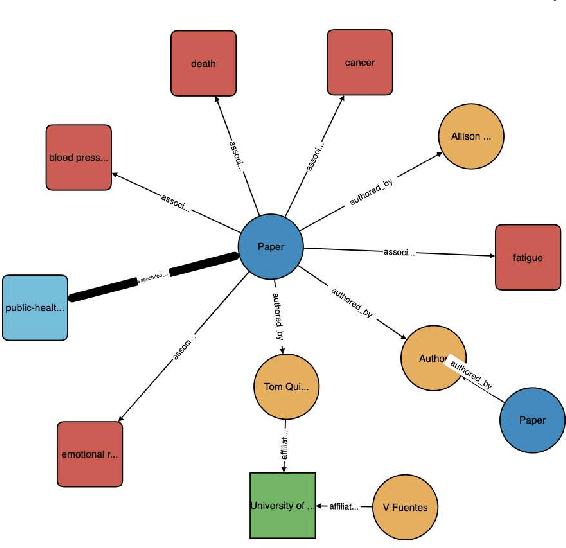
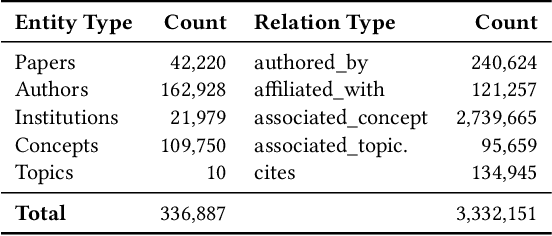
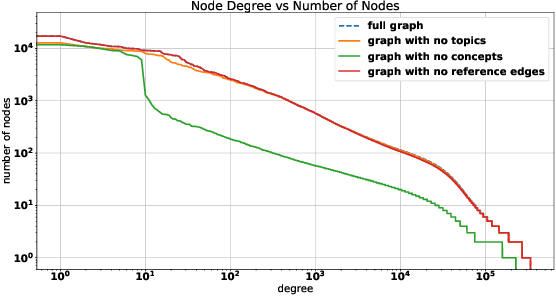
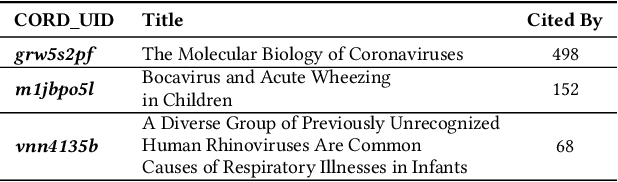
The coronavirus disease (COVID-19) has claimed the lives of over 350,000 people and infected more than 6 million people worldwide. Several search engines have surfaced to provide researchers with additional tools to find and retrieve information from the rapidly growing corpora on COVID-19. These engines lack extraction and visualization tools necessary to retrieve and interpret complex relations inherent to scientific literature. Moreover, because these engines mainly rely upon semantic information, their ability to capture complex global relationships across documents is limited, which reduces the quality of similarity-based article recommendations for users. In this work, we present the COVID-19 Knowledge Graph (CKG), a heterogeneous graph for extracting and visualizing complex relationships between COVID-19 scientific articles. The CKG combines semantic information with document topological information for the application of similar document retrieval. The CKG is constructed using the latent schema of the data, and then enriched with biomedical entity information extracted from the unstructured text of articles using scalable AWS technologies to form relations in the graph. Finally, we propose a document similarity engine that leverages low-dimensional graph embeddings from the CKG with semantic embeddings for similar article retrieval. Analysis demonstrates the quality of relationships in the CKG and shows that it can be used to uncover meaningful information in COVID-19 scientific articles. The CKG helps power www.cord19.aws and is publicly available.