 Add to Chrome
 Add to Firefox
 Add to Edge
Increasing ultrasound field-of-view with reduced element count arrays containing large elements
Feb 16, 2026
Several applications of medical ultrasound can benefit from a larger imaging field of view (FOV). This study is aimed at increasing the FOV of linear array probes by increasing the element size rather than the element count. To investigate larger FOV, this study used coupled elements to imitate a larger element size. The effects of coupling on array beam patterns are examined with Fourier transforms of elements. The effects of coupling on resolution, contrast, and speckle signal-to-noise ratio are examined through phantom images and in-vivo images of a rabbit tumor reconstructed with plane-wave compounding. Furthermore, a positioning system was used to acquire data from a virtual large aperture with 120 mm FOV and 128 elements, collected in sections with a single probe. This study also investigates the Null Subtraction Imaging (NSI), Sign Coherence Factor (SCF), and Minimum Variance (MV) beamformers for regaining resolution lost by an increased F-number with large elements. The MV beamformer, while the most computationally expensive, was best for improving resolution without increasing speckle variance, decreasing Full-Width at Half-Max (FWHM) estimates of wire targets from 0.78 mm with DAS on a 2.5 wavelength element size to 0.54 mm with MV on a 5 wavelength element size.

Large elements and advanced beamformers for increased field of view in 2-D ultrasound matrix arrays
Feb 16, 2026Three-dimensional (3D) ultrasound promises various medical applications for abdominal, obstetrics, and cardiovascular imaging. However, ultrasound matrix arrays have extremely high element counts limiting their field of view (FOV). This work seeks to demonstrate an increased field-of-view using a reduced element count array design. The approach is to increase the element size and use advanced beamformers to maintain image quality. The delay and sum (DAS), Null Subtraction Imaging (NSI), directional coherence factor (DCF), and Minimum Variance (MV) beamformers were compared. K-wave simulations of the 3D point-spread functions (PSF) of NSI, DCF, and MV display reduced side lobes and narrowed main lobes compared to DAS. Experiments were conducted using a multiplexed 1024-element matrix array on a Verasonics 256 system. Elements were electronically coupled to imitate a larger pitch and element size. Then, a virtual large aperture was created by using a positioning system to collect data in sections with the matrix array. High-quality images were obtained using a coupling factor of two, doubling the FOV while maintaining the same element count in the virtual large aperture as the original matrix array. The NSI beamformer demonstrated the best resolution performance in simulations and on the large aperture, maintaining the same resolution as uncoupled DAS for coupling factors up to 4. Our results demonstrate how larger matrix arrays could be constructed with larger elements, with resolution maintained by advanced beamformers.
Tumor monitoring and detection of lymph node metastasis using quantitative ultrasound and immune cytokine profiling in dogs undergoing radiation therapy: a pilot study
Mar 25, 2025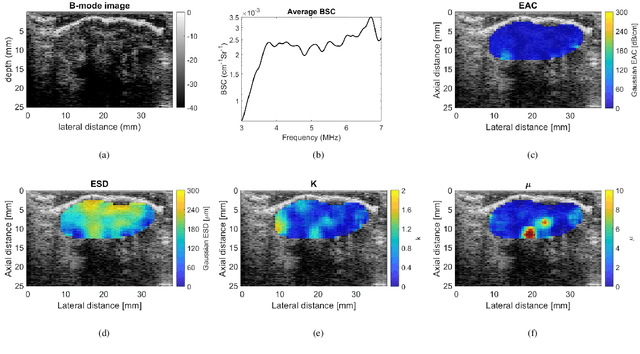
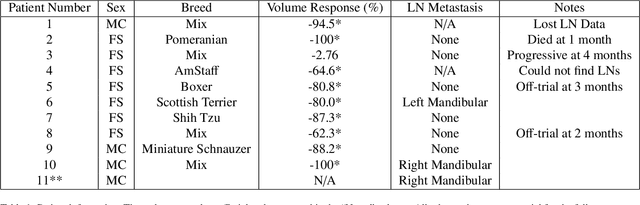
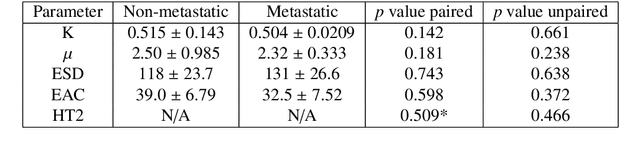
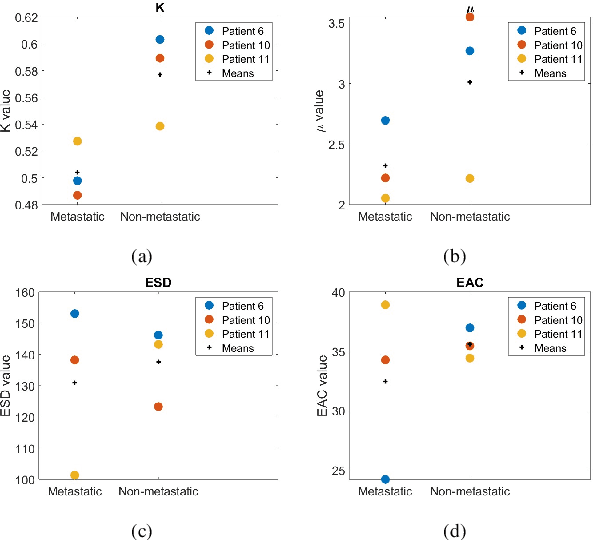
Quantitative ultrasound (QUS) characterizes the composition of cells to distinguish diseased from healthy tissue. QUS can reflect the complexity of the tumor and detect early lymph node (LN) metastasis ex vivo. The objective in this study was to gather preliminary QUS and cytokine data from dogs undergoing radiation therapy and correlate QUS data with both LN metastasis and tumor response. Spontaneous solid tumors were evaluated with QUS before and up to one year after receiving RT. Additionally, regional LNs were evaluated with QUS in vivo, then excised and examined with histopathology to detect metastasis. Paired t-tests were used to compare QUS data of metastatic and non-metastatic LNs within patients. Furthermore, paired t-tests compared pre- versus post-RT QUS data. Serum was collected at each time point for cytokine profiles. Most statistical tests were underpowered to produce significant p values, but interesting trends were observed. The lowest p values for LN tests were found with the envelope statistics K (p = 0.142) and mu (p = 0.181), which correspond to cell structure and number of scatterers. For tumor response, the lowest p values were found with K (p = 0.115) and mu (p = 0.127) when comparing baseline QUS data with QUS data 1 week after RT. Monocyte chemoattractant protein 1 (MCP-1) was significantly higher in dogs with cancer when compared to healthy controls (p = 1.12e-4). A weak correlation was found between effective scatterer diameter (ESD) and Transforming growth factor beta 1 (TGFB-1). While statistical tests on the preliminary QUS data alone were underpowered to detect significant differences among groups, our methods create a basis for future studies.